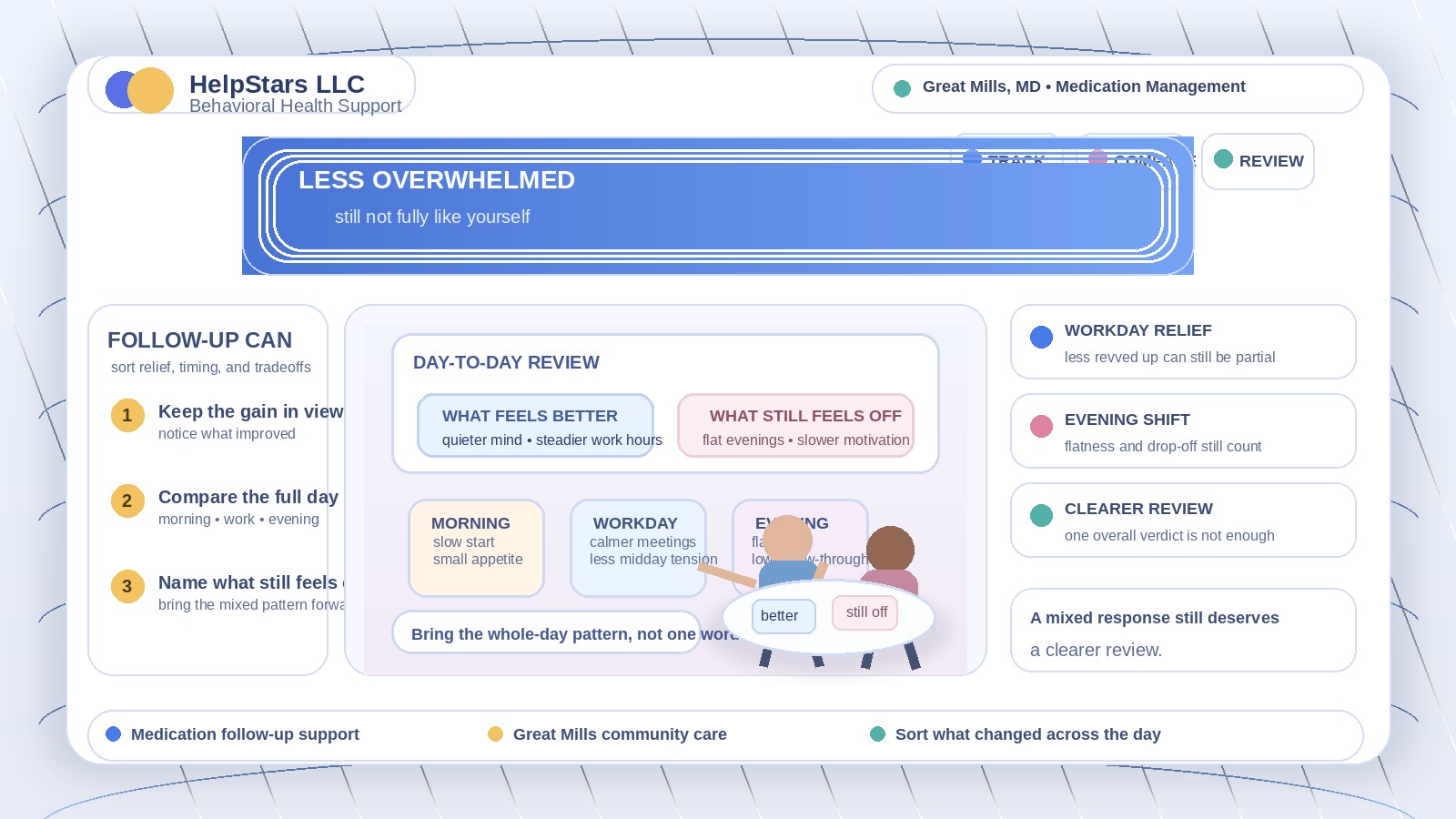
You Can Feel Less Overwhelmed and Still Not Feel Like Yourself: Medication Management for Adults Serving Great Mills, Maryland
Some adults delay a medication follow-up because the change was not completely bad. Maybe the racing thoughts eased. Maybe the panic is not hitting as hard. Maybe the workday feels a little more manageable than it did two weeks ago. But something still feels off. Energy may drop in a way that feels unfamiliar. Evenings may feel flatter. Appetite, patience, motivation, or focus may shift enough to make the day feel different even when one symptom technically improved.
For adults seeking medication management serving Great Mills, Maryland, that middle ground can be surprisingly hard to talk about. People often feel pressure to give one overall verdict: either the medication is helping or it is not. Real life is usually less tidy than that. Medication management can help adults sort out what seems better, what now feels harder, when those changes show up, and whether the current plan still feels like a good fit for daily life.
HelpStars LLC supports adults and families across Southern Maryland with compassionate behavioral health services. When the hardest part is not a dramatic side effect but the nagging sense that you feel improved in one way and unlike yourself in another, a thoughtful medication follow-up may offer a more useful next step.
Better on Paper Can Still Feel Off in Real Life
Many medication changes are judged too quickly by one headline result. A person may say the anxiety is lower, sleep is better, or irritability is less intense, and those improvements matter. But a medication plan should also be livable. If getting out of bed now takes more effort, if your concentration fades by late afternoon, or if the emotional tone of the day feels strangely muted, those details belong in the conversation too.
This is where adults often get stuck. They do not want to sound ungrateful for progress. They worry that mentioning a downside means they are overreacting or being difficult. As a result, they keep living inside a pattern that is technically improved but still not sitting right with the rest of the day.
Why Partial Relief Is Easy To Dismiss
When symptoms have been intense, even modest relief can feel important enough that people start minimizing everything else. Someone who was having constant anxiety may feel relieved just to have fewer spikes, even if they now feel emotionally flat by dinner. Another person may be grateful that sleep improved, while also noticing that mornings have become foggier and slower. Because the benefit is real, they keep telling themselves the tradeoff does not count yet.
There is also a social reason people dismiss mixed results. It can feel awkward to explain that a medication helped and also created a different problem that is harder to name. “I guess it’s better” becomes easier to say than, “My mind is quieter, but I do not quite feel like myself across the whole day.”
That kind of summary can leave an important pattern unexplored. Medication follow-up visits are often most useful when they make space for complicated responses instead of forcing the week into a simple yes-or-no answer.
What a Medication Review Can Clarify
A good follow-up is not only about listing side effects. It is about understanding how the current plan is interacting with the person’s actual routine. Depending on the situation, medication management may help adults:
- separate symptom relief from new daily-life burdens,
- notice whether the hardest changes happen in the morning, afternoon, evening, or after certain stressors,
- compare emotional improvement with changes in sleep, appetite, motivation, patience, or focus,
- decide whether the current response seems promising but incomplete, or
- identify what details should guide the next treatment conversation.
The goal is not perfection after one adjustment. The goal is a clearer picture. Adults often feel more confident once they realize they do not have to choose between “it helped” and “it feels wrong.” Both can be true at the same time, and both may matter.
A Great Mills Example: Calmer at Work, Flatter by Evening
Imagine an adult serving Great Mills, Maryland and nearby St. Mary’s County communities who recently started a medication change after several months of feeling on edge. Within a couple of weeks, something does improve. Work meetings feel less tense. They are not bracing for every email. Their body is not as revved up in the middle of the day.
But another pattern starts showing up by evening. After the commute home, they feel oddly dulled out instead of relieved. Dinner feels like one more task to complete. Family conversation takes more effort. Motivation for even simple chores drops off fast. The person cannot tell whether they are tired, emotionally flat, adjusting normally, or seeing an early sign that the medication fit needs another look.
If they only report, “It helped my anxiety,” the fuller picture stays hidden. If they only say, “I do not like how I feel,” the benefit gets erased. Medication management can help hold both sides of the story at once and turn that mixed experience into a more useful review.
Four Details Worth Bringing to the Next Medication Conversation
- When the helpful part shows up. Does the person feel calmer in the morning, steadier at work, or less reactive during specific parts of the day?
- When the harder part shows up. Is the tradeoff strongest when waking up, trying to eat, switching tasks, driving home, or settling down in the evening?
- What daily function changed. It helps to mention whether motivation, patience, appetite, concentration, or follow-through now feel easier, harder, or just different.
- How consistent the pattern is. A clear daily rhythm, a weekend-only shift, or a pattern that changes day to day can each point to a different kind of follow-up conversation.
These are often more helpful than trying to summarize the medication with one broad statement like “good” or “bad.”
Why Timing Across the Day Matters
Medication responses do not always stay the same from breakfast to bedtime. A person may feel more focused in one block of the day and more drained in another. They may feel less anxious socially but less emotionally available at home. They may sleep better at night while feeling slower every morning. That timing information matters because it reflects how treatment is landing inside real life, not just how it sounds in a short update.
For adults in Great Mills, Lexington Park, California, Leonardtown, and nearby communities, routine pressures often include work schedules, family responsibilities, commuting, errands, and appointments that stretch from early morning into evening. A medication plan should make sense within that full rhythm. Follow-up support becomes more useful when it looks at the whole day instead of one isolated symptom snapshot.
Common Questions About Medication Management
Do I need to wait until something feels severe before bringing it up?
No. Adults often benefit from follow-up before a problem becomes dramatic. A pattern that feels mildly but consistently off can still matter.
What if I am not sure whether the change is from medication or stress?
That uncertainty is worth discussing. Part of medication management is helping adults sort out timing, patterns, and possibilities more carefully rather than expecting them to know the answer alone.
Does some improvement mean I should stay quiet about the downsides?
No. Real progress should not require hiding the part that now feels harder. Benefits and burdens can both belong in the same conversation.
Can medication management fit alongside therapy or other outpatient behavioral health support?
Yes. Depending on the person’s needs, medication management may be one part of a broader outpatient plan that also includes counseling, psychiatric evaluation, group therapy, or other behavioral health services.
You Do Not Need To Force a Simple Answer
Adults sometimes stay in uncomfortable uncertainty because they think they need a cleaner conclusion before asking for help. But “partly better, partly off” is already useful information. If the medication reduced one problem while creating a new strain in the shape of the day, that pattern deserves attention.
HelpStars LLC supports adults and families across Southern Maryland with compassionate behavioral health care. For adults seeking medication management serving Great Mills, Maryland, a thoughtful follow-up may help clarify what improved, what changed, and what would make the next version of the day feel more workable.