Why Chronic Stress Can Start to Feel Like Numbness — and How Outpatient Mental Health Counseling Can Help Adults in Hollywood, Maryland
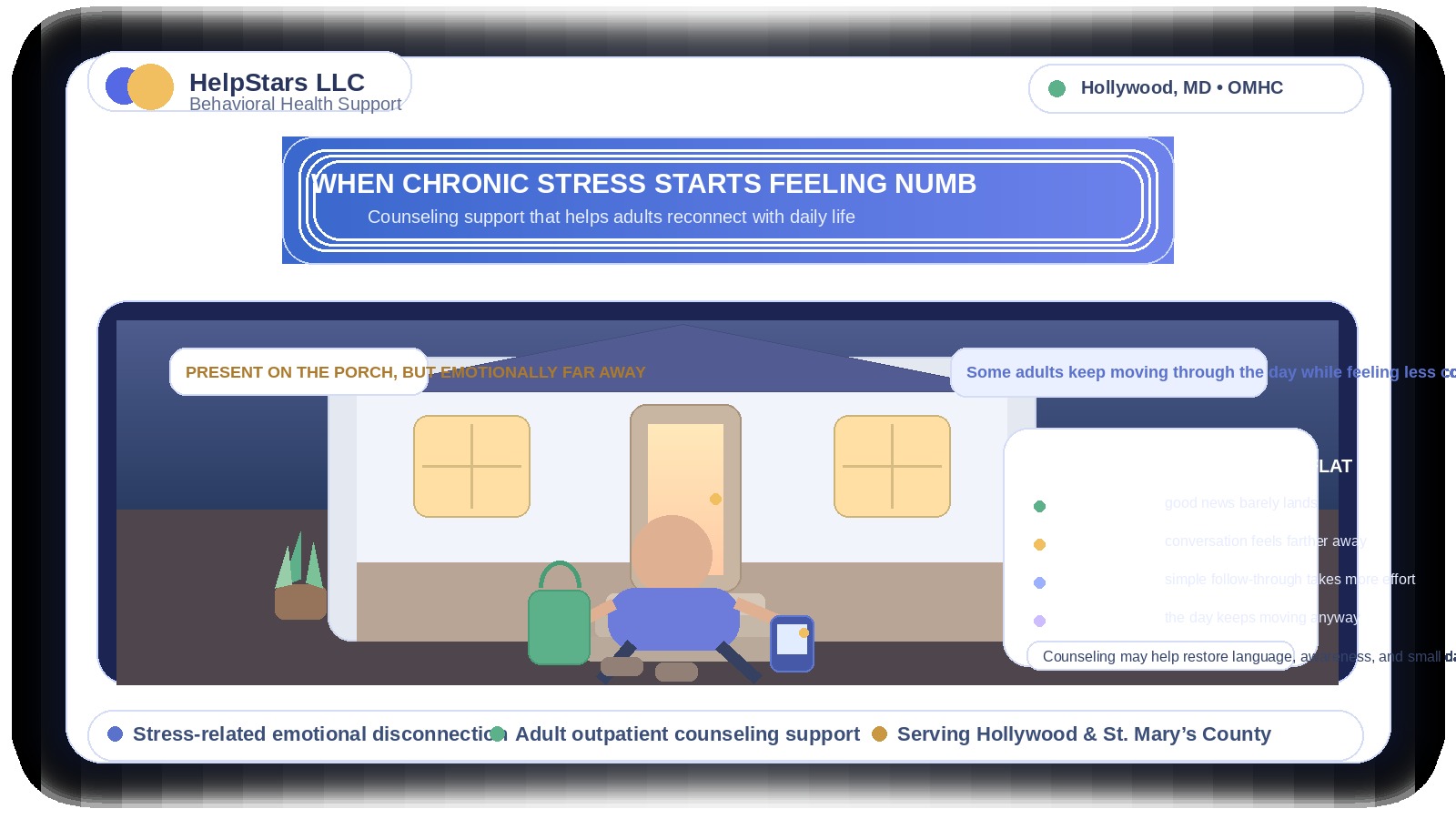
You answer the text. You put away the groceries. You show up where you are supposed to be. From the outside, nothing may look especially wrong. But inside, everything can start to feel far away.
For some adults, stress does not always show up as tears, panic, or visible overwhelm. Sometimes it shows up as emotional flatness. Conversations feel harder to stay present in. Good news does not land the way it used to. Responsibilities still get handled, but only on autopilot. If that sounds familiar, outpatient mental health counseling in Hollywood, Maryland may be a useful next step.
HelpStars LLC supports adults and families across Southern Maryland with compassionate behavioral health services. When chronic pressure turns into disconnection, counseling can help people slow down, notice patterns earlier, and start reconnecting with daily life in a more workable way.
Emotional Numbness Is Easy to Miss Because It Does Not Always Look Dramatic
Many people expect emotional distress to look intense. They assume they will know they need support when they are crying constantly, having obvious panic symptoms, or unable to get through the day. But stress can also narrow a person’s emotional range more quietly.
That can look like:
- feeling detached during conversations that used to matter,
- going through the motions of work, parenting, or errands without much inner response,
- struggling to tell whether you are tired, sad, angry, overwhelmed, or simply shut down,
- losing interest in routines that normally help you feel like yourself,
- finding it harder to return calls, answer messages, or make decisions, and
- hearing loved ones say, “You seem distant lately,” even when you are still showing up.
This kind of emotional flattening does not mean a person is lazy, uncaring, or unwilling to try. It can be a sign that the mind and body have been carrying too much stress for too long.
Why Stress Sometimes Turns Into Disconnection Instead of Visible Breakdown
When pressure stays high for long enough, some adults stop feeling everything at full volume. That does not mean the stress is gone. It may mean the person has shifted into survival mode.
In that state, people may keep functioning just enough to protect the basics while feeling less connected to the rest of their lives. Meals become mechanical. Relationships feel muted. Enjoyment drops. Important tasks start taking longer because the person is no longer working from steadiness — only from momentum.
That is one reason behavioral health counseling in St. Mary’s County can be helpful before things become more severe. A person does not have to wait until life fully falls apart to talk with a professional about feeling emotionally absent from their own routine.
How Counseling May Help When Life Starts Feeling Flat
Outpatient mental health counseling is not about forcing someone to “snap out of it.” It is about creating space to understand what the numbness may be connected to and what support could help restore more clarity and engagement.
Depending on the individual situation, counseling may help adults:
- notice whether stress, anxiety, grief, depression, burnout, or unresolved experiences are contributing to the disconnection,
- identify the times of day or types of situations where emotional shutdown shows up most strongly,
- put language around internal experiences that have become difficult to describe,
- rebuild routines that support sleep, meals, follow-through, and emotional awareness,
- practice grounding and reflection skills that make it easier to feel present again, and
- explore whether other behavioral health services should also be part of the conversation.
The goal is not to create a perfect mood every day. The goal is to help life feel more reachable again.
A Hollywood, Maryland Example: Present in the Room, But Not Really There
Imagine an adult in Hollywood, Leonardtown, Lexington Park, or another part of St. Mary’s County who keeps doing what they need to do, but with less and less connection to what is happening around them. They make breakfast for the kids, answer a coworker’s question, drive where they need to go, and smile at the right moments. Still, by the end of the day, they cannot remember much that actually felt meaningful.
Maybe they have been under steady family pressure. Maybe work demands have stretched on for months. Maybe there was a painful event that never felt fully processed. Maybe they simply know they have not felt like themselves in a long time. Nothing looks urgent from the outside, so they keep postponing support.
That is often how emotional numbness stays in place. Because it does not always look like a crisis, it can quietly become someone’s new normal. Counseling can help interrupt that pattern by giving the person a place to reconnect language, awareness, and practical support to what they are living through.
Small Daily Clues That Emotional Shutdown May Be Affecting Functioning
- You keep saying “I’m fine,” but cannot explain how you actually feel. The problem may be less about secrecy and more about not having access to the words.
- Tasks are getting done, but only with heavy effort. You may still be functioning, but without much emotional energy behind the routine.
- Important relationships feel harder to enter fully. You care, but you feel far away while conversations are happening.
- The things that usually reset you are not working the same way. Rest, hobbies, walks, or time with others may feel oddly muted.
- You are becoming harder to reach — even for yourself. It gets more difficult to notice what you need before stress builds further.
None of these signs prove one specific diagnosis. They do suggest it may be worth seeking support rather than assuming the feeling will pass on its own.
Why This Is Different From Ordinary Tiredness
Everyone has dull days. Ordinary tiredness usually improves with rest, a lighter schedule, or time away from pressure. Emotional numbness tends to linger differently. Even when there is a quiet moment, the person may still feel flat, unreachable, or disconnected from what should matter.
That difference matters. When someone keeps waiting for a weekend, a day off, or one good night of sleep to fix the problem — and it never fully does — the issue may be bigger than temporary fatigue alone.
How Local Stressors in St. Mary’s County Can Keep the Cycle Going
Adults in Hollywood and nearby St. Mary’s County communities are often balancing caregiving, commuting, work shifts, household management, relationship strain, and ongoing financial pressure at the same time. When stress becomes chronic, people often stop checking in with themselves because there is always one more task to finish first.
That makes mental health counseling in Hollywood, Maryland valuable not only for symptom relief, but also for helping adults notice how local routine pressures are shaping their emotional health. Support becomes more useful when it matches the actual rhythm of daily life.
What Loved Ones Often Notice First
Sometimes the person experiencing numbness is the last one to recognize it. A spouse, parent, sibling, or friend may be the first to say:
- “You are here, but you don’t seem fully present.”
- “You don’t react to things the way you used to.”
- “You seem shut down, even when nothing specific is wrong.”
Those observations are not always comfortable to hear, but they can be useful. They may point to a pattern that deserves attention before disconnection starts affecting more parts of work, family, and day-to-day functioning.
Questions Adults Often Ask About Feeling Numb or Disconnected
Does emotional numbness always mean depression?
Not necessarily. Emotional disconnection can happen for different reasons, including chronic stress, burnout, anxiety, grief, trauma-related experiences, or depression. A professional can help explore the bigger picture rather than guessing from one symptom alone.
Do I need to wait until things get worse before seeking counseling?
No. Many adults benefit from counseling precisely because they seek support before a quiet pattern becomes a deeper crisis.
What if I am still functioning at work or at home?
Functioning does not always mean thriving. If daily life feels flat, distant, or increasingly hard to stay emotionally present in, support may still be appropriate.
Can counseling work alongside other behavioral health services?
Yes. Depending on the person’s needs, counseling may be part of a broader support plan that includes additional outpatient behavioral health services.
Feeling More Present Again Often Starts With Naming What Has Gone Flat
When chronic stress turns into numbness, people often blame themselves for not caring enough, not trying hard enough, or not bouncing back fast enough. But disconnection is not a character flaw. It is a sign that something may need care.
If you have been moving through your days on autopilot and feeling harder to reach — even to yourself — outpatient mental health counseling in Hollywood, Maryland may help you reconnect with your emotions, your routines, and your relationships in a steadier way. HelpStars LLC provides compassionate behavioral health support for adults and families across Southern Maryland.