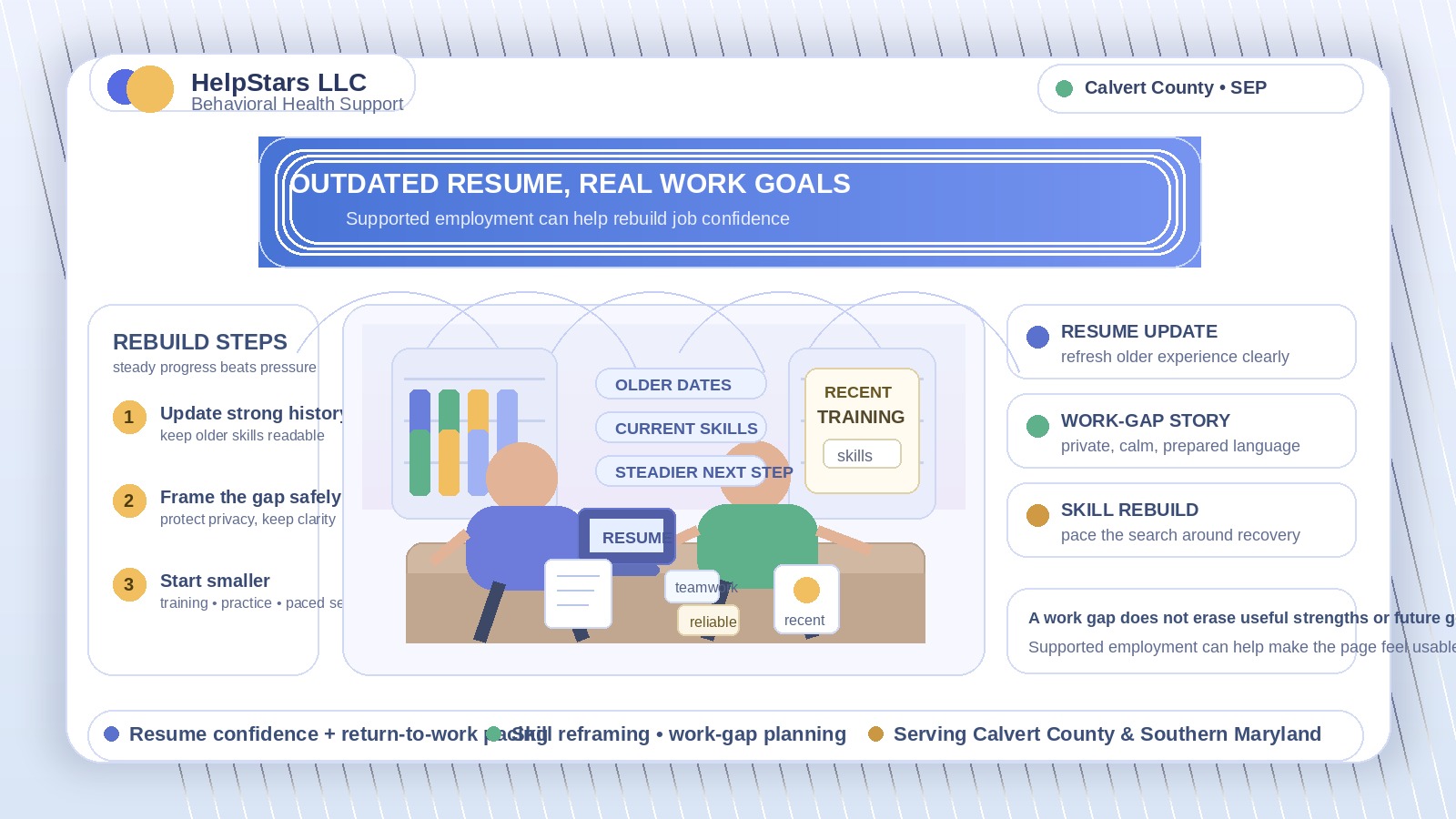
When Your Resume Feels Outdated but Work Still Matters: How Supported Employment Can Help Adults Serving Calvert County, Maryland Rebuild Job Confidence
Sometimes the hardest part of returning to work is not deciding that employment matters. It is opening a resume and feeling as if the page belongs to an older version of your life. The dates look far away. The experience feels disconnected from who you are now. A person may still want structure, income, purpose, and forward movement, yet feel unsure how to turn that desire into a realistic next step.
For adults seeking supported employment serving Calvert County, Maryland, that moment can carry more weight than people around them realize. The problem is not always lack of willingness to work. Often, it is the pressure of figuring out how to talk about a gap, rebuild confidence, and restart a job search without feeling exposed at every step. Supported employment can help adults move from embarrassment and avoidance toward a steadier, more practical return-to-work plan.
HelpStars LLC supports adults across Southern Maryland with compassionate behavioral health services, including employment-focused support. When the resume feels outdated but the goal of working still matters, supported employment may help create a more workable path forward.
The Resume Can Become an Emotional Trigger Before It Becomes a Job Tool
Many adults do not struggle because they have nothing to offer. They struggle because the resume seems to turn private history into a visible problem. A work gap can bring up shame, grief, self-doubt, family pressure, and fear about being judged before anyone hears the fuller story.
That can sound like:
- “I do want to work, but my resume makes me feel already behind,”
- “I do not know how to explain the missing years without overexplaining my health,”
- “Everything on that page feels older than my actual effort right now,”
- “I could probably do the job, but I do not know how to present myself anymore,” or
- “Every time I open the document, I end up closing it again.”
That reaction is more common than many people think. The page can begin to represent not just employment history, but everything the person fears has been interrupted, delayed, or lost.
Why Work Gaps Often Feel Bigger Than a Formatting Problem
When mental health recovery has affected daily life, a gap on paper may hold a lot more than missing job dates. It may represent hospital stays, symptom-heavy periods, caregiving strain, treatment changes, unstable routines, grief, burnout, or long stretches of simply trying to stay steady. Even when the person is making real progress now, the resume can make all of that feel flattened into one silent blank space.
That is one reason the problem is rarely solved by generic advice alone. Telling someone to “just update the resume” misses the real issue if the person is also asking themselves:
- How much do I say and how much do I keep private?
- What if my old experience feels too far away to matter now?
- How do I show that I am more ready than the timeline suggests?
- What if I start applying before my confidence can support the process?
Supported employment can help because it treats job re-entry as both a practical task and a recovery-sensitive transition.
Supported Employment Can Help Rebuild the Story, Not Just the Document
A resume is not only a list. It is also a short version of how a person understands their own work identity. If that identity has been shaken, the first useful step may not be applying fast. It may be rebuilding the story with more accuracy and less shame.
Depending on the person’s needs, supported employment may help with:
- updating older experience so it reads more clearly and confidently,
- identifying transferable strengths that still matter even after time away,
- finding safer language for discussing a gap without oversharing personal health details,
- mapping smaller re-entry steps such as volunteering, training, or low-pressure practice tasks,
- organizing recent examples of reliability, learning, or follow-through, and
- building a pace of job searching that supports recovery instead of destabilizing it.
The goal is not to invent a new person on paper. It is to help the existing person see how their strengths, limits, and next steps can be presented more honestly and more effectively.
A Calvert County Example: The Person Is Ready To Try Again, but the Resume Keeps Pulling Them Backward
Imagine an adult serving Calvert County who has begun feeling more open to employment after a hard stretch. Maybe life is steadier than it was a year ago. Maybe treatment is more consistent. Maybe the person misses the structure and sense of movement that work once provided. They sit down at a library table or kitchen desk to update their resume and quickly feel stuck.
The last listed job is older than they remembered. The bullet points sound flat. The gap in dates feels louder than every other line on the page. Instead of feeling encouraged by the idea of moving forward, the person starts feeling as if they have to defend the whole missing chapter of their life before the job search has even started.
Supported employment can interrupt that spiral. The work may begin with smaller questions: Which older experience is still strongest? What responsibilities from daily life, volunteering, caregiving, or treatment-supported routine show persistence and organization? What kind of role fits the person’s current energy and recovery structure? What would make the first application feel manageable instead of exposing? Once those pieces are clearer, the page often becomes easier to approach.
Four Resume-Reentry Tasks That Often Matter More Than People Expect
- Translating older experience into present value. A job from several years ago may still show customer service, reliability, scheduling, teamwork, or problem-solving strengths if it is framed clearly.
- Reducing the pressure to explain everything at once. Many adults need help learning how to protect privacy while still sounding grounded and prepared.
- Building recent confidence markers. Practice tasks, short courses, volunteering, support roles, or steady routine gains can help the person feel less defined by the gap alone.
- Matching the search to actual readiness. A smaller, steadier entry point may be more useful than chasing roles that look impressive but do not fit the person’s current pace.
These steps matter because the job search usually gets easier when the person no longer feels that the resume is arguing against them.
Confidence Often Returns Through Concrete Evidence, Not Positive Thinking Alone
Adults are often told to “be more confident” before applying, but confidence usually grows after a person starts seeing believable proof that they can move forward. That proof may come from a cleaned-up resume, a clearer explanation of a gap, a recent training certificate, one completed application, or a realistic shortlist of jobs that feel within reach.
Supported employment can help create those pieces in an order that makes sense. Instead of jumping from shame straight to interviews, the person can move through a sequence that feels more stable:
- review the old resume,
- identify what still belongs there,
- add stronger language and more relevant examples,
- decide how to handle the gap if asked,
- narrow the search to roles that fit current capacity, and
- build momentum through manageable steps rather than pressure-heavy leaps.
That kind of sequencing can make the difference between avoiding the process for another six months and starting it with less fear.
Why This Is About More Than Getting the Resume Past One Employer
The resume is often the first place a person tests whether they believe work is possible again. If the document only triggers shame, the job search may stall before it becomes real. But if the person can build a version that feels honest, competent, and connected to the present, the rest of the process often becomes easier to tolerate.
That is why mental health employment support serving Calvert County matters. Adults are not only trying to impress an employer. They are trying to rebuild a workable relationship with effort, pacing, routine, and future planning after a difficult period. The job document is only one part of that larger transition.
How Loved Ones Can Help Without Making the Resume Feel Like a Test
Family members and supporters often mean well when they say, “Just put something together and apply.” But if the page already carries shame, pressure can make the person shut down faster. Support tends to work better when loved ones:
- ask what part of the process feels hardest instead of assuming the answer is laziness,
- focus on one step at a time rather than demanding a finished resume immediately,
- recognize that a confidence gap can be as real as a skills gap, and
- encourage a paced return-to-work plan instead of a rush toward any available job.
That kind of support protects dignity and makes the process easier to re-enter without feeling cornered.
Why Local Routine Matters for Adults Serving Calvert County
Adults serving Calvert County are often balancing transportation, household routines, family responsibilities, treatment appointments, and regional travel across communities such as Prince Frederick, Lusby, Huntingtown, Dunkirk, Chesapeake Beach, North Beach, and nearby Southern Maryland areas. Job decisions are easier to sustain when they fit that real-life structure.
A work plan that looks fine on paper can still fail if it ignores commute load, early-morning stamina, support appointments, or how much pressure the person can realistically absorb during re-entry. Supported employment becomes more useful when it helps a person build a resume and search strategy that match the week they are actually living.
Questions Adults Often Ask About Work Gaps and Resume Confidence
Do I have to explain my mental health history on my resume?
No. Many adults want help finding a way to discuss time away from work more professionally and privately without disclosing more personal information than they are comfortable sharing.
What if my older work experience feels too far back to matter?
Older experience may still show useful strengths. Support can help identify which past responsibilities are still relevant and how to present them more clearly.
Can supported employment help even if I am not ready to apply this week?
Yes. Some adults start by rebuilding the resume, clarifying goals, or identifying smaller re-entry steps before they begin active applications.
What if confidence is my biggest barrier right now?
That still matters. Confidence barriers often respond better to structured support, concrete practice, and realistic pacing than to pressure alone.
Sometimes the First Sign of Readiness Is Being Able To Look at the Page Without Shutting Down
Returning to work does not always begin with a job offer. Sometimes it begins with opening the document again, seeing possibility instead of only lost time, and taking one step that feels honest enough to continue. That shift can matter more than people expect.
HelpStars LLC supports adults across Southern Maryland with compassionate behavioral health and employment-focused services. For adults looking for a supported employment program serving Calvert County, help with resume confidence and return-to-work pacing may be a strong next step.