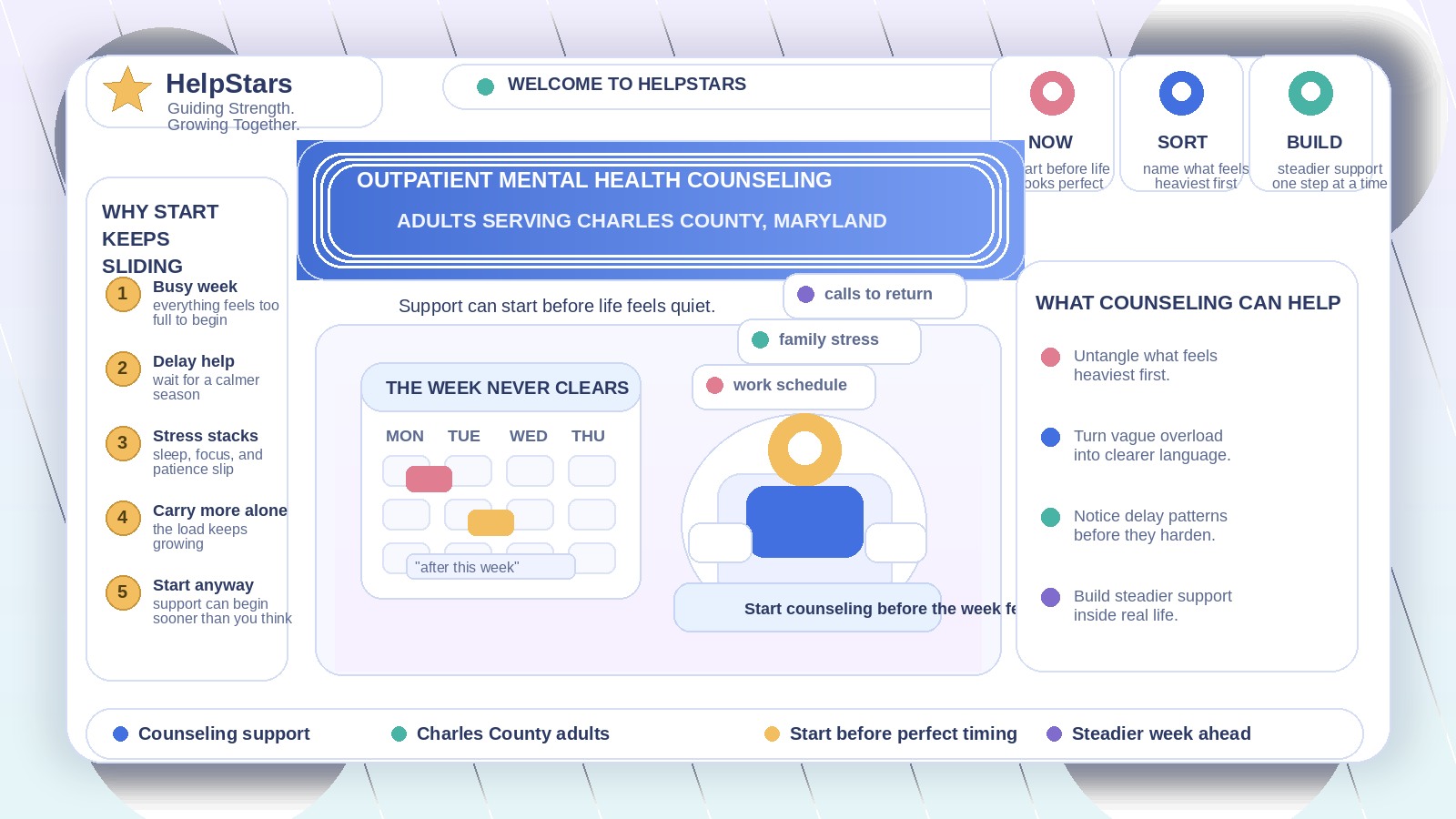
When You Keep Waiting for Life to Calm Down Before Starting Therapy: Outpatient Mental Health Counseling for Adults Serving Charles County, Maryland
Some adults do not put off therapy because they think it would never help. They put it off because they keep looking for a week that feels less crowded, less messy, less emotionally expensive, and easier to explain. They tell themselves they will reach out after the next appointment, after the school issue settles down, after the work schedule gets clearer, after the family stress cools off, or after they feel a little more in control.
For adults seeking outpatient mental health counseling serving Charles County, Maryland, that delay can last much longer than expected. The problem is not always denial. Sometimes it is the belief that support should begin only after life becomes calmer. In practice, that often means help gets postponed until stress has already spread into sleep, concentration, patience, relationships, and follow-through.
HelpStars LLC supports adults across Southern Maryland with practical behavioral health services, including outpatient mental health counseling. When the right time keeps moving further away, starting support before life feels fully settled may be more realistic than waiting for a perfect opening.
The Starting Line Can Keep Moving Even When the Need Is Real
Many adults imagine therapy will work best once they can finally give it proper time and attention. That sounds reasonable. But for people living with anxiety, depression, trauma-related stress, mood instability, grief, burnout, or chronic emotional overload, the week may never present itself that neatly.
There is always one more demand. A bill needs attention. A call has to be returned. A child needs support. Work changes shape again. A relationship conversation is still unfinished. The person may genuinely want help while also feeling unable to start one more thing that seems emotionally important.
Over time, the delay itself becomes part of the stress. The person is no longer only carrying the original problem. They are also carrying the repeated thought that they should have reached out already.
What This Delay Often Looks Like in Real Life
Waiting for a calmer week can sound like:
- “I do want counseling. I just need to get through this month first,”
- “I do not want to start and then miss appointments,”
- “Things are not good, but they are not organized enough to explain yet,”
- “I should probably handle the practical problems before I talk about the emotional ones,” or
- “Once life slows down, then I will finally deal with this.”
Those thoughts are understandable. They can also keep a person stuck for a long time. Stress rarely pauses long enough to create a perfect doorway into care.
Why Waiting for a Better Season Often Backfires
When emotional strain is already affecting daily life, waiting for ideal timing can quietly raise the cost of starting later. Sleep may become less reliable. Patience may shorten. Small tasks may begin taking too much energy. Important relationships can feel thinner because the person is using most of their capacity just to stay outwardly functional.
There is also a practical problem with postponing help: the longer a person waits, the more pressure they may feel to summarize everything at once. They may think they need a perfectly organized explanation before reaching out. That belief can make the first step feel even heavier.
Outpatient counseling does not require a fully edited story. In many cases, support is most useful precisely when the person does not yet have everything sorted out.
A Charles County Example: The Week Never Quite Clears
Imagine an adult serving Charles County, Maryland who has been thinking about counseling for months. They are still showing up for work. They are handling errands in pieces. They answer people when they have to. From the outside, they may not look like someone on the edge of asking for help.
But internally, the strain keeps stacking up. They are more irritable at home than they want to be. They replay conversations at night. They feel behind before the day even starts. One family issue, one transportation problem, or one work disruption can push the whole week off balance. Still, they keep postponing counseling because they imagine they should begin during a cleaner stretch of life.
That cleaner stretch does not come. Instead, the calendar keeps changing while the emotional pattern stays the same. The person does not need a perfect week first. They may need support that helps the week become more manageable.
How Outpatient Mental Health Counseling Can Help Before Life Feels Organized
Outpatient mental health counseling is not only for adults whose schedules are already stable or whose stress is easy to describe. It can also help adults who are carrying too many moving parts at once and need a more workable place to slow the pattern down.
Depending on the person’s needs, counseling may help with:
- making sense of stress that has been accumulating across several areas of life,
- separating urgent responsibilities from the emotional weight attached to them,
- recognizing patterns of avoidance, overextension, or shutdown earlier,
- building steadier coping routines instead of waiting until the next overload point,
- creating language for experiences that still feel tangled, and
- reducing the pressure to have a polished explanation before support begins.
For some adults, the most helpful first outcome is not immediate relief. It is finally having a place where the week stops running entirely on reaction and postponement.
Four Questions Worth Asking Before You Delay Again
- Has “after this week” already turned into several months? If the same delay keeps repeating, that may be a sign the timing problem is part of the reason support is needed.
- What is stress already changing in daily life? Irritability, sleep disruption, emotional numbness, poor concentration, isolation, and low follow-through all matter.
- Am I waiting to feel ready, or waiting to feel unrealistically clear? Many adults do not feel neatly ready. They start when the need becomes harder to ignore than the hesitation.
- What would improve if I did not have to carry all of this alone for one more month? That question often reveals more than trying to decide whether the situation is “serious enough.”
Starting Does Not Have To Mean Doing Everything Perfectly
Some adults avoid reaching out because they are afraid of starting badly. They worry they will not know what to say, will forget details, will miss something important, or will sound scattered. But scattered is often exactly how stress feels before it is named more clearly.
Beginning counseling can look much simpler than people expect. It may start with saying that the week has felt too heavy for too long. It may start with naming one area that keeps slipping: sleep, motivation, anxiety, anger, shutdown, grief, or constant overwhelm. It may start with admitting that nothing is in dramatic crisis, but life does not feel sustainably manageable either.
Those are enough starting points. A person does not need a perfect case presentation in order to deserve support.
Why This Matters in Charles County
Adults serving Waldorf, La Plata, White Plains, Bryans Road, Indian Head, Hughesville, Port Tobacco, and nearby Charles County communities often balance work, school schedules, family obligations, transportation demands, treatment follow-through, and financial pressure at the same time. In that kind of real-life setting, mental health strain does not always arrive as one dramatic event. It often shows up as a week that keeps feeling harder to carry than it looks from the outside.
That is part of why outpatient mental health counseling serving Charles County, Maryland can matter. Support does not have to wait until life becomes simpler. It can begin while the person is still living inside the actual pace and pressure of everyday life.
Questions Adults Often Ask
Do I need to wait until I can explain everything clearly before starting counseling?
No. Many adults begin therapy while their thoughts still feel disorganized or emotionally mixed. Part of the work can be sorting that out with support.
What if my life is too busy right now to start?
That may be exactly why support is worth considering. If the schedule and stress level never seem to open up on their own, waiting may only extend the strain.
Does outpatient counseling only make sense if things are obviously severe?
Not necessarily. Many adults seek outpatient support because life feels persistently heavy, tense, or hard to manage even without a dramatic crisis point.
What if I am worried I will not know what to say in the first conversation?
That is common. Starting with one honest description of what has been feeling hardest is often enough. Clarity can build from there.
Support Does Not Have To Wait for a Quieter Season
When adults keep postponing therapy until life becomes calmer, they can end up waiting on a version of the week that never fully arrives. The need for support does not become less real just because the calendar stays crowded.
HelpStars LLC supports adults across Southern Maryland with practical behavioral health services, including outpatient mental health counseling. For adults seeking outpatient mental health counseling serving Charles County, Maryland, starting before everything feels sorted may be the step that helps life feel more manageable again.