When Transportation Breakdowns Start Interrupting Recovery: How PRP Services Can Help Adults Stay Connected to Appointments and Daily Life in St. Mary’s County, Maryland
The problem may look small at first. A ride falls through. The bus connection gets missed. A pharmacy pickup is pushed to tomorrow. A counseling visit needs to be rescheduled because nobody is sure who can drive. By itself, each delay can sound manageable. But when transportation keeps becoming the weak point, treatment follow-through, errands, routines, and confidence can all start narrowing at the same time.
For adults who need PRP services in St. Mary’s County, Maryland, transportation challenges are often about much more than getting from one place to another. They affect whether medications are picked up on time, whether appointments happen consistently, whether groceries make it home, and whether a person keeps enough momentum to stay involved in recovery at all. That is where a psychiatric rehabilitation program can make a practical difference.
HelpStars LLC serves adults across Southern Maryland with compassionate behavioral health support. When recovery goals keep getting interrupted by missed rides, unclear plans, or transportation stress, PRP support may help build a more usable weekly system.
Transportation Problems Often Shrink a Person’s World Before Anyone Says So
Many adults do not describe the issue as transportation at first. They may say they are behind on appointments, running out of medications, avoiding errands, or feeling overwhelmed by simple tasks. Sometimes the deeper pattern is that too many parts of the week depend on a ride being available at exactly the right moment.
That can look like:
- canceling or postponing outpatient appointments because the trip feels too hard to organize,
- missing pharmacy pickups and then feeling embarrassed about calling again,
- putting off grocery trips until the kitchen is almost empty,
- skipping community errands because one missed stop throws off the whole day,
- depending on family members who are willing to help but not always available, or
- staying home more and more because leaving the house starts to feel logistically exhausting.
Over time, this can make recovery feel smaller. The person is not only missing rides. They are missing consistency, options, and a sense that the week is still under their control.
Why Transportation Barriers Can Turn Into Recovery Barriers
When transportation becomes unreliable, every other task starts carrying extra pressure. A routine appointment is no longer routine if it requires multiple calls, backup drivers, or guessing whether the plan will hold. A quick errand is no longer quick if it depends on borrowing a car, coordinating around someone else’s work shift, or navigating a route that already feels stressful.
This matters in behavioral health because mental health symptoms often make planning harder in the first place. Depression can lower energy for organizing a trip. Anxiety can make unfamiliar routes feel bigger than they are. Cognitive overload can make multi-stop days hard to sequence. A history of setbacks can make one cancellation feel like proof that the whole week is slipping again.
That is one reason psychiatric rehabilitation in St. Mary’s County can be so useful. PRP is not only about insight. It is about building workable systems around daily life so recovery does not depend on last-minute improvising every time someone needs to leave home.
PRP Can Help Build a Transportation System, Not Just Offer Reminders
Adults sometimes assume that if transportation is the problem, the only answer is to try harder, ask family for more help, or wait until things feel less chaotic. PRP takes a different approach. Instead of treating each missed ride like a one-time failure, it can help identify the pattern underneath and build supports around it.
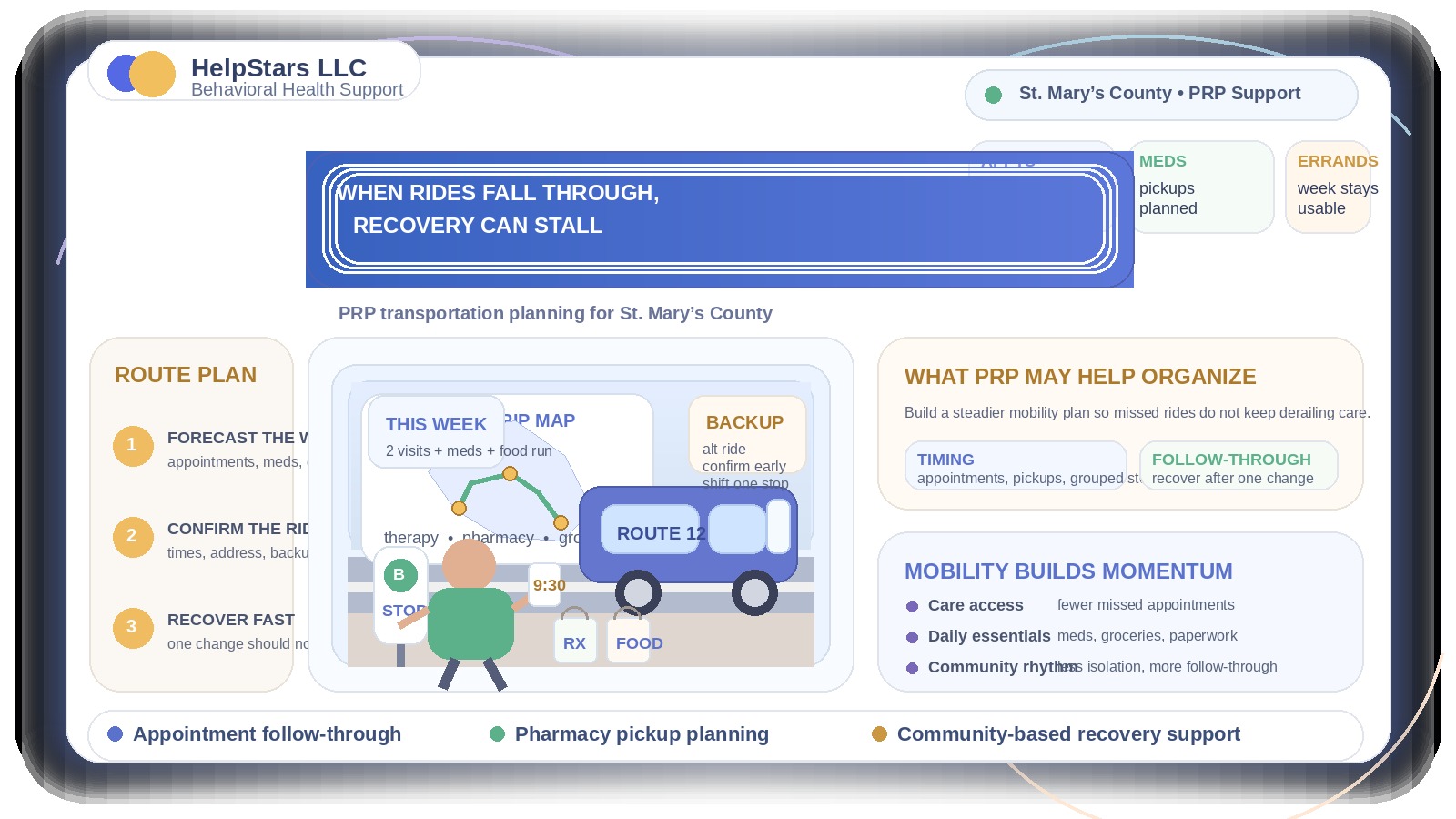
Depending on the person’s needs, PRP may help with:
- mapping out which appointments, errands, and pickups happen most often,
- separating essential trips from trips that can be grouped together differently,
- creating a ride-planning routine before the day becomes urgent,
- building backup options when the first transportation plan changes,
- practicing how to confirm times, addresses, and pickup details,
- organizing reminders in a way that fits the person’s actual week, and
- reducing the shame spiral that can start after one missed stop or rescheduled visit.
The goal is not to make life perfectly predictable. The goal is to help the person stay connected to care and daily responsibilities even when transportation requires more planning than it should.
A St. Mary’s County Example: One Missed Ride Starts Pulling the Whole Week Off Course
Imagine an adult in Lexington Park or Great Mills who is trying to stay on top of counseling, medication pickups, groceries, and benefit-related errands. They do not need everything in life to become easier overnight. They need the week to stop collapsing because one ride changes at the last minute.
On Monday, a pharmacy pickup gets delayed because the ride is late. On Wednesday, an outpatient appointment is rescheduled because the person is unsure whether transportation will line up in time. By Friday, groceries still have not happened, stress is higher, and the person feels less motivated to call anyone back because the week already feels messy.
PRP support can help slow that cycle down. The work may involve figuring out which trips need to happen first, what can be scheduled on the same day, where confirmation problems usually begin, and what backup plan is realistic when a ride changes. Sometimes the biggest shift is not dramatic. It is that the person starts having a plan before the transportation problem becomes a crisis.
Four Transportation Skills PRP May Help Strengthen
- Trip forecasting. Looking ahead at the week early enough to identify appointment days, pharmacy deadlines, grocery needs, or other community tasks before they pile up.
- Route and timing organization. Clarifying addresses, travel time, pickup windows, and how to group stops so one task does not disrupt the others.
- Backup planning. Deciding what happens if a ride changes, a call is not returned right away, or the person needs to shift a plan without giving up on the entire task.
- Follow-through after disruption. Recovering from one missed errand or appointment without turning it into a week-long shutdown.
These are not small skills. For many adults, transportation stress is one of the places where recovery either keeps moving or starts stalling out.
Why This Is Different From Employment Commute Planning
Transportation support in PRP is not the same thing as workplace commute coaching. A job commute focuses on getting to work consistently and managing employment-related routines. PRP transportation planning is broader. It may involve medical appointments, pharmacy pickups, grocery trips, benefits-related tasks, treatment follow-through, and staying engaged in community life overall.
That distinction matters because a person can be unemployed, underemployed, or not focusing on work at all and still need reliable mobility to support mental health recovery. Community access is often part of stability. When leaving the house becomes too unpredictable, symptoms and isolation can both get worse.
How Loved Ones Can Support the Plan Without Becoming the Entire Plan
Family members often become the informal transportation safety net. That help can be valuable, but it can also create tension if every important errand depends on one relative’s availability. Loved ones may want to help without becoming the full scheduling system for another adult.
Support often works better when relatives help strengthen the person’s process rather than taking over every step. That might include:
- helping the person identify the week’s essential trips ahead of time,
- encouraging confirmation calls before the day becomes rushed,
- supporting backup planning instead of only rescuing last-minute crises, and
- keeping conversations focused on problem-solving rather than blame.
PRP can help make those conversations more practical. Instead of repeating, “You have to stay on top of this,” the family and client can work from a clearer transportation routine that is easier to repeat.
Signs Transportation Support May Be Worth Talking About
An adult may benefit from additional recovery support when transportation is no longer an occasional nuisance and is starting to interfere with consistent care or daily stability. That may be true when:
- appointments are being missed or delayed because rides keep falling apart,
- pharmacy pickups or grocery trips are repeatedly pushed back,
- the person wants help but shuts down when plans change,
- family members are carrying the full ride burden and tension is growing,
- one missed trip causes several other tasks to stop happening, or
- the person is leaving home less because the planning itself feels discouraging.
In those situations, the issue is usually not laziness. It is that the current transportation system is too fragile for the demands being placed on it.
Questions Adults and Families Sometimes Raise About PRP Transportation Support
Is PRP only helpful if someone has no transportation at all?
No. Support may still be useful when transportation technically exists but keeps breaking down in practice because the planning, timing, follow-up, or backup steps are inconsistent.
Can PRP help if the person relies on family rides right now?
Yes. In many situations, the goal is not to remove family support. It is to make the overall process steadier, clearer, and less crisis-driven for everyone involved.
What if anxiety or overwhelm is part of why trips keep getting missed?
That is often relevant. Transportation barriers are not always only logistical. Emotional overload, avoidance, and frustration can all affect follow-through, which is why recovery-oriented support can matter.
Does PRP replace therapy or outpatient counseling?
No. PRP and counseling can serve different roles. Therapy may focus more on emotional processing and symptom patterns, while PRP may focus more on practical daily-life structure, community functioning, and recovery follow-through.
Why Local Geography Matters in St. Mary’s County
Transportation planning in St. Mary’s County, Maryland has to fit real distances and real routines. Adults may be trying to coordinate across Leonardtown, California, Lexington Park, Great Mills, Hollywood, and nearby communities while also managing work, benefits, parenting, symptoms, or caregiver stress. What looks simple on paper can fall apart quickly if one ride runs late or if multiple tasks are spread too far apart.
That is why community-based mental health support should take local logistics seriously. A transportation plan has to match the places a person actually goes, the timing they can realistically manage, and the backup options they truly have.
A More Reliable Week Can Start With a More Reliable Mobility Plan
Recovery does not only depend on motivation. It also depends on whether the practical parts of the week are strong enough to carry treatment and daily life forward. When missed rides, delayed pickups, and disrupted errands keep shrinking what feels possible, PRP support may help adults in St. Mary’s County rebuild consistency one system at a time.
HelpStars LLC serves adults across Southern Maryland with compassionate behavioral health services, including practical support for community-based recovery goals. For adults exploring PRP services in St. Mary’s County, transportation planning may be one of the most important places to restore stability before another week slips off course.