When the Right Words Only Show Up Later: Group Therapy for Adults Serving Leonardtown, Maryland
Some conversations do not feel hard until they are over. You get through the call, the appointment, the family check-in, or the ordinary talk with a coworker. Then, an hour later, the real words finally arrive. You think of what you meant to say, what you wish you had clarified, or what would have sounded more honest if you had been able to reach it in time.
For adults looking for group therapy serving Leonardtown, Maryland, that pattern can be more draining than it sounds. The problem is not always that a person has nothing to say. Sometimes it is that pressure, self-consciousness, and overload make the right words show up too late. By the time the mind catches up, the moment has already passed.
HelpStars LLC supports adults across Southern Maryland with practical behavioral health services, including group-based care. When a person keeps leaving conversations with better words than the ones they could access in the room, group therapy may offer a steadier place to practice speaking sooner, listening with less fear, and staying present long enough to try again.
Why Some People Think More Clearly After the Conversation Ends
Many adults are not confused about their feelings in the long run. They are overwhelmed in the moment. During the conversation itself, the brain may shift toward monitoring tone, tracking reactions, avoiding embarrassment, or trying not to say the wrong thing. That can crowd out the calmer thinking that appears later.
The result can sound like this:
- “I knew I felt off, but I could not explain it until I got home,”
- “I always think of the clearer version later,”
- “I either overshare too fast or stay too vague,”
- “I leave the room replaying what I should have said,” or
- “I can write it better than I can say it.”
That experience can show up with anxiety, depression, trauma-related stress, social strain, mood instability, or long-term burnout. It can also happen when someone has spent a long time staying guarded and no longer trusts their words to come out cleanly under pressure.
How Group Therapy Can Help With Real-Time Expression
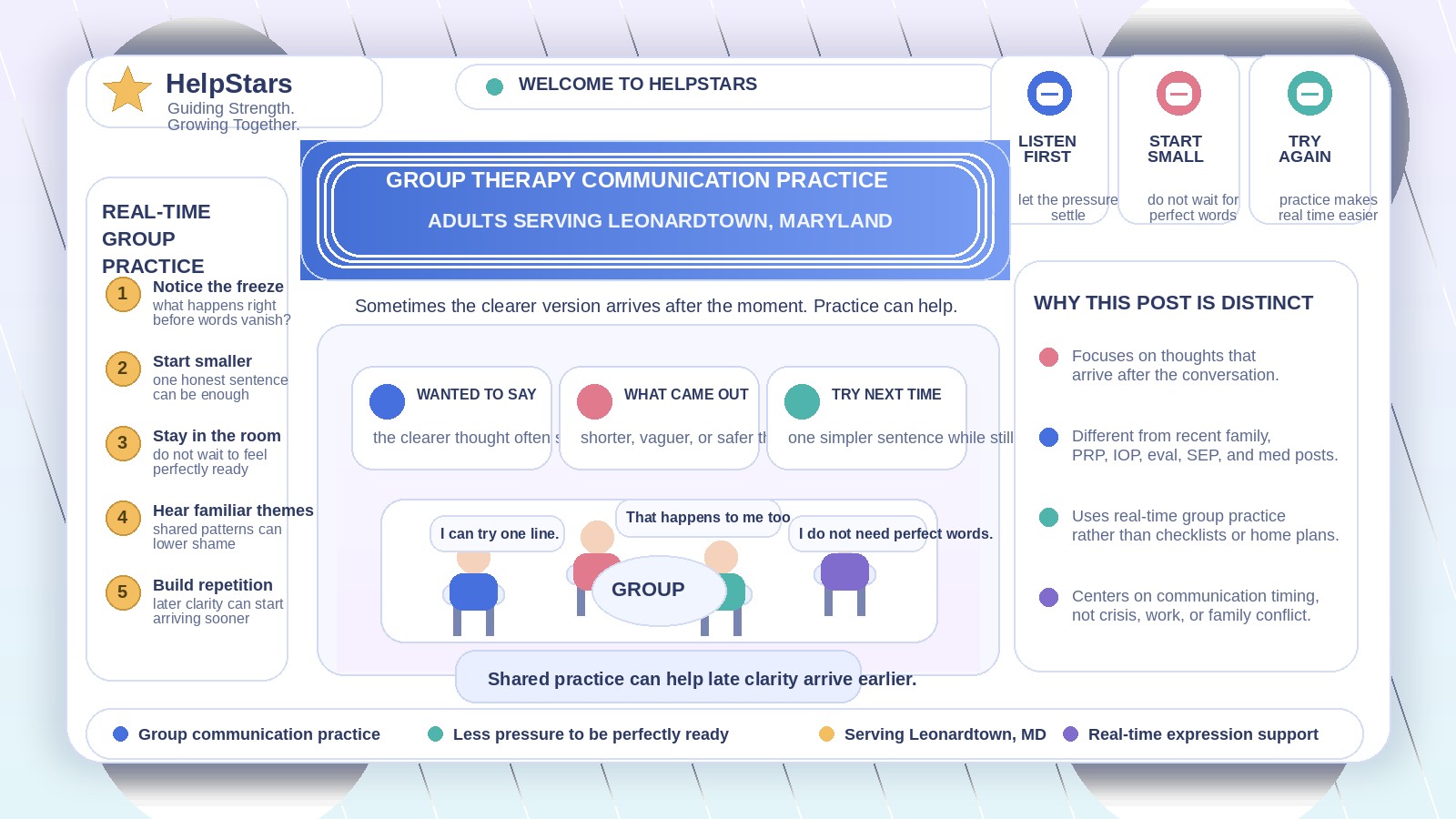
Group therapy is not only about hearing other people’s stories. It can also be a place to practice how thoughts become words in real time. That matters for adults who are not only isolated, but also frustrated by how differently they sound under pressure than they do in private reflection.
Depending on the group and the person’s needs, group therapy may help with:
- noticing what happens in the body right before words disappear,
- trying smaller, more direct statements instead of waiting for a perfect explanation,
- hearing familiar patterns from others and feeling less alone in them,
- practicing presence when the urge is to shut down, retreat, or over-edit, and
- building confidence that a person can speak honestly without having every sentence perfectly prepared first.
The goal is not to make someone perform well in a room. It is to help conversation feel more usable and less punishing.
A Leonardtown Example: The Better Version Always Arrives in the Car
Imagine an adult serving Leonardtown, Maryland and nearby St. Mary’s County communities who often leaves important conversations frustrated with themselves. At appointments, they give short answers. At home, they say “I’m fine” because the fuller truth feels too tangled. At work or in community settings, they keep their response brief and agreeable, then replay the interaction later with much better words.
In the car ride home, they suddenly know what they meant. They can name the stressor, the hurt feeling, the fear, or the need. But in the room itself, the words did not come together fast enough. After enough repetitions, the person may start avoiding deeper conversation altogether because they assume they will not represent themselves well anyway.
Group therapy can be helpful here because the issue is not just isolation. It is also practice. A supported group setting may give the person more chances to notice their pattern earlier and speak before the whole moment gets away from them.
Four Patterns That Often Keep Adults Stuck
- Trying to sound complete too quickly. Some adults wait for a fully polished explanation, then say nothing when that version does not come fast enough.
- Reading the room too hard. Monitoring everyone else’s reaction can take up the space needed to find one’s own words.
- Confusing hesitation with failure. A slow start does not mean the person has nothing meaningful to say.
- Rehearsing afterward instead of practicing in the moment. Reflection can help, but it does not replace real-time support and repetition.
These patterns are common. They are also workable when a person has structure, repetition, and a setting that reduces some of the all-or-nothing pressure.
Why Shared Conversation Can Be Useful Even for Quiet Adults
Some people assume group therapy only fits adults who are naturally open or talkative. In reality, a good group setting can help quieter adults too. Listening is part of the work. Noticing shared themes is part of the work. Speaking in shorter, more manageable pieces is part of the work.
For some adults, it is actually easier to try one honest sentence in a room where imperfection is expected than in a one-on-one conversation that feels high stakes. Group therapy can create a setting where communication becomes something to practice, not something to pass or fail.
Why This Matters in St. Mary’s County
Adults serving Leonardtown, California, Great Mills, Lexington Park, Hollywood, Mechanicsville, and nearby St. Mary’s County communities often balance treatment, work strain, family pressure, transportation realities, and everyday stress at the same time. Communication struggles can affect far more than one awkward conversation. They can shape appointments, household tension, friendships, workplace confidence, and willingness to seek help at all.
That is part of why group therapy serving Leonardtown, Maryland can matter. A person may not need perfect words. They may need a steadier place to practice finding usable ones while the conversation is still happening.
Questions Adults Often Ask About Group Therapy
What if I am better at writing my thoughts than saying them out loud?
That is a common experience. Group therapy may help adults practice moving from internal clarity to spoken clarity in smaller, less pressured steps.
Do I have to talk a lot for group therapy to help?
No. Listening, noticing patterns, and speaking in shorter pieces can still be meaningful parts of the work.
What if I always think of the right response too late?
That exact pattern can be worth bringing into treatment. Support may help the person notice earlier where the words get interrupted and try different ways of staying present long enough to respond more honestly.
Is group therapy only for people who feel comfortable around others?
Not at all. Some adults benefit precisely because being around others feels difficult and they want a more supported place to work on that difficulty.
The Conversation Does Not Have to Be Over Before Your Real Voice Arrives
When the clearer version of your thoughts keeps showing up afterward, it is easy to assume you missed the chance and will probably miss it again next time. That pattern can feel discouraging, but it does not have to stay fixed. Real-time communication can be practiced.
HelpStars LLC supports adults across Southern Maryland with practical behavioral health services, including group-based care. For adults seeking group therapy serving Leonardtown, Maryland, support may help turn late-arriving clarity into earlier, steadier expression that feels more useful in everyday life.