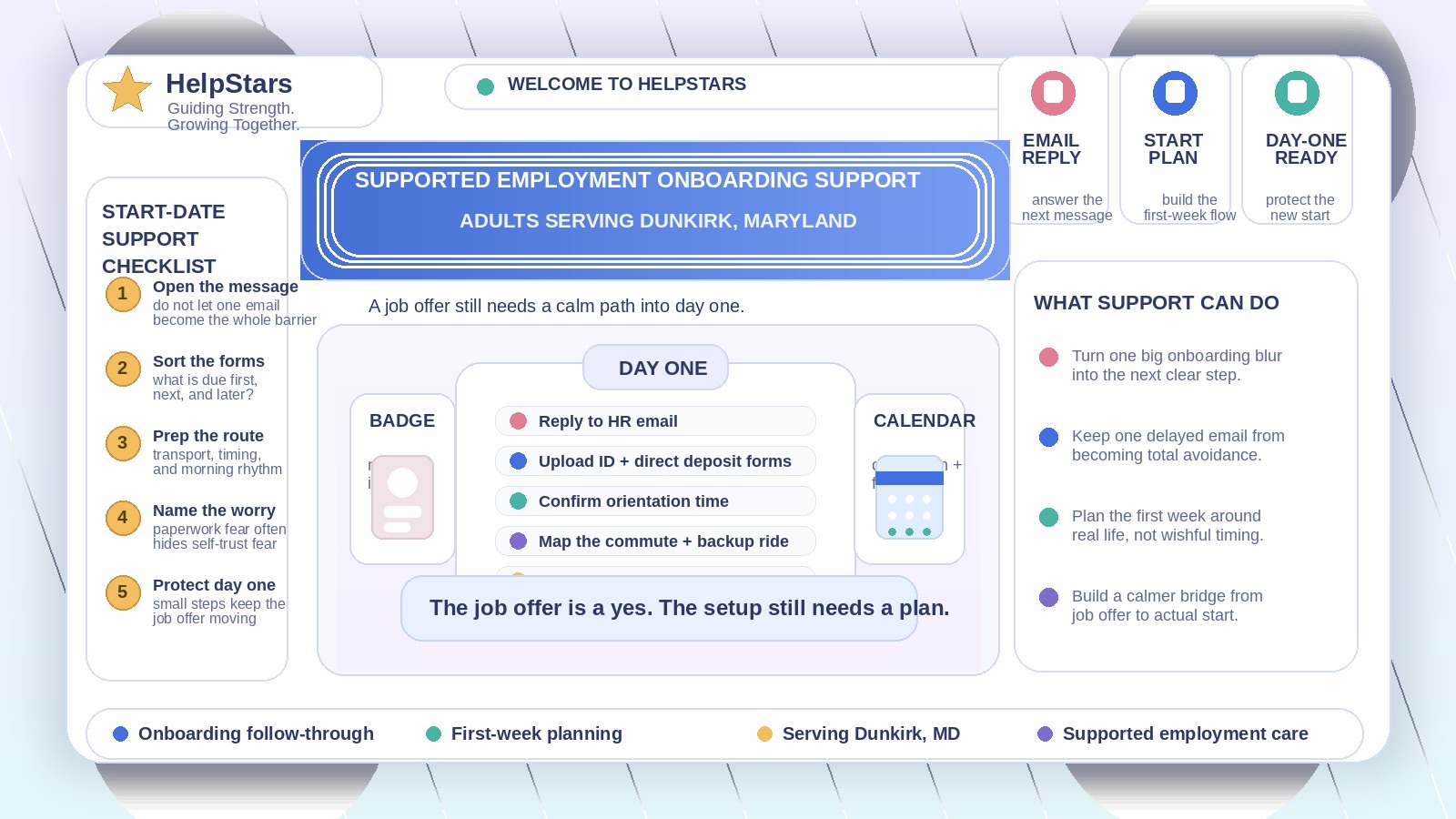
When the Job Is a Yes but the Onboarding Steps Keep Stalling: Supported Employment for Adults Serving Dunkirk, Maryland
For some adults, the hardest part of returning to work is not the interview. It is everything that happens after the yes. The offer comes through, relief shows up for a moment, and then a different kind of pressure takes over. There are emails to answer, forms to complete, documents to find, start dates to confirm, and small decisions that all seem to carry too much weight at once.
For adults seeking supported employment serving Dunkirk, Maryland, that stage matters more than people often realize. A person can want the job, feel proud to have gotten this far, and still freeze when the onboarding checklist starts filling up. The problem is not always motivation. Sometimes it is the collision between job momentum and a routine that still feels fragile.
HelpStars LLC supports adults across Southern Maryland with practical behavioral health services, including employment-focused care. When the job is real but the steps between acceptance and day one keep stalling, supported employment may help turn that stressful middle stretch into a more workable plan.
The Invisible Workload Often Starts After the Offer
People around the job seeker may think the difficult part is over once someone gets hired. In reality, that is often when the invisible workload begins. A person may suddenly need to upload identification, watch for a background-check email, return a scheduling call, pick an orientation time, decide what to wear, plan transportation, and figure out how the new routine will fit around treatment, family obligations, or recovery structure.
None of those tasks look huge by themselves. Together, they can create a pileup that feels surprisingly easy to avoid. A person may keep thinking, “I will do it tonight,” while also feeling less and less able to start. That delay can bring embarrassment fast because the stakes now feel public. The person is no longer only hoping for a chance. They are afraid of losing one they already earned.
Why Onboarding Can Feel Harder Than Applying
Applications are often abstract. Onboarding is concrete. Once a start date, contact person, or payroll form appears, the return to work stops being theoretical. For adults recovering from anxiety, depression, trauma-related stress, executive-function strain, or a long period of instability, that shift can activate a different layer of fear.
It can sound like:
- “I wanted the job until it started becoming real hour by hour,”
- “Every form makes me feel like I am one missed step away from messing this up,”
- “I do not know which task matters first, so I keep doing none of them,”
- “I am excited, but I also feel weirdly panicked now that there is a start date,” or
- “I can picture working there. I just cannot get myself through the setup part.”
That reaction does not mean the person is not ready to try. It often means the transition needs more structure than outside observers can see.
What Supported Employment Can Help Organize Before Day One
Supported employment is not only about finding openings. It can also help adults move through the practical middle space between “I got the job” and “I actually started.” That middle space is where many promising opportunities wobble.
Depending on the person’s needs, supported employment may help with:
- breaking the onboarding list into a clearer order,
- deciding which message, form, or deadline needs attention first,
- planning transportation and morning timing before the first shift arrives,
- thinking through how treatment appointments or support routines fit around the new schedule,
- preparing for orientation, introductions, and first-week communication, and
- reducing the shame spiral that turns one delayed task into total avoidance.
The goal is not to make the process perfect. It is to help the person get through the steps in a way that protects momentum instead of letting that momentum collapse under pressure.
A Dunkirk Example: The Offer Is Good, but the Setup Phase Starts Slipping
Imagine an adult serving Dunkirk, Maryland and nearby Calvert County communities who has just been offered a part-time position. They feel genuine relief. The interview went better than expected. The schedule seems manageable. The role looks like a believable re-entry point after time away from work.
Then the setup tasks begin. There is an email asking them to complete paperwork within two days. Another message mentions orientation. A voicemail asks them to confirm availability. They realize they need to find identification, check transportation timing, and think about whether a standing appointment needs to move. Suddenly the emotional tone changes. What felt like progress starts feeling like exposure.
The person does not exactly decide to avoid it. They just keep not starting. By the next afternoon, the unread messages feel louder. By the second evening, they are already imagining how embarrassed they will feel if they answer late. Supported employment can be useful here because the problem is not only confidence. It is the sequence. Once the steps become clearer, the chance is often easier to protect.
Four Pressure Points That Often Derail a Good Start
- Too many tasks arrive at once. A person may need to reply, sign, upload, schedule, and prepare all in the same short window.
- The first missed step creates extra shame. One unanswered email can quickly start feeling like proof that the person is about to fail at the whole job.
- Real-life logistics show up fast. Transportation, clothing, sleep, meals, child care, or appointment timing may all need attention before the first shift.
- The emotional meaning gets bigger than the checklist. For many adults, onboarding pressure is tied to self-trust, not paperwork alone. The fear is not only missing a form. It is losing faith in their own ability to follow through.
These pressure points are common, especially after a work gap or a difficult mental health stretch. They deserve practical support rather than judgment.
How Family or Supporters Can Help Without Taking Over
Loved ones often want to help by stepping in quickly, but too much takeover can make the person feel even less capable. Support tends to work better when it increases structure without stripping away ownership.
That may look like:
- helping the person sort the onboarding tasks into first, next, and later,
- asking what part feels most stuck instead of calling the person irresponsible,
- offering a calm check-in window for forms or scheduling tasks,
- helping think through transportation or morning preparation, and
- encouraging one completed step at a time rather than demanding the whole checklist at once.
The point is to support follow-through without turning the job start into another situation where the person feels supervised or rescued.
Why This Transition Matters in Calvert County
Adults serving Dunkirk, Huntingtown, Chesapeake Beach, North Beach, Prince Frederick, and nearby Calvert County communities are often building a work plan around actual local routines. Commutes, family schedules, treatment visits, shared vehicles, and regional travel all affect whether a new job is manageable in practice. A return-to-work plan works better when those daily realities are acknowledged early rather than treated as side notes.
That is one reason supported employment can matter so much during onboarding. Starting a job is not only about confidence in the abstract. It is also about whether the first week can be organized in a way the person can realistically sustain.
Questions Adults Often Ask About Job Onboarding
Is it a bad sign if I got the job but now feel frozen by the setup tasks?
No. That reaction is more common than many adults admit. The shift from hoping to start working to actually preparing for day one can bring up pressure, fear, and practical overload all at once.
Can supported employment help even if the job is already secured?
Yes. Employment-focused support can still be useful after an offer if the person needs help with follow-through, planning, communication, or first-week preparation.
What if I already delayed replying and now feel too embarrassed to answer?
That kind of shame loop is very common. Support may help the person break the delay into one next action instead of treating the late reply as proof the opportunity is already lost.
Does needing structure around onboarding mean I am not ready to work?
Not necessarily. It may simply mean the transition needs more scaffolding so the person’s motivation is not overwhelmed by logistics and fear.
A Steadier Start Often Begins Before the First Shift
Many adults think job readiness is only about interviews, resumes, or motivation. Sometimes the truest test is whether the small steps after a yes can be carried without the whole plan unraveling. That middle stage deserves support too.
If the job is real but the onboarding process keeps slipping, a calmer and more organized transition may still be possible. HelpStars LLC supports adults across Southern Maryland with practical behavioral health services, including employment-focused care. For adults seeking supported employment serving Dunkirk, Maryland, help with onboarding follow-through and first-week planning may make it easier to turn a job offer into an actual start.