When the Family Still Talks to the Version of You Who Was in Crisis: Family Therapy for Adults Serving Waldorf, Maryland
Sometimes a person really has changed, but the household has not caught up yet. Symptoms may be less intense. The worst stretch may be over. The person may be showing more follow-through, more steadiness, or more honesty than they were able to offer a few months earlier. Even so, family conversations can keep sounding like everyone is still bracing for the hardest version of the problem.
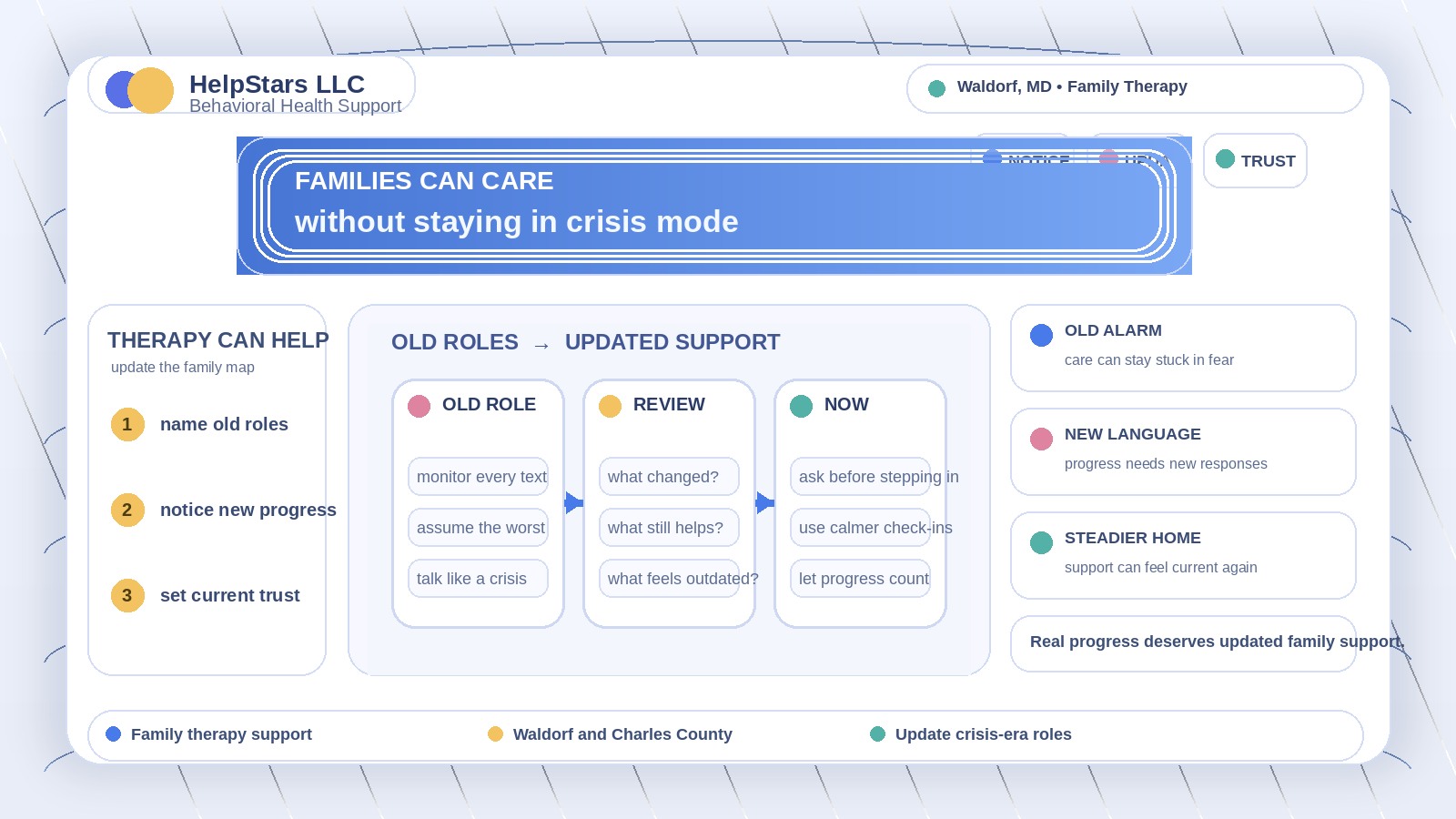
For adults seeking family therapy serving Waldorf, Maryland, that mismatch can create a new kind of strain. The issue is no longer only the crisis itself. The issue is that old roles, protective habits, and crisis-era communication may still be shaping the relationship after the situation has started to change. Family therapy can help adults and loved ones notice that lag, talk about what is different now, and build a more accurate way of relating to each other moving forward.
HelpStars LLC supports adults and families across Southern Maryland with compassionate behavioral health services. When one person has begun to stabilize but the family still responds as if every week might fall apart, structured support may help everyone adjust to the present instead of staying trapped in the old emergency pattern.
Improvement Does Not Automatically Update Family Roles
Families often build survival habits during the hardest season. One person becomes the checker. Another becomes the explainer. Someone else starts watching for warning signs in every mood shift, delayed text, or missed chore. Those roles may have developed for understandable reasons. The problem is that they can stay active long after the situation begins to improve.
That can sound like:
- “I know you are doing better, but I still feel like I have to monitor everything,”
- “Every conversation starts like I am about to disappoint someone,”
- “They keep reacting to who I was three months ago, not who I am now,”
- “I cannot tell whether this is support or just old fear talking,” or
- “We all say things are better, but nobody actually acts like they believe it yet.”
When that pattern continues, the family can start having conflict about the recovery itself. The person who has improved may feel unseen. The loved one who stayed hyper-alert may feel guilty for not being able to relax. Both sides may care deeply while still feeling stuck in an outdated version of the relationship.
Why Old Alarm Systems Stay Turned On
Family members do not always keep reacting this way because they doubt the progress. Often they do it because their nervous system learned to expect disruption. After weeks or months of watching someone struggle, loved ones may still feel primed for the next collapse even when the pattern has changed. They may keep checking, reminding, interpreting silence negatively, or stepping in too quickly because those responses once felt necessary.
The person receiving that response may experience it very differently. They may feel overread, mistrusted, or talked to like they have no recent track record. This is where family tension can become confusing. The family is no longer fighting only about symptoms. They are fighting about how long protection should stay in place and what trust should look like after a hard chapter.
What Family Therapy Can Help Clarify
Family therapy can be useful when the household needs help updating its map of the problem. That may include looking at what roles formed during the hardest stretch, which of those roles still help, and which ones now create friction instead of safety.
Depending on the family’s needs, therapy may help with:
- naming how crisis-era communication still shows up in ordinary check-ins,
- distinguishing healthy support from reflexive over-monitoring,
- giving the person who improved space to describe what feels different now,
- letting loved ones talk honestly about fear without turning that fear into control,
- setting more current expectations around reminders, privacy, and follow-through, and
- creating a relationship pattern that reflects the present rather than the worst month everyone remembers.
The goal is not to erase what the family went through. The goal is to stop the hardest part of the past from running every conversation in the present.
A Waldorf Example: Better Functioning, Same Old Script
Imagine an adult serving Waldorf, Maryland and nearby Charles County communities who had a genuinely difficult season earlier in the year. They missed responsibilities, withdrew more than usual, and needed extra support just to keep the week moving. Over time, things started improving. They began making appointments more consistently, handling more of their own schedule, and following through on daily responsibilities with less crisis-level strain.
But at home, the family still sounds like it is talking to the person from the worst stretch. Every slow reply becomes a concern. Every tired evening gets read as a setback. Ordinary reminders come with a layer of urgency that no longer matches the actual situation. The adult feels frustrated because real progress keeps getting filtered through old fear. The family feels frustrated because their vigilance once helped and now they do not know how to turn it down safely.
In that situation, family therapy serving Waldorf, Maryland may help by slowing the pattern down. The question is not only whether progress happened. The question is whether the relationship has been allowed to update alongside that progress.
Three Signs the Family May Be Relating to an Older Version of the Problem
- Small current events trigger big old reactions. A delayed text, tired tone, or changed plan quickly gets interpreted through the worst past period instead of the present facts.
- Support still sounds like emergency management. Check-ins, reminders, or questions carry the same intensity they had when things were less stable.
- Progress keeps getting acknowledged verbally but not relationally. People say things are better, yet the daily pattern still assumes collapse is always right around the corner.
These signs do not mean anyone is uncaring or unreasonable. They often mean the family needs help catching its relationship pattern up to reality.
What Trust Can Look Like Without Pretending the Past Never Happened
Rebuilding trust does not have to mean acting like the family imagined everything. It can mean updating the level of oversight, worry, and interpretation to match what is actually happening now. In some families, that looks like fewer repeated reminders. In others, it means clearer agreements about when concern should be voiced and when a person can be allowed to handle their own next step. Sometimes it means saying out loud, “I know I am responding to what happened before, not only to what is happening today.”
That kind of honesty can be relieving. It gives both sides something more accurate to work with than blame. The goal is not to force instant trust. It is to make trust something the family can rebuild on purpose instead of something everyone keeps waiting to feel automatically.
Why This Matters for Adults and Families in Charles County
For adults serving Waldorf, La Plata, White Plains, Bryans Road, and nearby Charles County communities, family dynamics often sit inside full weeks of work, parenting, commuting, treatment appointments, and household responsibilities. When the home environment keeps reacting to an outdated crisis script, it can make genuine progress harder to maintain. A person may feel discouraged no matter what they do. Loved ones may stay exhausted from carrying a level of vigilance they no longer want but do not yet know how to release.
Support becomes more useful when it helps the whole family function in the current version of life, not only the past one. That can make home feel less like a surveillance zone and more like a place where recovery actually has room to keep growing.
Questions Families Often Ask
Does this mean the family should stop being careful altogether?
No. The point is not to remove support blindly. The point is to make support more accurate to the present situation.
What if the family member really did need that level of oversight before?
That history still matters. Family therapy can help everyone sort out which supports remain useful and which ones now create unnecessary conflict.
Can this kind of tension show up even when things are objectively improving?
Yes. Sometimes improvement creates its own adjustment period because people do not automatically know how to stop responding like they are still in the worst phase.
Can family therapy fit alongside other outpatient behavioral health support?
Yes. Depending on the family’s needs, it may be one part of a broader outpatient care plan.
Recovery Deserves Relationships That Can Update With It
It is hard to keep moving forward when every conversation keeps pulling everyone back toward the oldest emergency version of the story. Real progress deserves room to be recognized in the way people talk, respond, and trust each other.
HelpStars LLC supports adults and families across Southern Maryland with compassionate behavioral health services. For adults seeking family therapy serving Waldorf, Maryland, support may help the whole household shift from crisis-era roles toward a steadier, more current way of caring for one another.