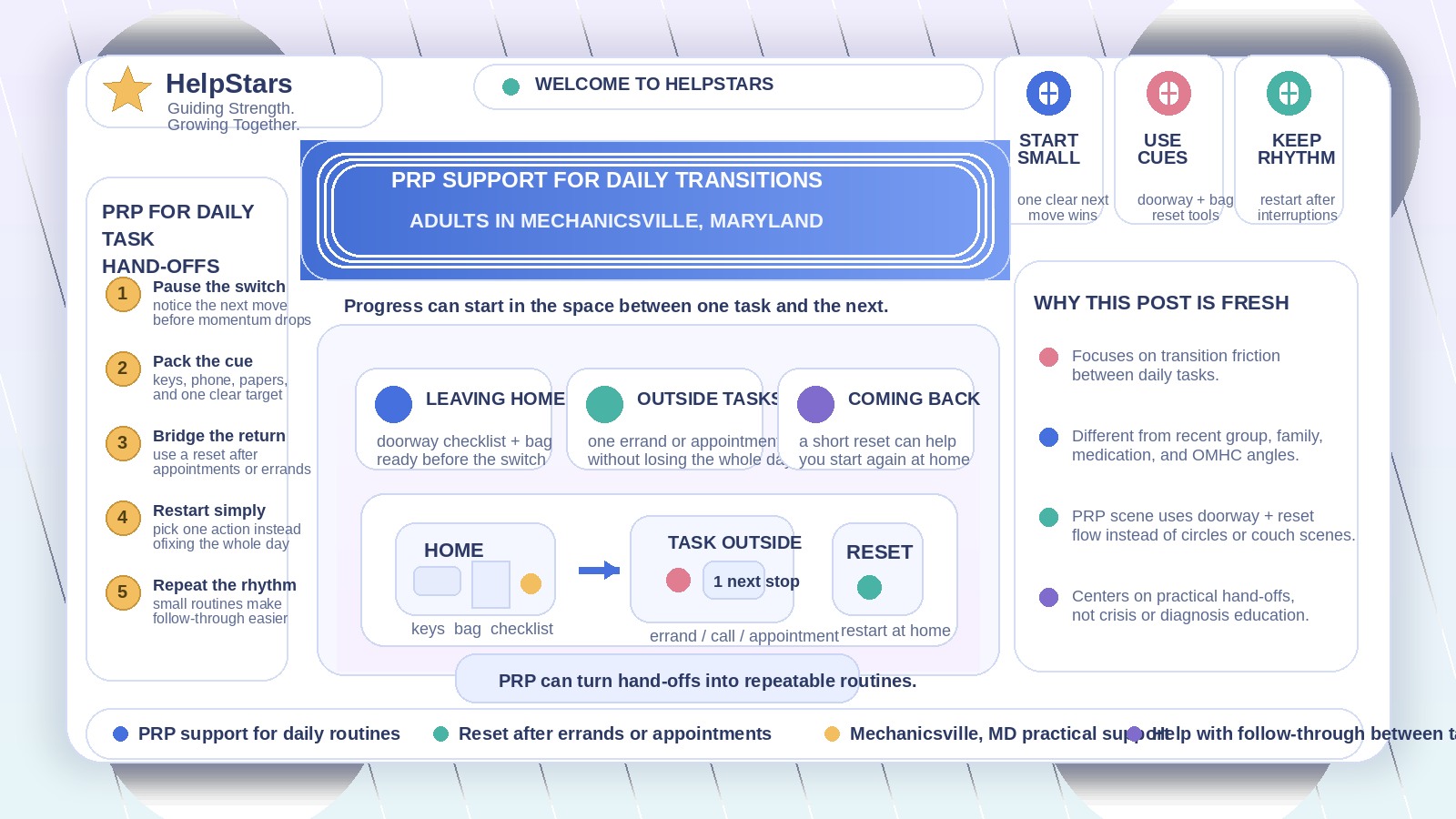
When the Day Has Too Many Hand-Offs: How PRP Can Help Adults in Mechanicsville, Maryland Move From One Task to the Next
Some days do not fall apart because of one major crisis. They fall apart in the spaces between tasks. An adult gets dressed but never makes it out the door. They answer one text and lose the rest of the morning. They come back from an appointment and cannot restart the day. They know what needs to happen next, but the shift from one step to another keeps breaking down.
For adults in Mechanicsville, Maryland, psychiatric rehabilitation program (PRP) services can help when daily life keeps stalling at these transition points. HelpStars LLC supports adults who may need more practical structure, more usable routines, and more real-world coaching around follow-through. The goal is not to pressure someone into doing more all at once. It is to make the next step easier to start and easier to repeat.
The Problem Is Often the Transition, Not the Whole Task
Many adults can picture what a successful day would look like. The challenge is not a lack of awareness. It is that each hand-off asks for a fresh burst of energy, focus, and organization. Moving from the shower to getting dressed, from getting dressed to leaving, from leaving to arriving, from an errand to the next responsibility, or from an appointment back into home routines can all feel harder than they should.
That can lead to patterns like:
- getting stuck after one completed task instead of rolling into the next one,
- losing momentum every time the setting changes,
- needing long recovery time after a phone call, meeting, or errand,
- forgetting important items during the switch from home to outside responsibilities, and
- ending the day feeling busy but still behind.
When these hand-offs keep breaking down, people often blame themselves for inconsistency. In reality, the day may simply need more support at the transition points.
Why Daily Hand-Offs Can Drain So Much Energy
Task transitions ask the brain to stop, shift, remember, and restart. That becomes especially difficult when someone is already carrying stress, depression, anxiety, low motivation, attention strain, or the fatigue that comes from trying to hold life together while functioning below their usual level.
What looks small from the outside can feel heavy in the moment. Finding keys. Packing the right paperwork. Deciding what order to do things in. Restarting after a disruption. Re-entering the house without losing the rest of the evening. These are not dramatic obstacles, but they can quietly control the entire day when enough of them pile up.
How PRP Can Help Make the Next Step More Reachable
PRP focuses on practical daily-living support. For adults who keep losing momentum between tasks, that support may center less on talking about the whole week in abstract terms and more on making each transition more usable in real life.
Depending on the person’s needs, PRP support may help with:
- breaking a long day into smaller, linked steps instead of one overwhelming plan,
- creating simple transition routines for leaving home, coming back home, and restarting after interruptions,
- building visual or written cues that reduce the mental load of remembering what comes next,
- preparing key items ahead of time so every hand-off does not begin from zero,
- practicing how to recover the day after one step goes off track, and
- turning “I should do that” into one specific next action.
That matters because many adults do not need a bigger lecture about responsibility. They need a steadier bridge between one part of the day and the next.
A Mechanicsville Example: The Day Keeps Restarting but Never Moves Forward
Imagine an adult in Mechanicsville who wakes up with a reasonable plan: make one call, go to an appointment, stop for one errand, and handle two household tasks later in the afternoon. Nothing on that list is unrealistic by itself. The problem begins in the spaces between the items. The call takes more emotional energy than expected. Leaving the house happens later than planned. After the appointment, the person sits in the driveway to recover and loses the errand. Once they finally come inside, the household tasks feel too far away to begin.
By evening, the person may feel like the entire day slipped away. But the real issue may not be motivation alone. It may be that every hand-off required more structure than the day had built into it. PRP can help identify exactly where the routine keeps dropping and what kind of support makes those transitions easier to complete.
Practical Supports That Can Reduce Transition Friction
Adults often benefit from supports that sound simple on paper but make a major difference when they become consistent. PRP may help someone build tools such as:
- a go-bag or doorway checklist for the home-to-community transition,
- a short reset routine after returning from appointments or errands,
- one-task restart plans for afternoons that have already drifted off schedule,
- step-by-step preparation for calls, forms, transportation, or follow-up tasks, and
- a more realistic daily sequence that fits the person’s actual energy pattern.
The value is not perfection. The value is reducing how many times a person has to improvise the same transition under stress.
Who Might Benefit From This Kind of PRP Support
PRP may be worth exploring for adults who:
- keep getting stuck between tasks even when they understand what needs to happen,
- lose the rest of the day after one difficult errand or appointment,
- need more practical structure around routines, follow-through, or community functioning,
- feel that daily life requires more restarting than actual progress, or
- want support that is focused on real-world functioning rather than insight alone.
Questions Adults Often Ask
Does needing help with daily transitions mean I am doing badly overall?
No. Many adults manage important responsibilities and still struggle with the hand-offs between them. Those transition points can be genuinely hard, especially during periods of stress or mental health strain.
Is PRP only for people with major crises?
No. PRP can also help adults whose daily functioning keeps slipping in practical ways even when the issue does not look dramatic from the outside.
Can PRP work alongside counseling or other behavioral health services?
Yes. Depending on the person’s needs, PRP may complement outpatient counseling, psychiatric evaluation, medication management, intensive outpatient support, or other parts of a broader treatment plan.
What if my main problem is that I cannot restart once the day gets off track?
That is exactly the kind of real-life difficulty PRP may help address. Support can focus on recovery steps, routines, and practical strategies instead of assuming the whole day is lost.
Why Local Routine Matters in Mechanicsville, Maryland
Daily life in Mechanicsville can involve commuting, family responsibilities, appointments, errands, and the logistical strain of moving between home, roads, and community obligations across St. Mary’s County. When someone already feels mentally overloaded, those location changes can intensify the transition problem. A practical support plan works better when it matches the actual rhythm of local daily life instead of assuming unlimited time and energy.
Progress Sometimes Starts in the Space Between Tasks
Adults do not always need a completely different life plan. Sometimes they need help with the small bridges that keep a normal day from collapsing. PRP support can make those hand-offs more manageable, more repeatable, and less draining.
For adults in Mechanicsville, Maryland, HelpStars LLC provides compassionate behavioral health support focused on building steadier daily functioning. When the day keeps stalling between one task and the next, practical PRP support may be an important step toward more usable momentum.