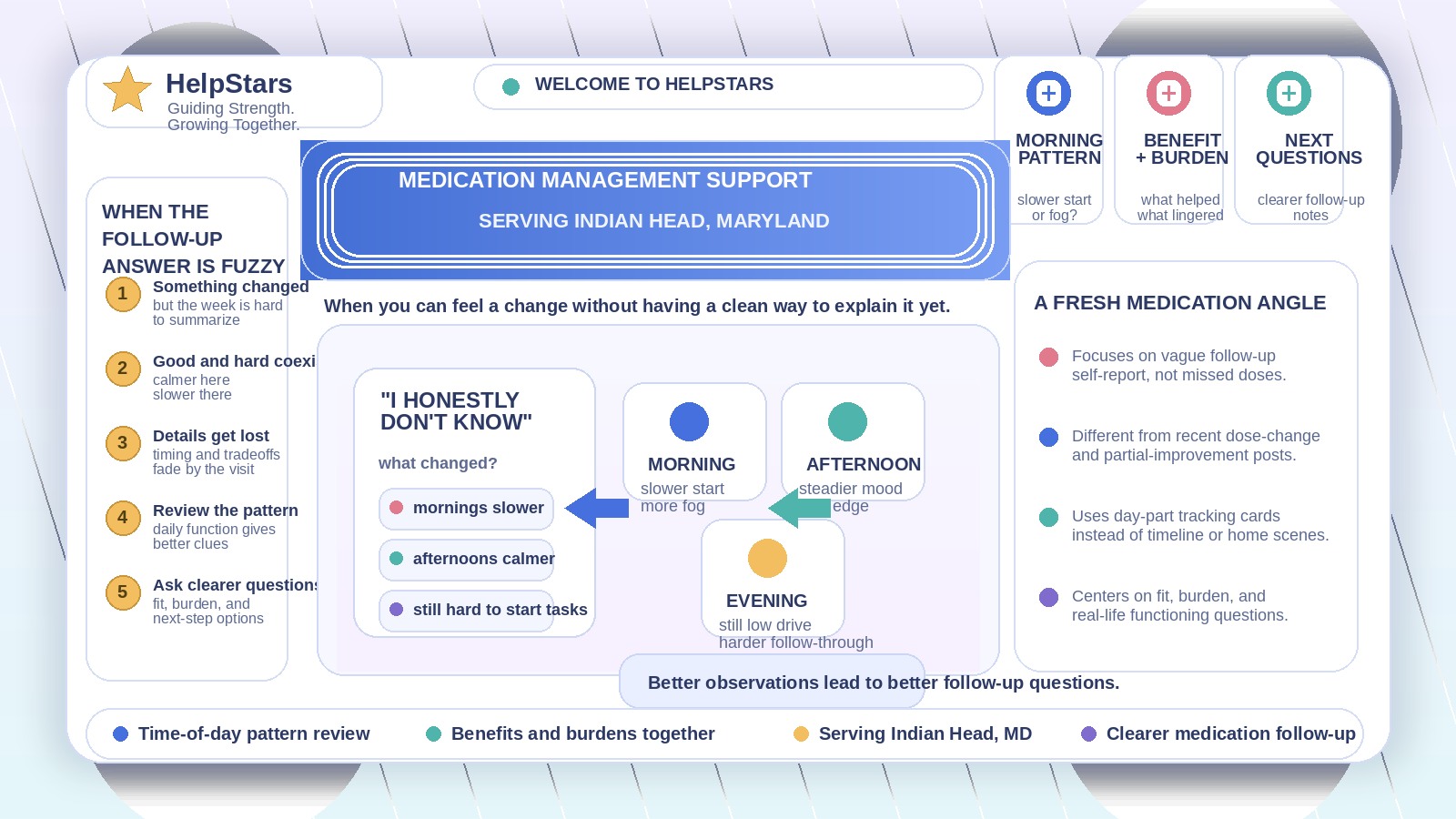
When the Answer to ‘How’s the Medication Going?’ Is ‘I Honestly Don’t Know’: Medication Management for Adults Serving Indian Head, Maryland
Some follow-up appointments begin with a question that sounds simple and immediately feels hard to answer: How is the medication going? A person may know the week feels different, but not know how to describe that difference clearly. Maybe mornings feel slower, but afternoons feel calmer. Maybe anxiety is not as sharp, yet motivation is still unreliable. Maybe sleep changed, appetite shifted, or concentration became harder to read instead of easier to understand.
For adults seeking medication management serving Indian Head, Maryland, that kind of uncertainty matters. The problem is not always that the medication is doing nothing. Sometimes it is doing something, but the pattern is too uneven, subtle, or mixed to explain well on the spot. A useful follow-up visit can help turn vague impressions into practical details so the next decision is based on more than guesswork.
HelpStars LLC serves adults and families across Southern Maryland with compassionate behavioral health support. When a prescription seems to be changing parts of the week but the full picture still feels difficult to describe, medication-management support may help adults sort out what is helping, what is burdensome, and what questions belong in the next conversation.
Why “I Don’t Know” Can Still Be Important Information
Many adults think they are supposed to arrive at follow-up appointments with a neat answer. Better or worse. Working or not working. More anxious or less anxious. But medication responses often do not unfold that cleanly. A person may feel slightly steadier in one setting and more fatigued in another. They may notice fewer spiraling thoughts but more difficulty getting started in the morning. They may feel calmer socially but mentally flatter at home.
That is why “I honestly don’t know” should not be treated like a non-answer. It can signal that the response pattern is mixed, time-sensitive, or too layered to summarize in one sentence. In medication management, those mixed impressions can be exactly what deserves a closer look.
What Makes Medication Follow-Ups Harder Than People Expect
Adults are often trying to remember two weeks of life while sitting in one short appointment. That is not easy. Daily functioning is shaped by sleep, work stress, parenting, commuting, appetite, routine, and other treatment supports too. If medication changes happen quietly rather than dramatically, the person may leave the visit feeling as if they said either too little or the wrong thing.
Common follow-up problems include:
- remembering only the hardest day instead of the overall pattern,
- focusing on one side effect and forgetting a meaningful benefit,
- describing mood without describing daily functioning,
- missing the timing of when symptoms or side effects show up most, or
- assuming uncertainty means the medication is failing when the pattern just needs better review.
A more useful follow-up does not require perfect memory. It usually requires better anchors.
A Better Question Than “Is It Working?”
“Is it working?” can be too broad to help. A more practical medication-management conversation often breaks that question into smaller ones:
- What part of the day feels most different than before?
- What problem feels lighter, even if it is not gone?
- What tradeoff feels harder to carry than expected?
- What routine, task, or interaction still does not feel easier?
- Does the change seem steady, or does it wear off, build up, or vary across the week?
Those questions help shift the visit away from a pass-or-fail judgment and toward a fuller picture of fit, timing, burden, and real-life usefulness.
An Indian Head Example: The Week Feels Different, but the Pattern Is Hard To Name
Imagine an adult serving Indian Head, Maryland and nearby Charles County communities who recently started a prescription or adjusted an existing one. At first, they expect the next follow-up to be straightforward. But when the appointment approaches, the week does not fit into one simple explanation. They are less keyed up during the workday, yet mornings feel heavy. They are sleeping a bit more consistently, but getting moving takes longer. Family members say they seem calmer, though the person still feels frustrated by how slow some tasks feel.
None of those observations is useless. Together, they tell a more realistic story: some things may be improving while other concerns still need attention. Medication management can help because the visit is not only about deciding whether the medication stays or goes. It is also about understanding how the response is showing up across the person’s actual week.
Five Details That Can Make the Next Follow-Up More Useful
- Time-of-day patterns. A person may feel better in the afternoon than the morning, or more settled at work than at home. Timing matters.
- What feels easier in daily life. It may be simpler to start tasks, stay in conversations, finish errands, or recover after stress.
- What feels harder than expected. Fatigue, appetite changes, emotional flatness, restlessness, or headaches may affect whether the plan still feels workable.
- How other people are describing the change. Sometimes a spouse, parent, or close friend notices steadiness, tension, or withdrawal patterns the person did not label on their own.
- What has not changed enough yet. A prescription can help in one area while leaving another problem mostly untouched.
These observations do not have to be polished. Even a few plain examples can make the follow-up more accurate and more useful.
Medication Management Is About Fit, Not Just Compliance
Adults sometimes assume the whole point of medication follow-up is proving they took the prescription correctly. Adherence matters, but it is not the only issue. Medication management is also about whether the plan fits the person’s life well enough to support steadier functioning. A medication that reduces one symptom but creates a new daily obstacle may still need closer review. A medication that is helping quietly may need more careful observation before someone gives up on it too soon.
This is one reason follow-up support can be valuable when the response feels mixed. The goal is not to pressure someone into saying a medication is working. The goal is to clarify what the real pattern is and what next-step discussion makes the most sense.
What Adults Serving Charles County Often Need From the Conversation
For adults serving Indian Head, Bryans Road, Waldorf, White Plains, La Plata, and nearby Charles County communities, mental health treatment happens inside ordinary responsibilities. Medication effects matter differently when a person is commuting, parenting, handling paperwork, staying present at work, or trying to protect energy for the evening. That local routine matters because a response that sounds acceptable in theory may still feel unsustainable in a real week.
A thoughtful medication-management visit can help connect the prescription plan to those practical realities. It can move the conversation beyond symptoms alone and into how the treatment is affecting concentration, pace, patience, follow-through, and day-to-day steadiness.
Questions Adults Often Ask About Medication Management
What if I really cannot tell yet whether the medication is helping?
That can still be useful information. A follow-up visit can explore what has and has not changed yet, whether the pattern is subtle, and what details are worth watching more closely.
Do I need to track every single symptom perfectly?
No. A few concrete examples about time of day, routine, side effects, and daily functioning are often more helpful than trying to remember everything at once.
What if part of me feels better, but another part still feels off?
That mixed response is common. Medication management can help clarify whether the current pattern suggests adjustment, more observation, or a broader treatment conversation.
Does medication management only matter right after starting something new?
No. It can also be important when a longer-term medication stops feeling like the same fit it once did, or when life circumstances make old routines harder to maintain.
Clearer Answers Often Start With Better Observations
A person does not need a perfect summary before a medication follow-up becomes worthwhile. Sometimes the most important shift is moving from “I don’t know” to “here is what seems different in the morning, here is what feels lighter by afternoon, and here is what still does not feel right.” That kind of clarity can support better decisions without oversimplifying the week.
HelpStars LLC serves adults and families across Southern Maryland with compassionate behavioral health support. For adults seeking medication management serving Indian Head, Maryland, a more structured follow-up conversation may help turn fuzzy impressions into a clearer, more workable next step.