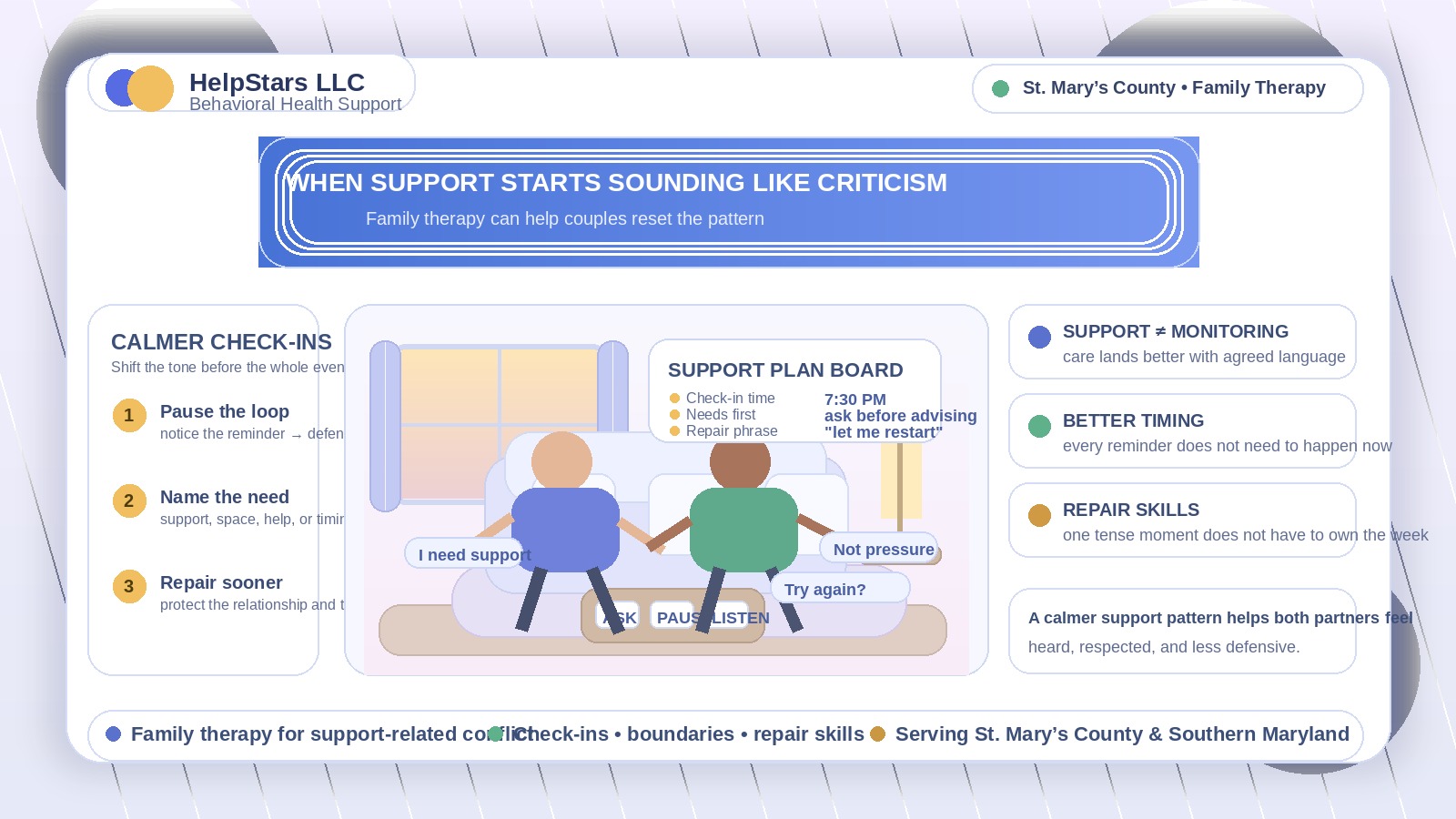
When Support Starts Sounding Like Criticism: Family Therapy for Couples in St. Mary’s County, Maryland
Sometimes a relationship problem does not begin with a lack of love. It begins with two people trying very hard to handle one person’s stress, anxiety, depression, or emotional overload and slowly making each other feel worse in the process. One partner asks a lot of questions because they are worried. The other hears those questions as pressure. One tries to fix the week with reminders and plans. The other starts feeling watched, corrected, or misunderstood. Before long, even caring conversations can land like criticism.
For couples in St. Mary’s County, Maryland, family therapy can help when mental health strain keeps changing the tone of everyday communication. The goal is not to decide who is the better partner. It is to understand the pattern, reduce defensiveness, and create a steadier way to talk about symptoms, support, boundaries, and daily responsibilities without turning every check-in into conflict.
HelpStars LLC serves adults and families across Southern Maryland with compassionate behavioral health support. When concern keeps coming out sideways and a relationship starts feeling more tense than helpful, family-therapy support may be a useful next step to explore.
Why Helpful Intentions Can Still Create More Tension
Mental health stress affects more than the person carrying the symptoms. It changes household timing, emotional energy, patience, sleep, follow-through, and the way both partners read each other’s tone. A question meant as support can sound like doubt. A suggestion meant as teamwork can sound like control. A quiet evening can feel restful to one person and emotionally distant to the other.
That can sound like:
- “I was only asking because I care,”
- “Every conversation feels like a performance review,”
- “I need support, not another checklist,”
- “If I don’t bring it up, nothing gets addressed,” or
- “We start with one small concern and end up arguing about everything else.”
These moments do not always mean the relationship is failing. Often, they mean the couple has slipped into a support pattern that creates more defensiveness than relief.
When Mental Health Changes the Job Both Partners Think They Have
Couples under strain often stop talking only as partners and start talking as manager and managed person, monitor and monitored person, rescuer and resistant person, or silent struggler and anxious pursuer. Once those roles harden, even ordinary household conversations can become emotionally loaded.
One partner may feel responsible for keeping everything from falling apart. The other may feel reduced to a problem that needs supervision. Both can end up exhausted for different reasons.
Family therapy can help couples slow that process down and ask more useful questions:
- What kind of support actually feels supportive?
- What kind of check-in feels intrusive or badly timed?
- Which responsibilities need to be shared clearly instead of assumed?
- How can concern be expressed without sounding like correction?
- What boundaries protect both people from turning every evening into a debrief about symptoms?
Those questions matter because many couples are not trying to be harsh. They are trying to survive a hard pattern without a shared map.
What Family Therapy Can Help Couples Rebuild
When mental health stress enters a relationship, the problem is rarely only the original symptom. Over time, the couple may also be dealing with tone misreads, repeated arguments, shutdown, resentment, overfunctioning, or fear of saying the wrong thing. Therapy can help separate the support problem from the relationship injury it keeps creating.
Depending on the couple’s needs, family therapy may help them work on:
- naming recurring communication loops before they escalate,
- learning how to ask about symptoms or rough days without sounding interrogative,
- setting clearer expectations around reminders, appointments, chores, and recovery time,
- reducing blame around low-energy or high-stress periods,
- making room for the supportive partner’s fatigue without turning that fatigue into accusation, and
- building repair skills so one tense night does not poison the rest of the week.
That does not mean every conversation will become easy. It does mean the couple can stop relying only on instinct when instinct is already being shaped by stress and hurt feelings.
A St. Mary’s County Example: The Reminder That Starts Another Fight
Imagine a couple in St. Mary’s County trying to get through a season where one partner’s anxiety and low mood have started affecting sleep, focus, and everyday follow-through. The other partner notices missed tasks, unfinished forms, and a growing pile of little loose ends around the house. They start giving reminders because they believe that is what support looks like.
But the reminders do not land that way. The partner already feeling overwhelmed hears each prompt as proof that they are falling short again. The supportive partner then gets frustrated because their effort is treated like criticism. Soon, something as small as “Did you call them back today?” turns into an argument about tone, effort, respect, and whether either person feels understood at all.
In family therapy, the work may begin by naming the loop instead of arguing inside it. The couple can look at what happens before the reminder, what each person assumes it means, what other need is hiding underneath the argument, and how a different structure might reduce the tension. Sometimes the issue is not the reminder itself. It is the absence of an agreed-on way to handle support, timing, and autonomy.
Four Shifts That Often Help Couples Feel Less Stuck
- Moving from constant monitoring to intentional check-ins. Many couples function better when support conversations happen at clearer times rather than leaking into every task and transition.
- Replacing mind-reading with specific language. “You’re disappointed in me” and “You never help” often hide more accurate concerns that need clearer words.
- Defining help before offering it. A partner may want listening, space, reminders, practical help, or quiet company. Guessing wrong repeatedly can create more strain than asking directly.
- Protecting the relationship from becoming only about symptoms. Couples need ways to handle hard periods without turning the entire relationship into a treatment meeting.
These changes sound simple on paper, but they often require practice because each person is reacting from stress, fear, and habit.
Why the Supportive Partner May Need Space Too
One common problem in couples work is that the more visibly struggling partner becomes the only person whose stress gets language. The other partner may be carrying worry, frustration, loneliness, or emotional fatigue while trying to stay patient and useful. When that strain stays invisible, it often comes out as impatience, micromanaging, or sudden emotional distance.
Family therapy can help because it gives both people room to describe what the pattern costs them without turning the conversation into a competition over who has it harder. That balance matters. A relationship is easier to protect when both partners feel like their experience can be spoken aloud without being used as evidence against them.
When It May Be Time To Ask About Family Therapy
Couples may want to explore support when they notice:
- the same mental-health-related argument keeps returning in slightly different forms,
- support attempts regularly turn into defensiveness or shutdown,
- one partner feels responsible for managing too much of the other person’s week,
- the person struggling feels watched, corrected, or parented rather than supported,
- both people care, but neither likes who they become in these conversations, or
- the relationship is starting to feel organized around symptoms instead of connection.
Therapy does not have to wait for a dramatic breaking point. It can also help when a couple is still functioning but knows the current pattern is wearing them down.
Questions Couples Often Ask
Does family therapy mean one partner is being blamed?
No. The goal is typically to understand the interaction pattern, not to choose one person as the problem.
What if one partner needs support but also wants more independence?
That tension is very common. Therapy can help couples talk more clearly about what kind of support feels respectful and what kind feels controlling.
Can family therapy help if the relationship issue is really about communication, not diagnosis?
Yes. Many couples seek help because mental health strain has changed communication, routines, and emotional safety even if the main question is not a specific diagnosis.
Can this fit alongside other behavioral health support?
Often, yes. Depending on the situation, family therapy may complement outpatient counseling, psychiatric care, or other behavioral health services by focusing on the relationship pattern around support.
A Better Support Pattern Can Protect the Relationship Too
Many couples do not need more concern. They already have plenty of concern. What they need is a better structure for expressing it so love stops arriving as pressure and support stops sounding like criticism.
HelpStars LLC serves adults and families across Southern Maryland with compassionate behavioral health support. For couples in St. Mary’s County, Maryland who feel stuck in repetitive support-related conflict, family therapy may help create calmer conversations, clearer boundaries, and a steadier way forward together.