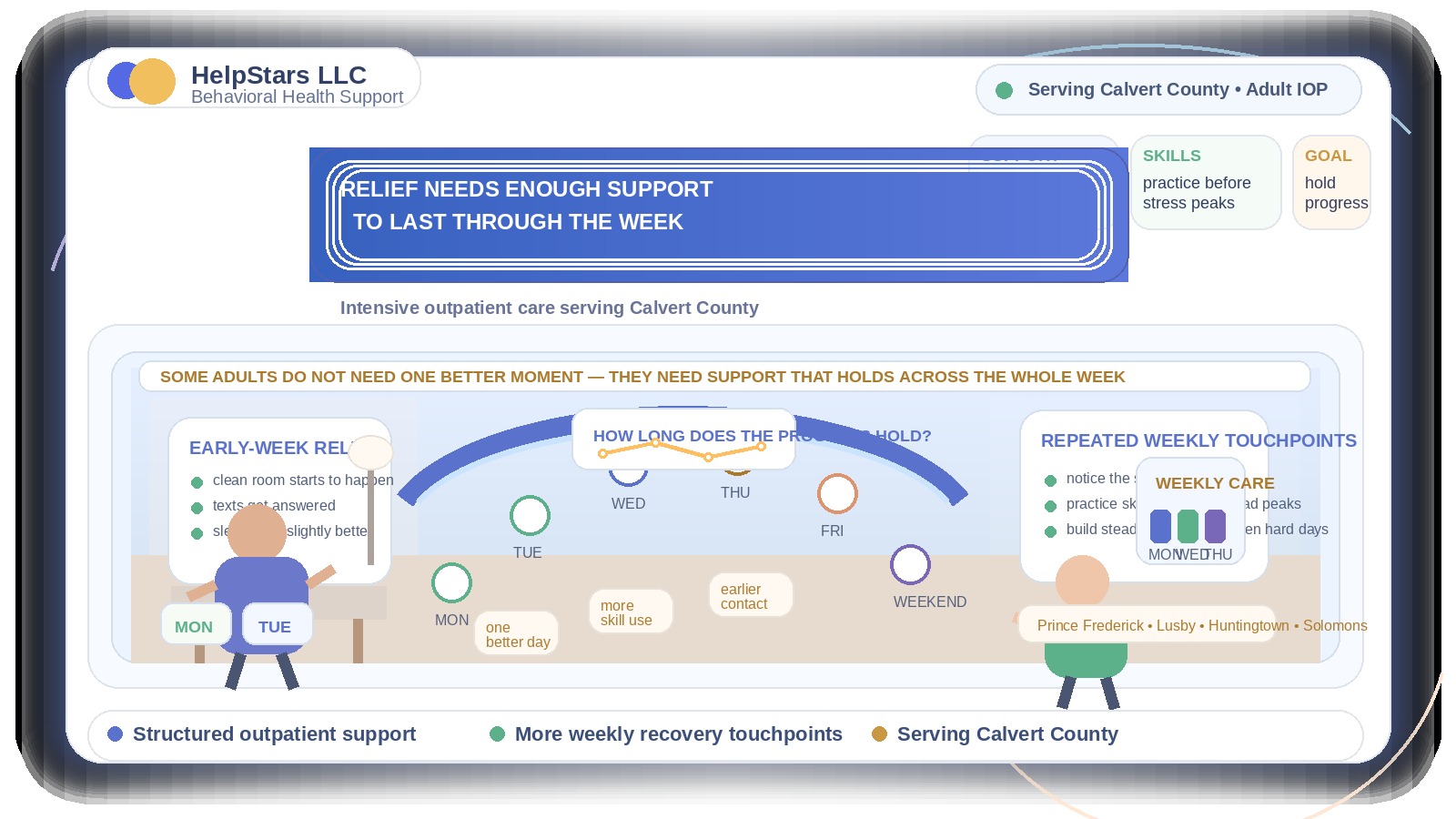
When Relief Fades Too Fast: How an Intensive Outpatient Program Can Help Adults Serving Calvert County, Maryland Build a More Stable Week
Some adults do not feel unwell every hour of every day. The harder pattern is that they get a little traction, think things may finally be settling down, and then watch the progress disappear again before the week is over. Monday goes better than expected. Tuesday feels manageable. By Thursday, sleep is off, irritability is back, appointments feel harder to keep, and the same coping plan that sounded realistic two days ago suddenly feels far away.
For adults looking for an intensive outpatient program serving Calvert County, Maryland, that pattern can matter more than any one bad day. The issue is not only whether someone can feel better for a short stretch. It is whether support is strong enough, frequent enough, and structured enough to help that progress last longer across real life.
HelpStars LLC provides compassionate behavioral health support for adults and families across Southern Maryland. When improvement keeps fading before the week is through, an adult mental health IOP may be worth exploring as a more structured level of outpatient care.
The Problem Is Not Always Constant Crisis — Sometimes It Is Unstable Progress
Many adults hesitate to ask about a higher level of care because they assume help like IOP is only for the worst moments. But some people are not stuck in nonstop crisis. They are stuck in a cycle of partial recovery that never quite holds.
That can look like:
- having one or two steadier days after an appointment, then sliding back into the same symptoms quickly,
- understanding coping strategies in theory but struggling to use them consistently by midweek,
- getting back on track briefly after a hard weekend, then losing momentum again,
- feeling like every week starts over instead of building forward,
- needing more support points than one conversation can provide, or
- hearing loved ones say, “You seemed better a few days ago,” over and over again.
That repeated rise-and-drop pattern can be exhausting. It makes people question their progress, their effort, and sometimes their hope. In reality, it may simply mean the current support rhythm is not enough to help stability last.
Why Brief Improvement Can Still Leave Someone Functionally Stuck
Short-term relief matters, but relief that fades too quickly can still disrupt daily life. A person may leave one appointment feeling clearer, more motivated, or more emotionally grounded. Then ordinary pressure returns: work demands, caregiving, sleep problems, transportation issues, household tasks, or relationship tension. Without enough structure between support points, the week can unravel before new habits have a chance to stick.
When that happens, adults may start dealing with problems such as:
- missing the window when coping skills would have helped most,
- waiting too long to speak up because things were “better yesterday,”
- feeling ashamed that progress does not last longer,
- losing confidence in treatment because each gain feels temporary, and
- drifting between hard days and recovery days without a steadier middle ground.
This is one reason structured outpatient mental health treatment serving Calvert County can be valuable. Some adults do not need a promise that life will become easy. They need more repetition, more practice, and more support across the actual days where things keep slipping.
What an Intensive Outpatient Program Can Add When the Week Keeps Resetting
An intensive outpatient program can offer more touchpoints than standard weekly care alone. While every treatment plan is individualized, IOP is generally designed to provide a more structured outpatient rhythm so adults can keep working on recovery in a more supported way across the week.
Depending on the person’s needs, IOP may help by:
- creating more consistent treatment contact across the week instead of one isolated support moment,
- giving adults more chances to practice coping strategies before stress builds too far,
- helping people notice early warning signs sooner rather than only reacting after things worsen,
- adding structure for emotional regulation, routine rebuilding, and follow-through,
- supporting reflection on what caused the setback between one better day and the next hard day, and
- helping the person build a recovery rhythm that feels more repeatable outside the session itself.
The goal is not perfection. The goal is to reduce the number of times someone has to start the same week over again.
A Calvert County Example: Better on Monday, Overwhelmed by Thursday
Imagine an adult in Prince Frederick, Lusby, Huntingtown, or another Calvert County community who is trying hard to stay engaged in treatment. After an appointment, they feel organized enough to clean up the bedroom, return a text, plan meals, or show up for work with a little more focus. For a day or two, it looks like momentum is coming back.
Then regular strain returns. Sleep shortens. A stressful conversation lingers too long. Laundry starts piling up again. Work or parenting pressure takes over the evening. By Thursday, the person is avoiding messages, losing track of the plan, and telling themselves they just have to push through until the next support point.
That kind of week can be confusing because the person did improve. The issue is that the improvement did not have enough reinforcement around it. An IOP may help adults in that position because it offers a more structured recovery framework for the days in between, not only the moment when someone first feels motivated again.
Five Signs the Current Support Rhythm May Not Be Holding
- The same hard pattern returns within a few days. Relief happens, but it fades too quickly to change the larger week.
- Skills make sense in session but disappear under pressure. Insight is present, yet follow-through collapses once stress rises again.
- Daily functioning keeps swinging up and down. Sleep, focus, meals, routines, and communication improve briefly, then slip back.
- Loved ones keep noticing short-lived improvement. The person is not imagining the change, but the stability is not holding long enough.
- Weekly care feels meaningful but too far apart. The issue is not that support is useless. It is that the gap between support points keeps proving too hard to manage alone.
These signs do not automatically mean IOP is the right fit for every adult. They do suggest it may be worth asking whether a more structured outpatient approach should be part of the conversation.
Why This Is Different From “Crisis-Only” Care
Some adults wait until symptoms become severe enough to feel unmistakable. Others keep functioning just enough to stay out of that category, but not well enough to feel steady. That middle ground can be easy to overlook.
The concern here is not only major crisis. It is the repeated failure of progress to hold. A person may keep recovering just enough to get through the next obligation, then slipping back before the week develops any real stability. IOP may be helpful in those situations because it can add more continuity to treatment before the person reaches another breaking point.
How Families and Supporters Sometimes Notice the Pattern First
Adults are not always the first to see that progress keeps evaporating. A spouse, parent, sibling, or close supporter may be the one saying, “Every week seems to start the same way,” or “You only feel on top of things for a day or two.” That does not mean the loved one understands everything better. It just means the pattern may be easier to spot from the outside.
Supporters can often help by:
- naming the week-to-week pattern gently instead of only reacting to the hardest day,
- paying attention to how long improvement actually lasts,
- encouraging the person to talk honestly about the gap between better moments and harder ones, and
- focusing on what level of support would make the week more sustainable rather than simply telling the person to try harder.
That kind of feedback can make it easier to recognize that the issue may be treatment rhythm, not lack of effort.
Why Local Routine Matters for Adults Serving Calvert County
Adults in communities such as Prince Frederick, Lusby, Solomons, North Beach, Chesapeake Beach, Dunkirk, and Huntingtown are often balancing mental health symptoms with commuting, caregiving, parenting, work demands, and household follow-through. A recovery plan has to hold up inside that real schedule, not inside a perfect week on paper.
That is why intensive outpatient treatment serving Calvert County, Maryland should be considered in the context of actual daily life. If stress keeps rebuilding faster than support can respond, more structure across the week may be more useful than simply hoping the next better day will last longer on its own.
Questions Adults Often Ask About IOP
Does asking about IOP mean I am doing worse than I thought?
Not necessarily. It may simply mean your current support schedule is not giving you enough reinforcement across the week.
Can IOP make sense if I do have some better days?
Yes. Some adults explore IOP not because they never improve, but because the improvement does not hold consistently enough to protect daily life.
Is IOP only for people in obvious crisis?
No. A more structured outpatient level of care may also be worth discussing when a person keeps slipping back between treatment touchpoints even if they are not in constant crisis.
Can IOP fit alongside other behavioral health services?
Depending on the individual situation, structured outpatient care may be discussed alongside other services as part of a broader treatment plan.
A More Stable Week May Start With More Support Inside the Week
Many adults are not failing treatment. They are running out of support before the next hard day arrives. When relief shows up but fades too fast, the next step may not be to wait longer and hope for a better week. It may be to ask whether a more structured level of outpatient care could help progress last.
HelpStars LLC serves adults and families across Southern Maryland with compassionate behavioral health support. For adults looking for an intensive outpatient program serving Calvert County, Maryland, it may be worth exploring whether more support across the week could help turn brief improvement into steadier forward movement.