When One Hard Appointment Starts Taking Over the Whole Week: Intensive Outpatient Support for Adults Serving Waldorf, Maryland
Some weeks do not unravel because everything is going badly. They unravel because one difficult point in the week starts swallowing the rest of it. A therapy visit, court date, medical follow-up, family meeting, job-related conversation, or school-related responsibility may take so much mental energy that the days before it tighten and the days after it go flat. The week starts organizing itself around one hard moment.
For adults seeking intensive outpatient support serving Waldorf, Maryland, that pattern can be a sign that the current level of support is too light for the amount of stress the week is carrying. The issue is not always crisis in the dramatic sense. Sometimes it is that one hard appointment keeps casting a shadow over several days, and the person does not have enough structure to regain momentum once it passes.
HelpStars LLC supports adults and families across Southern Maryland with compassionate behavioral health care. When one demanding part of the week keeps draining the days around it, a more structured outpatient level of support may help adults recover steadier footing instead of rebuilding from scratch over and over.
Sometimes the Week Narrows Before Anything Even Happens
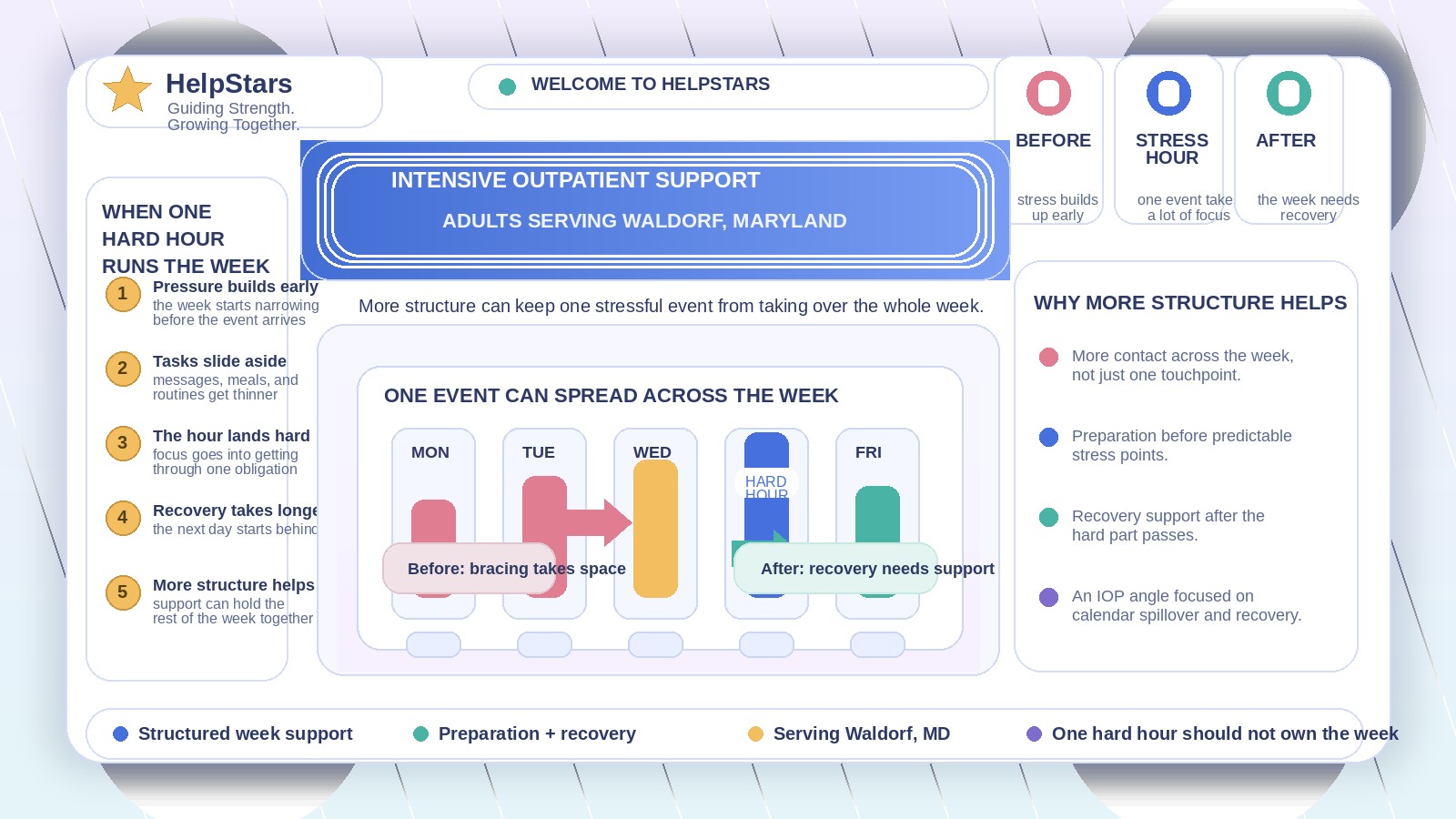
Adults do not always struggle only during the stressful event itself. Often the strain begins before it arrives. The mind starts rehearsing the appointment, the body gets tighter, sleep becomes less restorative, and ordinary tasks begin competing with the emotional preparation required just to get through that one moment. By the time the appointment or conversation actually happens, a large part of the week has already been spent bracing for it.
Afterward, the reverse can happen. Relief does not always restore momentum. A person may feel emptied out, behind on practical tasks, and too mentally wrung out to restart the week in a clean way. What looked like a single problem on the calendar ends up reshaping the entire week.
What This Pattern Can Look Like in Real Life
It may sound like:
- “I lose two days just thinking about the appointment.”
- “Once it is over, I still cannot get the rest of the week back.”
- “One hard conversation knocks out everything around it.”
- “I am not refusing responsibilities. I just do not recover from them quickly enough.”
- “My calendar is not that full, but one heavy thing makes the whole week feel full.”
This can be confusing because the person may still look functional from the outside. They may attend the appointment, answer some messages, or show up for work in pieces. But internally, the week keeps shrinking around stress instead of opening back up after it passes.
Why Weekly Support Can Feel Too Far Apart
When stress clusters around one hard part of the week, a single appointment may not provide enough contact to hold the rest together. Insight gained on one day may be hard to carry into the days before a stressful obligation, and even harder to reactivate in the drained period after it. The person may understand what helps in theory but still lose traction inside the actual timing of the week.
That is where a more structured outpatient approach can matter. Intensive outpatient support is not only about symptom severity. It can also be about how much reinforcement, repetition, and recovery structure a person needs between the moments that keep destabilizing them.
A Waldorf Example: The Whole Week Starts Orbiting One Stress Point
Imagine an adult serving Waldorf, Maryland and nearby Charles County communities who has one standing stress point every week: maybe a difficult family check-in, a court-related requirement, an emotionally loaded treatment visit, or a meeting connected to work or housing. The event itself may last only an hour. But by Monday, the person is already anticipating it. By Tuesday, concentration is thinner. By Wednesday, basic tasks feel heavier. By the time the appointment arrives, most of the week’s usable energy has already been spent.
Then the recovery lag begins. After the event, the person may need a long reset. Errands slide. Messages pile up. House tasks wait. The next day starts with guilt and mental fatigue instead of renewed capacity. In that kind of cycle, the hardest part of the week is not the hour on the calendar. It is the way the calendar never fully recovers around it.
How Intensive Outpatient Support Can Help
Intensive outpatient support may help adults who need more than occasional insight and less than inpatient care. The value often comes from having a stronger structure around the points where the week usually tightens, tips, or stalls.
Depending on the person’s needs and the program structure, support may help with:
- building more frequent therapeutic contact across the week,
- preparing for predictable stress points before they drain multiple days,
- recovering more quickly after emotionally heavy obligations,
- turning coping tools into repeatable routines rather than good intentions,
- reducing the all-or-nothing feeling that one event ruins the rest of the week, and
- creating more continuity between insight, follow-through, and recovery.
The goal is not to make every hard appointment feel easy. The goal is to keep one hard appointment from running the whole week.
Three Questions That Can Clarify Whether More Structure Is Needed
- How many days does one stressful event affect? If the impact spreads far beyond the event itself, the support level may need to change.
- What gets pushed aside every time? Meals, sleep, errands, messages, work tasks, and home routines often reveal the real cost of the cycle.
- How quickly can the week restart afterward? If recovery takes too long each time, more structured outpatient support may be worth discussing.
Why This Is About Function, Not Just Endurance
Many adults try to solve this pattern by pushing harder. They tell themselves to stop overthinking, stop dreading the appointment, or bounce back faster afterward. But endurance is not the same thing as stability. A person can force themselves through the visible obligation and still lose too much of the week on either side of it.
That matters because treatment should be measured partly by function. Can the person keep enough energy for work, relationships, self-care, and home responsibilities before and after the stress point? Can they recover in time to stay engaged with the rest of life? If not, the question may no longer be whether they are trying hard enough. The question may be whether the week needs more structure than it currently has.
Questions Adults Often Ask
Do I need to be in obvious crisis for intensive outpatient support to matter?
No. Some adults explore intensive outpatient care because the current support level is too thin for the week they are actually living, even if they are still functioning in some areas.
What if I can usually get through the stressful appointment itself?
That still leaves the question of what it costs you before and after. If one event consistently drains several days, that pattern is worth taking seriously.
Can this kind of support help with recovery after predictable weekly stress?
Yes. A more structured outpatient format can help strengthen both preparation and recovery when the same part of the week keeps creating instability.
Is the problem just that I need better discipline?
Not necessarily. When the same calendar pressure keeps shrinking the week despite real effort, the issue may be support structure rather than willpower.
Relief Can Start When the Week Stops Revolving Around One Hard Thing
Adults do not always need a bigger emergency before they deserve a stronger support plan. Sometimes they need help because one repeating stress point keeps taking more of the week than it should. Naming that pattern can be the first step toward a more usable treatment structure.
HelpStars LLC serves adults and families across Southern Maryland with compassionate behavioral health care. For adults seeking intensive outpatient support serving Waldorf, Maryland, a more structured level of care may help the week feel less controlled by one hard obligation and more recoverable from start to finish.