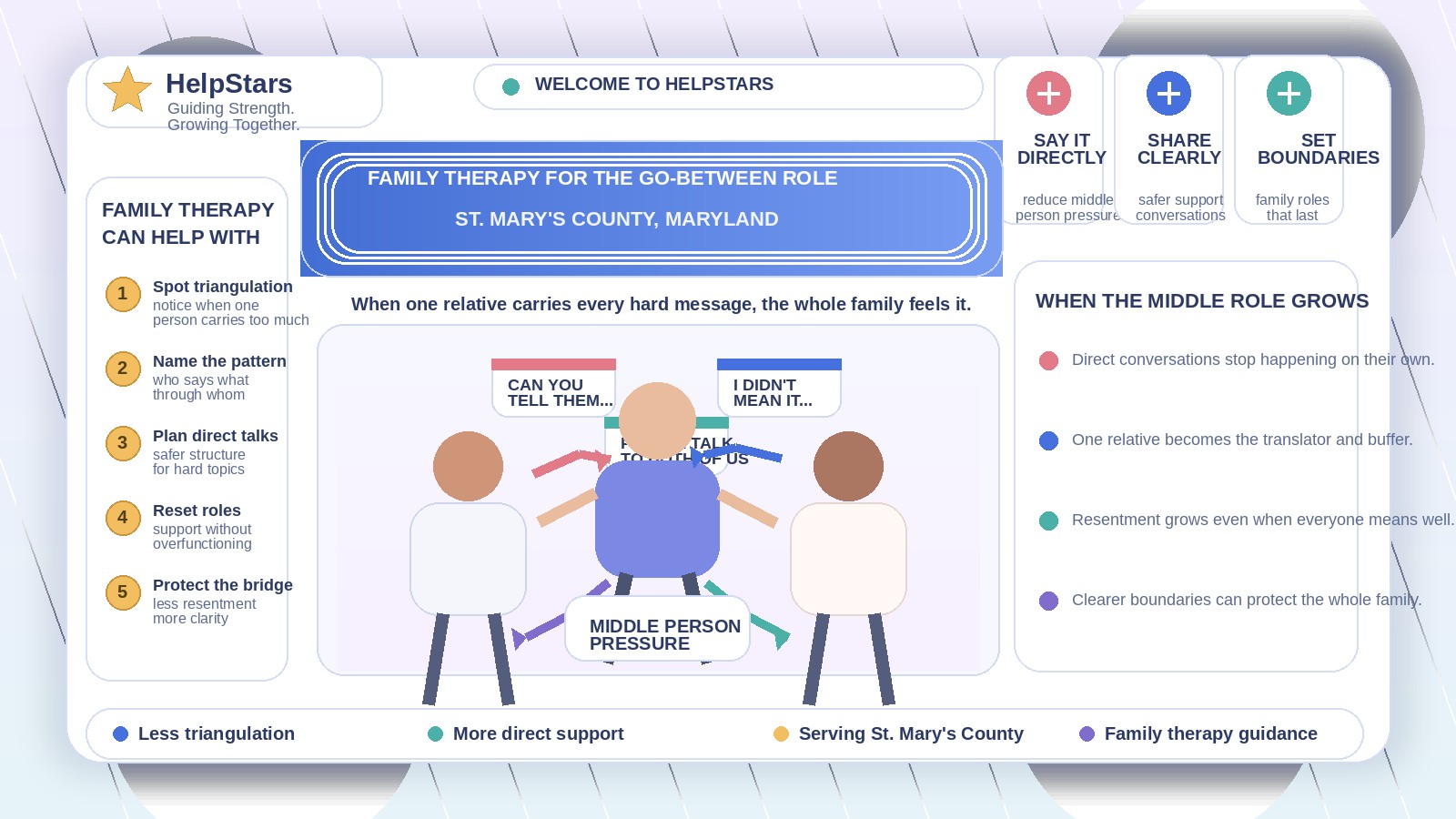
When One Family Member Becomes the Go-Between for Everyone Else: Family Therapy for Adults in St. Mary’s County, Maryland
Some families are talking all the time and still not talking to each other directly. One person becomes the translator, the peacemaker, the reminder system, and the emotional buffer all at once. They carry updates from one room to another, soften the wording before it lands, explain what someone “really meant,” and try to prevent every conversation from turning into a blowup. From the outside, that person can look like the family member who is holding everything together. On the inside, they are often getting worn down by a role they never meant to take on full-time.
For adults and families in St. Mary’s County, Maryland, family therapy can help when one relative keeps getting pulled into the middle of everyone else’s stress. The problem is not only conflict. It is the pattern where direct communication has broken down so much that one person becomes the route every hard conversation has to travel through first.
HelpStars LLC supports adults and families across Southern Maryland with compassionate behavioral health services. When one family member keeps carrying the emotional traffic for everyone else, family therapy may help create a steadier and more direct way to communicate.
Being the Go-Between Can Look Helpful While Quietly Becoming Too Much
Families often lean on the person who seems calmest, most available, or least likely to make things worse. That person may be the adult daughter who relays concerns between a parent and sibling, the partner who rephrases every disagreement before it explodes, or the relative who gets asked to “just talk to them for me” whenever tension rises. At first, it may feel practical. Over time, it can become exhausting.
That role may sound like:
- “Can you tell them I was not trying to start something?”
- “You explain it better than I do.”
- “If I say it directly, they will take it the wrong way.”
- “I am tired of being the middle person every time something is tense.”
- “Now both sides are upset with me, and I did not even start the issue.”
The more often this happens, the more the family starts depending on an arrangement that may feel easier in the moment but less healthy over time. Important concerns stop moving directly between the people who actually need to work them through.
Why Families Drift Into This Pattern
Most families do not choose a go-between because they want less honesty. They usually do it because direct conversations have started to feel risky. Someone may be quick to shut down. Someone else may raise concerns too sharply. Old arguments may make even simple questions feel loaded. A relative who seems more emotionally steady can start getting used as the safer channel.
That can happen when a family is already carrying mental health stress, caregiving pressure, grief, mood changes, treatment questions, transportation demands, financial strain, or uneven expectations about who should be helping with what. Instead of repairing the communication pattern itself, the family works around it by sending everything through one person.
The workaround may reduce tension for a day, but it often creates new problems. The go-between becomes overresponsible. Messages get filtered or softened. Frustration builds because no one feels fully understood. The family begins reacting not only to the original issue, but to the way the message was delivered, delayed, or interpreted in the middle.
What Family Therapy Can Help Change
Family therapy is not only for households with constant yelling or major estrangement. It can also help families who are trying hard to stay connected but have fallen into roles that are no longer sustainable. When one person has become the communication bridge, therapy can help the family examine both the role and the reasons it became necessary.
Depending on the situation, therapy may help with:
- noticing when a family member is being asked to carry too much emotional translation,
- separating support from overfunctioning,
- building safer ways for concerns to be said directly instead of passed through a third person,
- clarifying what belongs between two people and what truly needs wider family discussion,
- reducing resentment in the family member who has been stuck in the middle, and
- creating clearer boundaries so one person is not expected to manage everyone else’s reactions.
The goal is not to make every conversation easy. The goal is to stop one person from becoming the family’s unofficial emotional switchboard.
A St. Mary’s County Example: Every Concern Started With the Same Relative
Imagine an adult in Leonardtown, Lexington Park, California, Great Mills, Hollywood, or another St. Mary’s County community who keeps getting pulled between family members whenever stress rises. A parent wants help bringing up medication concerns. A sibling wants someone else to explain why they sounded frustrated. A loved one who is already overwhelmed does not respond well to direct questions, so everyone starts asking the same relative to “check in” first.
At first, that relative wants to help. They care about the family and do not want small issues to become bigger ones. But after a while, they start dreading their phone buzzing. Every message feels like the opening move in someone else’s difficult conversation. They are expected to understand both sides, say everything gently, and somehow keep anyone from feeling blamed.
Nothing about that role is neutral for long. The go-between may start feeling guilty for saying too much, guilty for saying too little, and frustrated that they are carrying responsibility for conversations that were never truly theirs. In therapy, the focus can shift from “Why can’t this one person keep smoothing things over?” to more useful questions: What makes direct conversation feel unsafe right now? What boundaries are missing? Which concerns need to be said face-to-face, and how can the family do that with less escalation?
Four Signs the Go-Between Role Is Hurting More Than Helping
- One person is being contacted first about nearly every conflict. The family stops attempting direct conversation unless the middle person approves or delivers it.
- The middle person feels responsible for everyone’s emotional outcome. They start believing it is their job to prevent disappointment, anger, shutdown, or misunderstandings for multiple adults at once.
- Resentment is building in the person who keeps translating. Even a caring family member can start feeling used, trapped, or blamed.
- Direct relationships are getting weaker instead of stronger. The family may look calmer on the surface while the real communication problem quietly grows underneath.
These signs do not mean the family does not love each other. They often mean the current coping pattern is buying short-term relief at too high a long-term cost.
Support Does Not Have To Mean Carrying Every Message
Some adults worry that stepping out of the middle means abandoning the people they care about. In reality, boundaries can be part of healthy support. A family member can still care deeply without becoming the courier for every worry, complaint, apology, or treatment concern. Therapy can help families learn the difference between being helpful and becoming overburdened.
That may involve new language such as:
- asking whether a concern can be said directly before passing it through someone else,
- planning a calmer time for a conversation instead of using the middle person as a pressure-release valve,
- making room for one relative to support without owning the whole outcome, and
- recognizing when a three-way discussion is more appropriate than private side messages.
These changes can feel awkward at first, especially if the go-between role has existed for a long time. But they can reduce confusion, resentment, and emotional overload for everyone involved.
Why This Pattern Matters in Daily Life
When one family member keeps functioning as the communication bridge, the strain shows up outside the family conversation too. That person may lose focus at work, avoid their phone, feel tension before family gatherings, or start resenting the very people they are trying to help. The relatives on either side may also stay stuck because they never build confidence in speaking more directly and more responsibly.
For adults and families in St. Mary’s County, that stress can spill into routines already shaped by appointments, caregiving, commuting, household tasks, and mental health treatment. A communication pattern that looked manageable in one moment can start affecting the whole week.
Questions Families Often Ask
Is it always unhealthy for one family member to help explain things?
No. Occasional support is different from becoming the permanent channel for nearly every difficult conversation. The concern is the repeated pattern, not one thoughtful assist.
What if direct conversations usually go badly?
That is often exactly why family therapy can help. The goal is to build safer structure around those conversations instead of depending forever on a middle person to absorb the impact.
Can the go-between still stay involved while boundaries improve?
Yes. The person does not have to disappear from family support. Therapy can help clarify when their presence is useful and when the responsibility being placed on them has become too heavy.
Does this only apply to families in crisis?
No. Many families seek help because they can feel an unhealthy role hardening before the situation becomes more damaging.
A More Direct Family Pattern Can Be Built
When one person keeps carrying everyone else’s messages, the family may start treating that burden as normal. It does not have to stay that way. A healthier pattern is possible, one where support does not require one relative to absorb every hard conversation before it reaches its real destination.
HelpStars LLC serves adults and families across Southern Maryland with compassionate behavioral health services. For adults and loved ones in St. Mary’s County, Maryland who feel stuck in a go-between role, family therapy may help create clearer boundaries, calmer conversations, and more direct support.