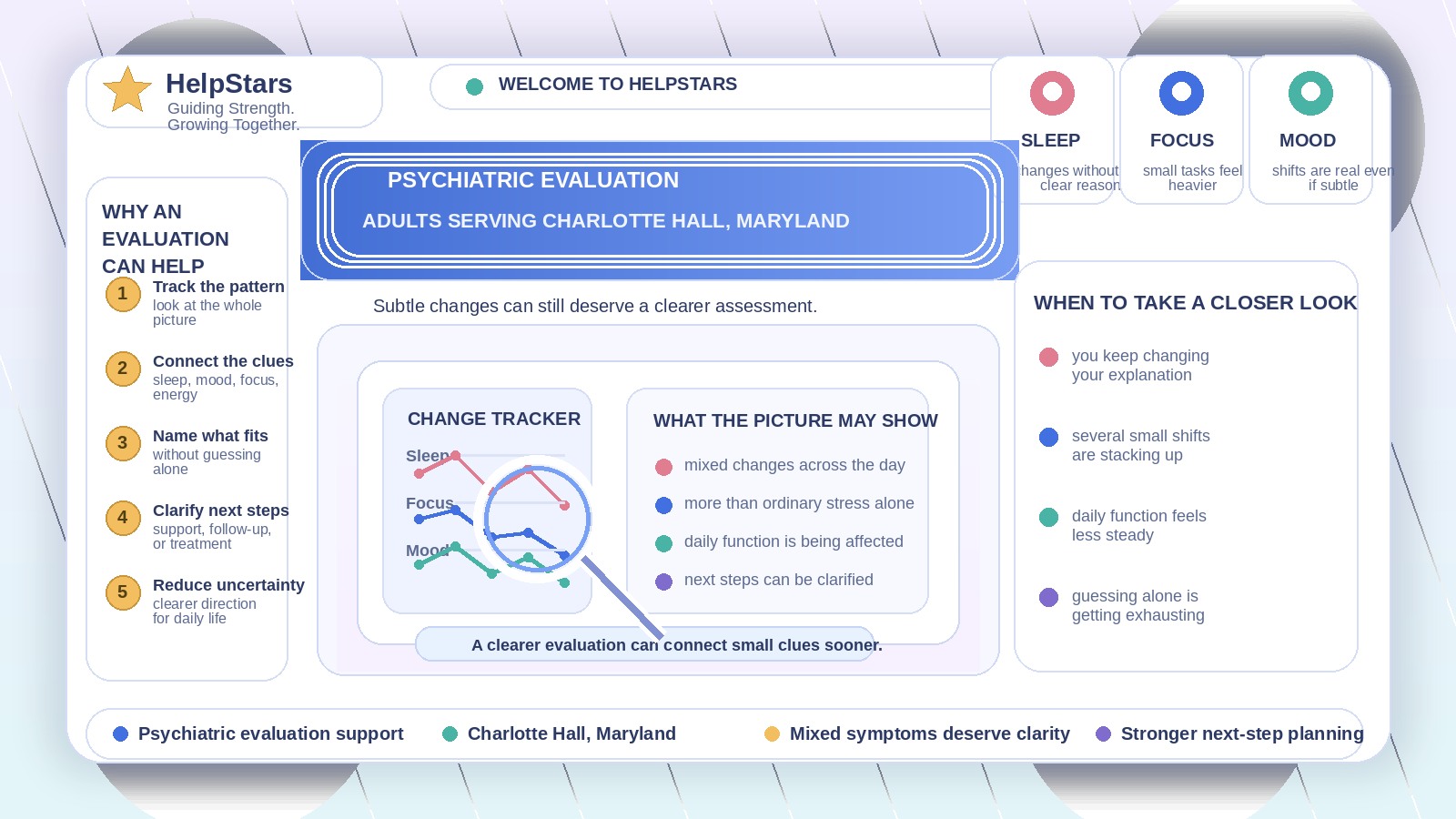
When Nothing Feels Dramatic Enough To Explain, but Daily Life Keeps Sliding: Psychiatric Evaluation for Adults Serving Charlotte Hall, Maryland
Some adults do not seek a psychiatric evaluation because they assume their situation is too unclear, too inconsistent, or not serious enough to describe well. They are not in one obvious crisis. They are just noticing that daily life is getting harder to carry. Sleep may be less reliable. Focus may break down faster. Motivation may swing more than it used to. Small tasks may take more effort, and conversations that should feel manageable may start feeling strangely heavy.
For adults seeking a psychiatric evaluation serving Charlotte Hall, Maryland, that pattern can be confusing. The problem is not always one dramatic symptom. Sometimes it is several smaller changes happening at the same time, with no single part seeming big enough to justify concern by itself. Taken together, though, those changes can begin to affect work, relationships, follow-through, and emotional steadiness in very real ways.
HelpStars LLC supports adults across Southern Maryland with practical behavioral health services, including psychiatric evaluation and related mental health care. When life keeps feeling slightly harder to manage but the picture still seems hard to name, a psychiatric evaluation may help organize what is happening and clarify a more useful next step.
Not Every Mental Health Struggle Arrives as One Clear Problem
People often imagine they should wait for a fully recognizable issue before asking for an evaluation. They think they should be able to say, with certainty, that this is anxiety, or depression, or panic, or a medication problem, or trauma-related stress, or a mood issue. Real life is often less tidy than that.
An adult may feel more irritable without knowing why. They may start forgetting ordinary things, pulling away from people, overthinking simple decisions, or feeling emotionally worn out by tasks they used to handle more easily. None of that may look dramatic from the outside. It can still be meaningful.
When those shifts overlap, the real question is not whether the person can diagnose themselves correctly. The question is whether the pattern deserves clearer assessment before it keeps spreading into more parts of life.
What This Kind of Unclear Strain Can Look Like Day to Day
A person may notice that:
- their sleep is off, but not in exactly the same way every night,
- their concentration drops at moments that used to feel routine,
- their patience is shorter even when nothing major happened that day,
- they keep changing their mind about whether they are doing okay,
- ordinary planning now feels more mentally expensive, or
- they feel “not like themselves,” but cannot reduce that feeling to one clean explanation.
These experiences can be easy to minimize. A person may tell themselves they are only tired, only stressed, only distracted, or only going through a rough stretch. Sometimes that is true. Sometimes the overlap of symptoms is exactly why a fuller evaluation is useful.
Why Adults Often Delay a Psychiatric Evaluation
Many adults postpone evaluation because they are waiting for more certainty. They want clearer evidence before they ask for help. They worry that if they cannot explain the problem neatly, the appointment will not be useful. Some are also concerned that what they are feeling will sound too minor compared to someone else’s crisis.
But psychiatric evaluation is not only for obvious emergency situations. It can also help when the picture is mixed, subtle, or hard to sort out alone. A confusing pattern is still a pattern. The earlier it is taken seriously, the easier it may be to understand what is contributing to it.
A Charlotte Hall Example: Several Small Changes, No Single Headline
Imagine an adult serving Charlotte Hall, Maryland and nearby Southern Maryland communities who has been feeling off for weeks. They are still functioning in a basic sense. They get through work most days. They answer some texts. They handle home tasks in pieces. But the rhythm feels different now.
They are more mentally tired by midday. Small decisions take longer. They lose track of details more often. Family members may notice they seem more withdrawn or more reactive, but the adult themselves is not sure how to summarize what changed. Nothing feels dramatic enough to lead with, so they keep postponing the idea of an evaluation.
That is where psychiatric evaluation can help. The appointment is not only for naming a diagnosis. It can help pull together several smaller clues that may make more sense once they are looked at as one connected picture instead of isolated annoyances.
How a Psychiatric Evaluation Can Help When the Picture Feels Mixed
Psychiatric evaluation can provide a more structured look at mood, anxiety, attention, daily functioning, recent changes, and the broader context affecting mental health. That can be useful when a person is unsure whether they are dealing with one issue, several overlapping issues, or a pattern that has gradually intensified without one obvious turning point.
Depending on the situation, an evaluation may help with:
- clarifying whether current symptoms point toward a recognizable pattern of concern,
- separating emotional strain from assumptions the person has been making about themselves,
- understanding how sleep, stress, mood, concentration, and energy may be interacting,
- identifying whether further treatment, counseling, medication discussion, or follow-up support may be appropriate,
- giving the person better language for what has been feeling difficult, and
- reducing the uncertainty that can grow when people keep guessing on their own.
The goal is not to force one fast label onto a complicated experience. The goal is to understand the experience more accurately so decisions can be made from a clearer starting point.
Four Signs It May Be Time To Stop Guessing Alone
- Several parts of life feel a little harder at the same time. The problem is not isolated to one setting or one bad day.
- You keep changing your own explanation. One day it feels like stress, another day it feels like burnout, then anxiety, then lack of motivation, then “nothing at all.”
- People around you are noticing a shift even when you struggle to name it. Outside perspective can sometimes confirm that the pattern is real.
- The uncertainty itself is becoming exhausting. When a person spends too much energy trying to figure out what is wrong without enough clarity, that effort becomes part of the burden.
Why This Matters in Everyday Functioning
Adults do not need a dramatic collapse before assessment becomes worthwhile. Small but persistent changes can interfere with basic life in meaningful ways. They can affect how a person sleeps, communicates, plans the week, responds under pressure, manages household tasks, follows through on responsibilities, or feels present with other people.
That is one reason evaluation matters. It is not only about symptom naming. It is also about function. If life feels increasingly harder to organize, tolerate, or move through, that deserves attention even if the person cannot point to one headline problem.
Why Local Access Matters for Adults Serving Charlotte Hall
Adults serving Charlotte Hall, Mechanicsville, Waldorf, La Plata, Leonardtown, and nearby Southern Maryland communities often balance work demands, transportation time, family responsibilities, health appointments, and financial pressure all at once. Mental health strain can disappear into that pace for longer than it should, especially when no single symptom feels dramatic enough to justify stopping everything for help.
That is part of why a psychiatric evaluation serving Charlotte Hall, Maryland can be meaningful. A clear assessment may help adults understand whether the pattern they have been minimizing is actually something that deserves more structured care and follow-up.
Questions Adults Often Ask
Do I need a psychiatric evaluation only if something feels severe or urgent?
No. Evaluations can also be helpful when symptoms feel subtle, mixed, or difficult to explain but are still affecting daily life.
What if I am not sure whether what I am feeling is “serious enough”?
That uncertainty is one of the reasons an evaluation can help. The appointment may provide more structure around concerns that feel too blurred to sort out alone.
Can an evaluation help if I do not have one obvious symptom to point to?
Yes. Many adults seek assessment because the issue is the overall pattern rather than one isolated symptom.
What if I keep telling myself it is probably just stress?
Stress may be part of the picture, but if the pattern keeps affecting sleep, mood, concentration, or functioning, it may be worth a fuller look instead of continued guessing.
Clearer Understanding Can Start Before Things Feel Extreme
When nothing feels dramatic enough to explain, adults often keep carrying the uncertainty far longer than they should. But unclear does not mean unimportant. A pattern does not need to become extreme before it deserves attention.
HelpStars LLC supports adults across Southern Maryland with practical behavioral health services, including psychiatric evaluation. For adults seeking a psychiatric evaluation serving Charlotte Hall, Maryland, a clearer assessment may help turn a vague sense that life is sliding into a more understandable and more manageable next step.