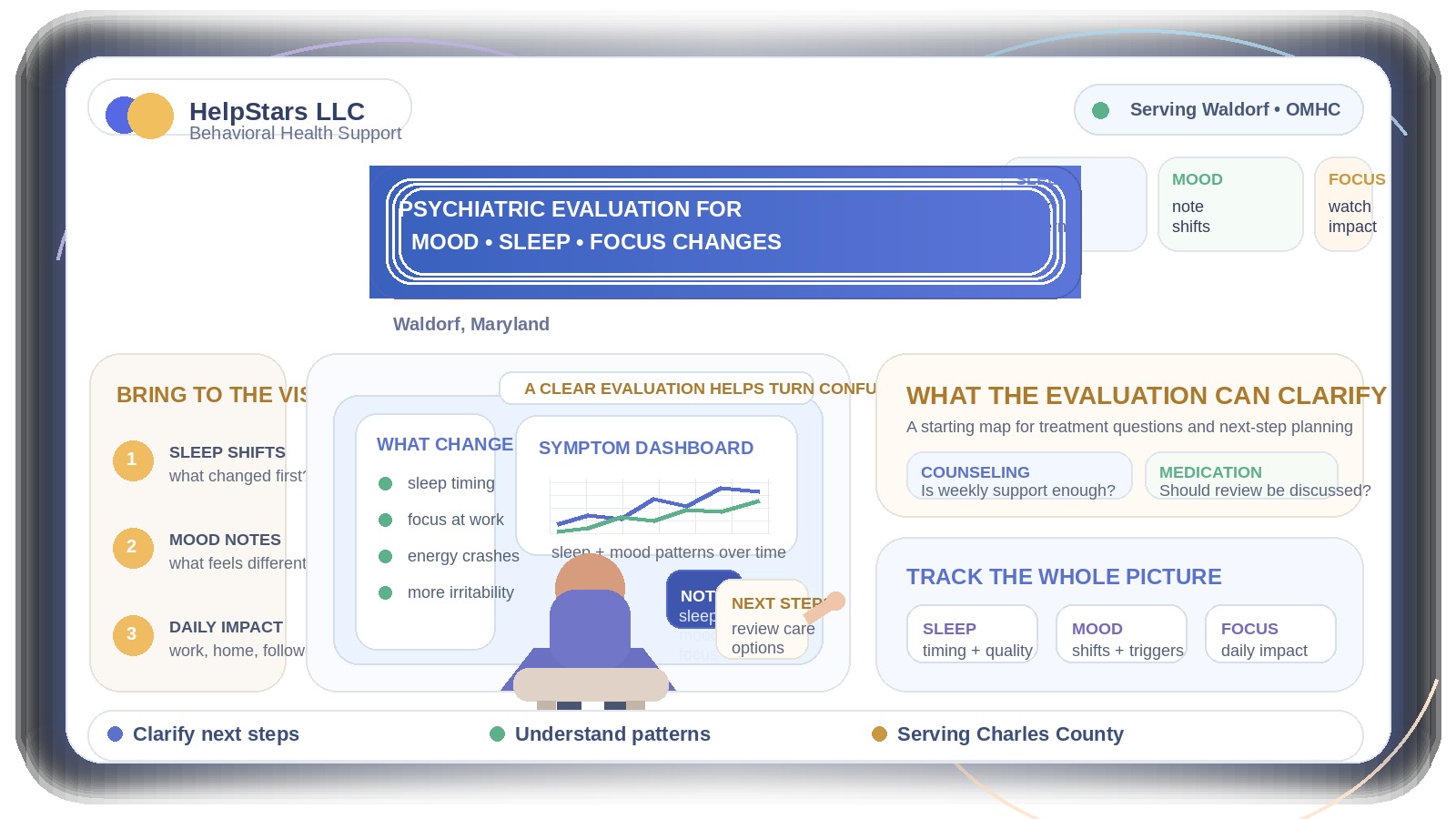
When Mood, Sleep, and Focus Stop Lining Up: Seeking a Psychiatric Evaluation Serving Waldorf, Maryland
Sometimes the hardest part is not admitting that something feels off. It is trying to explain what feels off. A person may say they are tired, but the problem is bigger than tired. They may call it stress, but the stress seems to be changing sleep, patience, concentration, and motivation all at once. Work starts taking longer. Small decisions feel strangely heavy. Family members notice irritability, shutdown, or sudden swings between pushing hard and pulling away. The person knows something has shifted, but they do not know whether they need therapy, medication support, a higher level of care, or simply a clearer understanding of what is happening.
For adults in Waldorf, Maryland and nearby Charles County communities, a psychiatric evaluation can be a useful starting point when symptoms no longer fit into one simple explanation. A thorough evaluation is not only about diagnosis. It is also about organizing the story: what has been changing, how long it has been happening, what is affecting daily life, and what kind of support may make the most sense next.
HelpStars LLC serves adults and families across Southern Maryland with compassionate behavioral health support. When mood, sleep, attention, anxiety, or daily functioning stop feeling predictable, an outpatient mental health evaluation may be a practical and clarifying next step.
The Real Problem Is Often the Pattern, Not One Bad Day
Many adults wait to seek support because each individual symptom can be explained away on its own. Trouble sleeping can be blamed on a rough week. Irritability can be blamed on work pressure. Brain fog can be blamed on being busy. Pulling back from people can be blamed on needing space. What often gets missed is the way these issues start stacking together.
A psychiatric evaluation can help when the concern sounds more like this:
- sleep is changing and daytime energy is changing with it,
- focus is worse, but anxiety or low mood may also be involved,
- motivation is dropping, yet the mind still feels restless or overactive,
- emotions are becoming harder to regulate across work, home, and relationships,
- stress reactions are lasting longer than they used to, or
- loved ones keep noticing a change even when the person is trying to push through it quietly.
That bigger pattern matters because treatment planning is more useful when it is based on how symptoms connect rather than on one isolated complaint.
What a Psychiatric Evaluation Can Actually Help Clarify
Some people hear the phrase psychiatric evaluation and imagine a rushed conversation or a label being applied too quickly. A thoughtful evaluation should feel more grounded than that. It can help identify how symptoms are affecting functioning and which kinds of care may fit best.
Depending on the situation, an evaluation may help clarify:
- whether the main pattern looks more connected to anxiety, depression, trauma-related stress, bipolar symptoms, emotional overload, or another mental health concern,
- how changes in sleep, concentration, appetite, energy, and motivation fit together,
- whether medication support should be discussed, monitored, adjusted, or ruled out,
- whether weekly outpatient counseling seems like the right starting point,
- whether more structured treatment may be worth asking about, or
- what additional history, follow-up, or coordinated support may be important before making next-step decisions.
For many adults, the biggest relief is not receiving a perfect answer in one sitting. It is leaving with a clearer map than they had before.
Five Details Worth Bringing to a First Appointment
A first evaluation often goes better when the person does not try to summarize everything as “I have been stressed.” Specific observations are usually more helpful than a polished explanation. Even a few notes on a phone can make the conversation easier.
- What has changed first? Was it sleep, mood, concentration, panic, irritability, shutdown, appetite, or follow-through?
- How is daily life being affected? Think about work tasks, driving, parenting, appointments, home routines, school demands, or social withdrawal.
- When is the pattern strongest? Morning, late evening, after conflict, before work, during overstimulating environments, or after several overloaded days in a row.
- What has already been tried? Counseling before, coping skills, schedule changes, previous medication, time off, support from family, or self-management strategies.
- What is starting to worry you most? Many people reveal the key issue here: “I am afraid I am slipping,” “I cannot focus the way I used to,” or “Everyone says I am different lately.”
These details give the clinician something more useful than a vague headline. They show how symptoms are actually behaving in real life.
The Next Step Is Not Always the Same for Everyone
One reason evaluations matter is that two adults can both say “I feel overwhelmed” and still need different types of support. One person may need outpatient counseling focused on anxiety and avoidance. Another may need a psychiatric provider to review mood instability, sleep changes, and medication questions. Someone else may need a more structured treatment plan because the week keeps unraveling between visits.
A psychiatric evaluation may help sort through questions such as:
- Would outpatient counseling alone likely match the current level of need?
- Does the person need psychiatric follow-up for medication management or diagnostic clarification?
- Would more structured services be worth discussing if functioning has dropped significantly?
- Are family concerns pointing to a pattern the person has normalized or minimized?
- Is the biggest issue symptom relief, treatment coordination, or figuring out where to begin at all?
That kind of sorting can prevent people from guessing their way through care when they already feel mentally overloaded.
Why Adults Often Delay This Step Longer Than They Mean To
Many adults in Waldorf and across Charles County do not avoid evaluation because they do not care about their mental health. They delay because uncertainty is tiring. They may worry they are overreacting. They may think they should wait until things become more obvious. They may keep functioning just well enough to postpone the conversation another month.
But confusion itself can be a reason to seek support. If a person keeps asking themselves whether they are anxious, depressed, burned out, emotionally flooded, scattered, or simply failing at basic routines, a good evaluation can turn that vague worry into something more concrete. It can also reduce the pressure to solve the whole puzzle alone before reaching out.
What Preparation Can Make the Visit More Useful
People do not need a perfect timeline or medical vocabulary to come in for an evaluation. Still, a little preparation can make the first conversation much more productive. Helpful preparation may include:
- writing down current concerns in plain language,
- noting recent changes in sleep, appetite, energy, focus, and mood,
- bringing a list of current medications and prior mental health treatment if available,
- thinking about what a better month would actually look like, and
- asking a trusted family member what changes they have noticed if that feels appropriate.
These simple steps can help the evaluation move beyond “I do not know, I just feel off” and into the specifics that make next-step planning more accurate.
Local Life in Charles County Often Shapes the Symptom Picture
Mental health symptoms do not happen in a vacuum. Adults in Waldorf, White Plains, La Plata, Bryans Road, Indian Head, and nearby Charles County communities are often trying to read their own symptoms while still managing commuting, parenting, caregiving, work pressure, household coordination, court or school responsibilities, and ordinary Southern Maryland logistics.
That local context matters. Sleep disruption feels different when someone still has a long drive in the morning. Mood instability can affect not only feelings but scheduling, family tension, and the ability to stay organized through the week. Concentration problems may show up as missed forms, delayed calls, or work tasks that now take twice as long. A useful outpatient mental health evaluation should take those real-life demands seriously instead of treating symptoms as abstract checkboxes.
A Clearer Starting Point Can Reduce Guesswork
The goal of a psychiatric evaluation is not to dramatize what someone is going through. It is to understand it more accurately. When mood, sleep, focus, and stress reactions stop lining up the way they used to, getting a clearer picture can make treatment decisions less random and more grounded.
HelpStars LLC supports adults and families across Southern Maryland with compassionate behavioral health services, including outpatient mental health support for people who need help understanding what has changed and what kind of care may fit next. For adults seeking a psychiatric evaluation serving Waldorf, Maryland, a thoughtful first appointment can be the point where confusion starts turning into a plan.