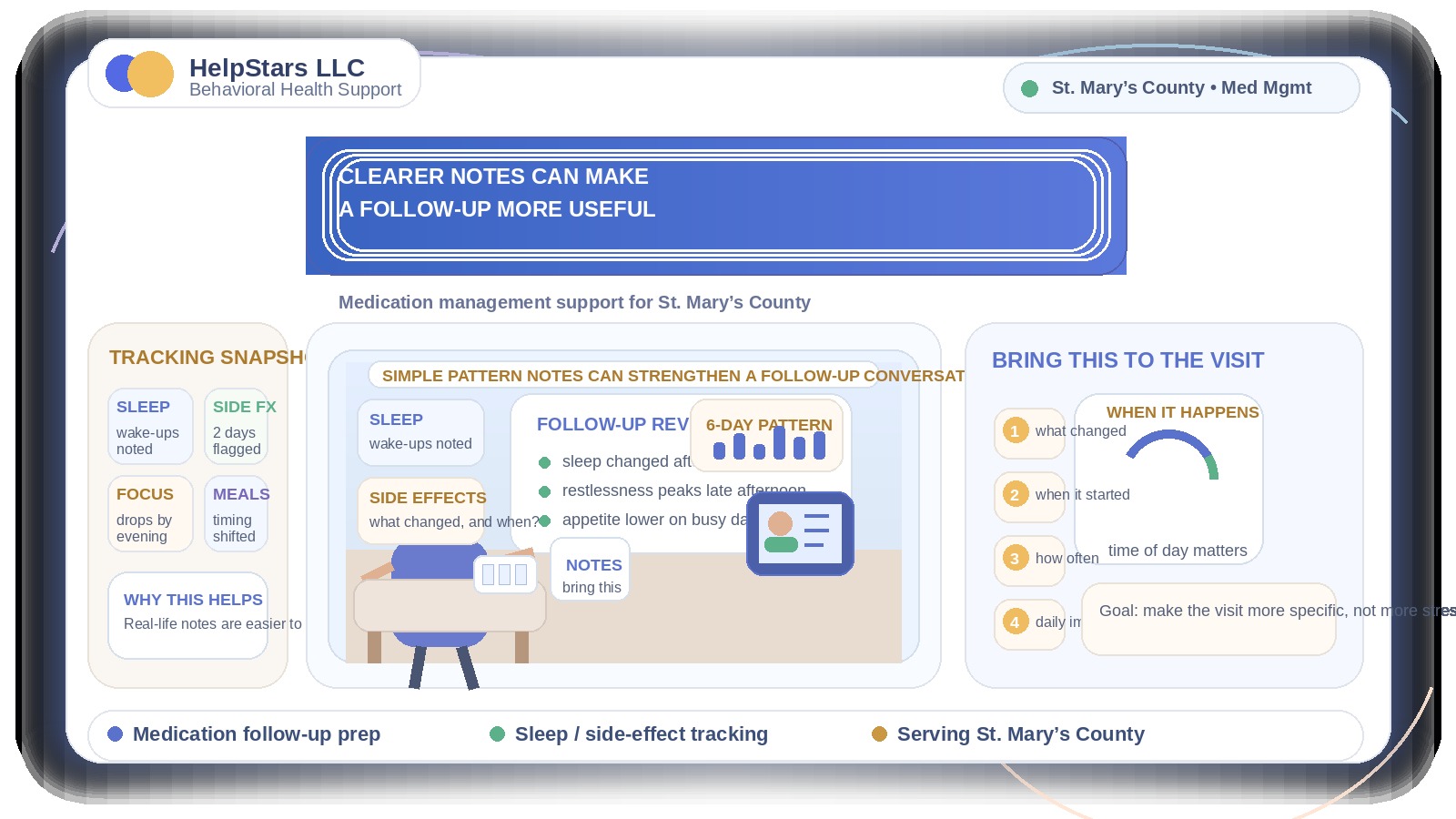
When It’s Hard to Explain What Changed: Medication Management Tips for Adults Preparing for a Follow-Up Appointment in St. Mary’s County, Maryland
By the time a follow-up appointment arrives, the last few weeks can feel blurry. You may remember that sleep changed, appetite felt different, focus dropped, or a side effect started bothering you, but the exact pattern is hard to explain once you are sitting in the room. Many adults do not need more motivation at that point. They need a clearer way to notice what has been happening between visits.
That is one reason medication management in St. Mary’s County, Maryland can work better when the appointment is supported by a simple tracking routine. A mental health follow-up is often more useful when a person can describe what changed, when it changed, and how those changes affected daily life instead of trying to reconstruct everything from memory in a rushed moment.
HelpStars LLC serves adults across Southern Maryland with compassionate behavioral health support. For adults preparing for a medication management appointment in St. Mary’s County, the goal is not to create perfect records. It is to bring enough real-world detail to make the conversation more practical, accurate, and useful.
Why Follow-Up Appointments Can Feel Vague Even When the Changes Are Real
Mental health patterns do not always change in dramatic ways. Sometimes the shift is subtle at first. Falling asleep takes longer. Energy is lower in the morning. Concentration fades in the afternoon. Appetite is less predictable. A person feels more restless, more flat, or more emotionally reactive, but only at certain times of day.
When those changes happen gradually, people often show up to the appointment knowing something is different without feeling confident about how to describe it. That can lead to updates like:
- “I think it’s helping, but I’m not totally sure.”
- “My sleep has been off, but I don’t know when it started.”
- “I feel different during the day than I do at night.”
- “I forgot to mention the side effect last time because it didn’t seem important yet.”
- “Some days are okay and some are not, but I can’t tell what the pattern is.”
That kind of uncertainty is common. It does not mean the person is doing anything wrong. It usually means the follow-up conversation would benefit from a better picture of life between appointments.
A Simple Tracking Method Can Make Medication Management More Useful
A follow-up does not require a complicated journal. In many cases, a basic note on a phone, calendar, or paper checklist is enough. What matters most is whether the information helps show patterns over time.
Useful things to track may include:
- sleep changes, including trouble falling asleep, waking during the night, or sleeping much more than usual,
- appetite shifts, such as eating less, craving more, nausea, or major changes in meal timing,
- energy and focus, especially if concentration, follow-through, or motivation changes during the day,
- mood patterns, including increased irritability, emotional flatness, sadness, tension, or mood swings,
- possible side effects, such as headaches, restlessness, dizziness, stomach upset, or feeling unusually slowed down, and
- daily functioning, like whether work, appointments, home tasks, parenting, or routines became easier, harder, or less predictable.
The goal is not to self-diagnose. It is to give the prescribing clinician a better description of what your actual week has looked like.
Four Questions to Answer Before the Appointment Starts
- What changed? Try to name the change in plain language. For example: “I am sleeping later,” “I feel more restless after lunch,” or “my motivation drops by evening.”
- When did it start? Even an estimate helps. “About ten days ago” is more useful than “a while back.”
- How often is it happening? Is it most days, once or twice a week, only on workdays, or mainly on weekends?
- What is it affecting? Think about whether it is changing attendance, parenting, chores, meals, driving, concentration, or emotional stability at home.
These questions can turn a vague concern into something much easier to discuss during the visit.
A St. Mary’s County Example: “I Know Something Feels Different, but I Can’t Describe It Well”
Imagine an adult in Lexington Park, California, Leonardtown, Great Mills, or Hollywood who has been trying to stay consistent with treatment. They are not in immediate crisis, but the past two weeks have felt off. Sleep has become uneven. Appetite is inconsistent. They feel more on edge in the late afternoon and less able to finish tasks at home. By the time the appointment arrives, though, they can only think of one or two examples.
Without notes, the conversation may stay too broad. The person may leave feeling like they forgot half of what they meant to mention. With a basic tracker, the same appointment can become much more specific. They may be able to say that the sleep change started after a routine shift, the restlessness happens more on weekdays, meals have been skipped three times this week, and focus has been worst on days with early appointments.
That level of detail does not guarantee a certain treatment decision. It does create a stronger starting point for a more informed discussion.
What to Bring to a Medication Management Follow-Up
Many adults find it helpful to bring a short list instead of trusting themselves to remember everything in the moment. That list might include:
- recent mood, sleep, appetite, or energy patterns,
- possible side effects and when they seem to happen,
- questions about timing, routine, or what changes should be reported,
- major life changes that may affect symptoms, such as work stress, caregiving demands, or schedule disruption,
- any problems with staying consistent, including missed doses or confusion about the routine, and
- specific examples of how daily functioning has improved or gotten harder.
If the person has trouble speaking up during appointments, it can also help to hand over the note or read from it directly.
What a Follow-Up Appointment Can and Cannot Do
A mental health medication management appointment can help review symptom patterns, side effects, routine concerns, and next-step questions. It can support better monitoring and more informed treatment decisions over time.
It should not be treated like a guessing game or a reason to make abrupt changes without guidance. Adults should avoid stopping, starting, doubling, or reducing prescribed psychiatric medication on their own unless the prescribing clinician instructs them to do so. If an urgent or emergency safety concern is happening, the person should seek immediate appropriate help instead of waiting for a routine follow-up visit.
Clear communication matters because the safest treatment planning usually depends on accurate information, not rushed assumptions.
How Family or Supporters Can Help Without Taking Over the Appointment
Some adults want help remembering patterns but do not want the appointment to become a conversation about them rather than with them. Support works best when it protects the person’s voice.
Loved ones may be helpful by:
- encouraging the person to keep simple notes between visits,
- helping identify changes in sleep, appetite, routine, or irritability if the person wants that input,
- writing down questions ahead of time instead of introducing them all at once under pressure, and
- supporting follow-through with the care plan after the appointment.
That approach keeps the focus on collaboration rather than control.
Why Local Routines Matter in St. Mary’s County
Adults across St. Mary’s County, Maryland are often balancing treatment with long commutes, parenting, work schedules, caregiving responsibilities, transportation coordination, and household demands spread across communities such as Lexington Park, California, Leonardtown, Great Mills, and Hollywood. Those daily factors can affect how symptoms show up and how manageable a medication routine feels in real life.
That is why medication management serving St. Mary’s County should be grounded in more than symptom labels alone. The most useful follow-up conversations usually connect treatment questions to the person’s actual week, actual schedule, and actual points of strain.
Questions Adults Often Ask About Medication Management Follow-Ups
Do I need to track every small detail between appointments?
No. A simple pattern log is usually enough. The point is to notice meaningful changes, not to create perfect records.
What if I am not sure whether something is a side effect or just stress?
It is still worth writing down. The follow-up appointment is a good place to describe the change, when it started, and how often it is happening.
Can medication management help if I am also in therapy?
Yes. Therapy and medication management often play different roles. Therapy may focus more on coping, patterns, and emotional processing, while medication follow-ups may focus more on symptom monitoring, side effects, and treatment-response questions.
What if I forgot important details at my last appointment?
That happens often. A brief note on your phone or calendar before the next visit can make the next conversation feel much more complete.
Better Details Can Lead to a Better Conversation
Adults do not need to become experts in psychiatric medication to prepare for a stronger follow-up. They usually just need a clearer way to notice what has been happening between appointments. When sleep, appetite, focus, side effects, or emotional shifts are tracked in a practical way, the appointment becomes easier to use well.
HelpStars LLC serves adults across Southern Maryland with compassionate behavioral health support, including services connected to ongoing mental health care. For adults preparing for medication management in St. Mary’s County, Maryland, bringing a clearer picture of the past few weeks may be one of the most useful steps toward a more productive appointment.