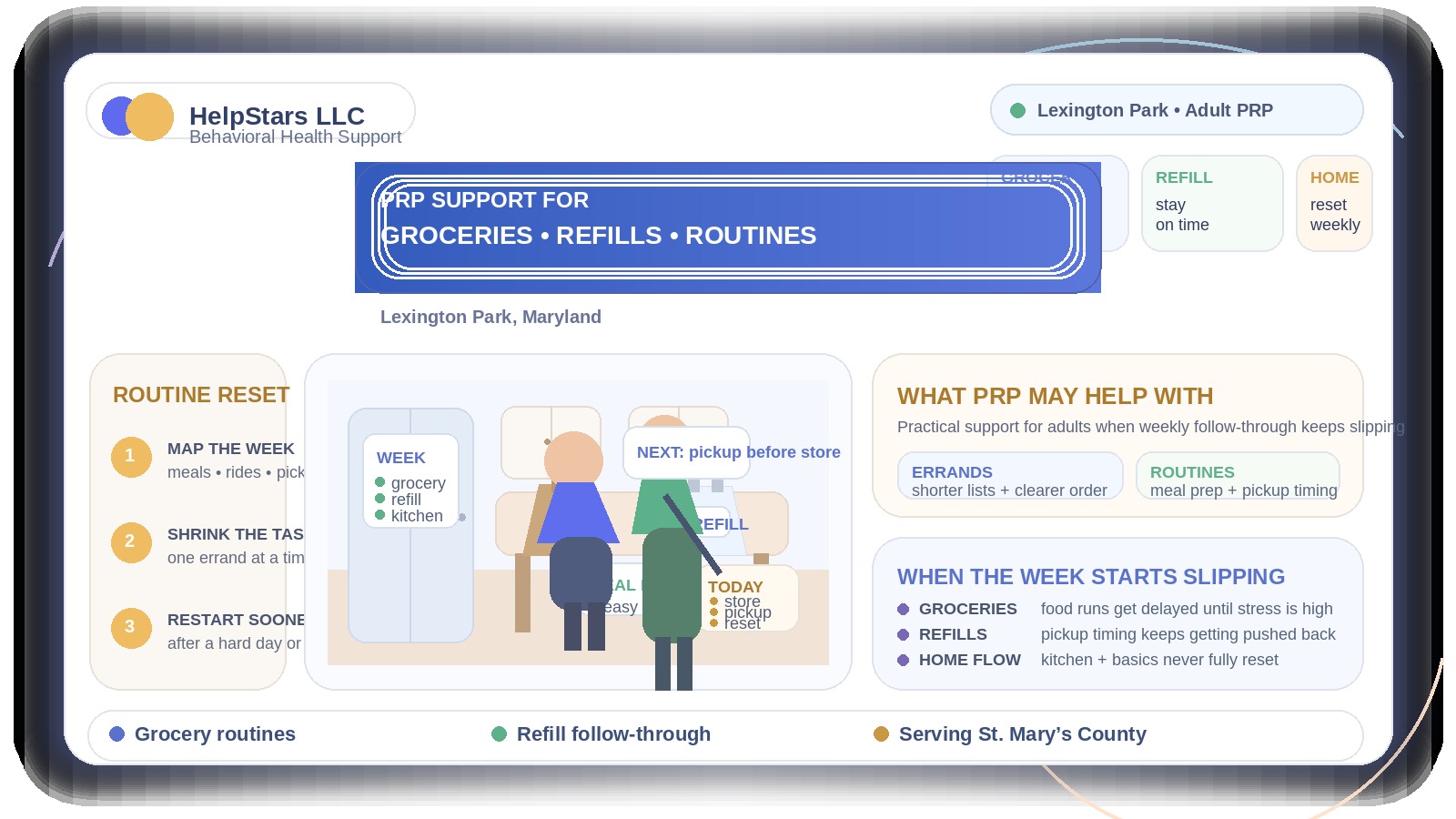
When Grocery Trips, Refills, and Home Routines Start Slipping: PRP Support for Adults in Lexington Park, Maryland
Sometimes the warning signs are sitting in plain sight. The refrigerator is mostly empty even though the week is only half over. A pharmacy pickup was supposed to happen two days ago. Mail is stacked on the counter beside a bus pass, a grocery list, and a reminder card for an appointment that already had to be rescheduled once. None of those problems may look dramatic by themselves. Together, they can show that daily life is becoming harder to hold together than it used to be.
For adults in Lexington Park, Maryland, PRP services can offer practical support when mental health symptoms begin disrupting follow-through with groceries, refills, meal planning, transportation, and home routines. A Psychiatric Rehabilitation Program (PRP) is not the same thing as traditional therapy. It focuses on helping adults build or rebuild the everyday systems that make community living more manageable.
HelpStars LLC provides compassionate behavioral health support for adults and families across Southern Maryland. When someone is trying to stay stable but keeps losing ground in the ordinary parts of the week, psychiatric rehabilitation may be worth exploring as a more practical layer of support.
What These Routine Breakdowns Can Actually Mean
People are often judged hardest in the areas that look simplest from the outside. Missing a grocery trip can be mistaken for laziness. Running out of basic supplies may get read as poor planning. Delayed refill pickups can look like someone is just not taking things seriously enough. In reality, these setbacks can be connected to depression, anxiety, trauma-related stress, bipolar disorder, thought disorganization, overwhelm, or the kind of emotional exhaustion that makes even a short errand feel bigger than it should.
When that happens, the problem usually is not a lack of caring. The problem is that the steps between intention and action have started breaking down. A person may know exactly what needs to happen and still struggle to organize the sequence, leave the house at the right time, tolerate the stress of the errand, keep track of details, or recover after one small disruption throws off the whole day.
Why PRP Is Different From Weekly Counseling Alone
Counseling can help people understand emotions, patterns, and coping strategies. PRP adds a more functional layer by focusing on how a person manages the daily structures around food, appointments, community tasks, routines, and independent living goals.
Depending on the person’s needs, PRP support may involve:
- breaking large routine problems into smaller action steps,
- building realistic systems for groceries, refills, and weekly planning,
- practicing ways to stay organized when motivation drops or anxiety rises,
- strengthening follow-through around community-based tasks,
- identifying what repeatedly interrupts progress, and
- creating more structure so one missed step does not become a lost week.
That distinction matters. Some adults do not need another abstract reminder to be more responsible. They need practical support that matches how hard basic tasks have become.
A Lexington Park Example: The Week Keeps Getting Away
Imagine an adult in Lexington Park who starts every Monday with good intentions. They plan to stop by the store, pick up refill items, answer two calls, and reset the kitchen for the week. Then the first rough morning happens. Energy drops. Anxiety goes up. One appointment runs late. The store feels too crowded. A small delay creates enough internal pressure that the rest of the list gets pushed to tomorrow.
Tomorrow becomes Thursday. By then, food options are thinner, the household feels more chaotic, and the person feels embarrassed that such ordinary tasks have gotten this off track. That embarrassment can make it even harder to ask for help. The week begins to feel like something that happens to the person instead of something they can shape.
PRP support may help by making the week visible again. Instead of relying on memory, energy, or last-minute motivation, a person may work on a step-by-step plan that accounts for the hardest points: getting out the door, handling overstimulation, remembering what comes first, recovering after interruptions, and regrouping before shame takes over.
What PRP Support Might Look Like in Real Life
Psychiatric rehabilitation is practical by design. For adults whose grocery trips, refills, and home routines keep slipping, support may focus on workable systems such as:
- Weekly food planning: creating a short, repeatable grocery list tied to actual meals and staples instead of an unrealistic full-house reset.
- Refill follow-through: keeping track of refill timing, pickup planning, reminders, and transportation steps so delays do not keep compounding.
- Task sequencing: deciding what must happen first, what can wait, and what usually gets dropped when the day becomes stressful.
- Home routine anchors: building a few steady checkpoints such as a kitchen reset, bag check, calendar review, or evening setup for the next morning.
- Recovery after interruptions: practicing how to restart the plan when one missed errand or hard day makes everything feel ruined.
The point is not perfection. The point is creating enough structure that basic needs do not keep sliding out of reach every time stress increases.
Small Community Tasks Can Carry a Big Emotional Load
Many adults underestimate how emotionally expensive routine errands can become when mental health symptoms are active. Grocery stores can be overstimulating. Pharmacy pickups can bring pressure about time, paperwork, or communication. Public transportation or ride coordination can make a short errand feel like a major production. Even meal planning can feel impossible when concentration is low and the kitchen already feels behind.
That is why PRP often works best when support is tied to the real task instead of only the theory of the task. It is one thing to say, “Stay organized.” It is another to help a person figure out why they repeatedly stall before leaving home, how to reduce decision fatigue in the store, or what routine needs to happen the night before so the next day goes better.
How Families Often Notice the Pattern First
Loved ones often recognize routine breakdown before the person experiencing it knows how to describe it. They may notice skipped meals, fewer groceries in the house, repeated last-minute store runs, increasing clutter, missed reminders, or a pattern of saying “I’ll do it tomorrow” when tomorrow rarely goes differently.
Family members may also see how quickly the situation can snowball. One difficult week can turn into late notices, higher stress, conflict at home, and more withdrawal. That does not mean the person lacks ability. It may mean they need more structured support around the tasks that are no longer staying manageable on their own.
Why This Local Context Matters in Lexington Park and St. Mary’s County
Routine support has to fit the places where people actually live. Adults in Lexington Park and nearby St. Mary’s County communities are managing real-life schedules that may include shared households, work hours, public benefits paperwork, medical appointments, community errands, and transportation planning across towns such as California, Great Mills, Leonardtown, and Hollywood.
That local context matters because stability is usually built through ordinary weekly movement: the store someone can realistically get to, the refill pickup they can manage on time, the home routine that works in their actual living space, and the schedule that fits the rest of their responsibilities. Support becomes more useful when it reflects that reality instead of assuming unlimited time, energy, or flexibility.
Signs It May Be Worth Asking About PRP Services
Adults and families may want to ask about psychiatric rehabilitation in Lexington Park, Maryland when someone is:
- repeatedly falling behind on groceries, meals, or household basics,
- having trouble following through with refill pickups or routine community tasks,
- feeling overwhelmed by errands that used to be manageable,
- losing track of the week whenever stress, low mood, or anxiety spikes,
- needing more practical structure between counseling or clinic visits, or
- experiencing increasing household tension because routines keep breaking down.
Seeking support does not mean a person has failed at independence. Often, it means they are trying to protect it before more pieces start slipping.
Questions People Commonly Ask
Is PRP only for people in crisis?
No. PRP can be useful before a situation becomes a full crisis. Many adults benefit when the main issue is that daily functioning is getting less reliable and basic community tasks are taking more out of them than they used to.
Does PRP replace therapy?
Not usually. PRP and therapy often support different parts of recovery. Therapy may focus more on emotions, processing, and coping patterns, while PRP can focus more on practical daily living structure and follow-through.
Can PRP help if the person knows what to do but cannot stay consistent?
Yes. That gap between knowing and consistently doing is one of the places psychiatric rehabilitation can be especially helpful. Support can focus on routines, sequencing, reminders, environmental setup, and realistic planning.
What if the problem seems too small to ask for help?
Routine problems may look small from the outside, but they often have a large effect on stress, health, confidence, and household stability. Getting help earlier can keep those smaller problems from becoming larger ones.
Steadier Weeks Usually Start With More Structure, Not More Shame
When groceries, refills, and home routines start slipping, people often respond by criticizing themselves harder. That rarely creates stability. What usually helps more is clearer structure, more realistic support, and a plan that meets the person where the breakdown is really happening.
HelpStars LLC serves adults and families across Southern Maryland with compassionate behavioral health support. For adults in Lexington Park and surrounding St. Mary’s County communities who are struggling to keep up with everyday routines, PRP services may offer a practical path toward steadier follow-through, greater confidence, and more manageable weeks.