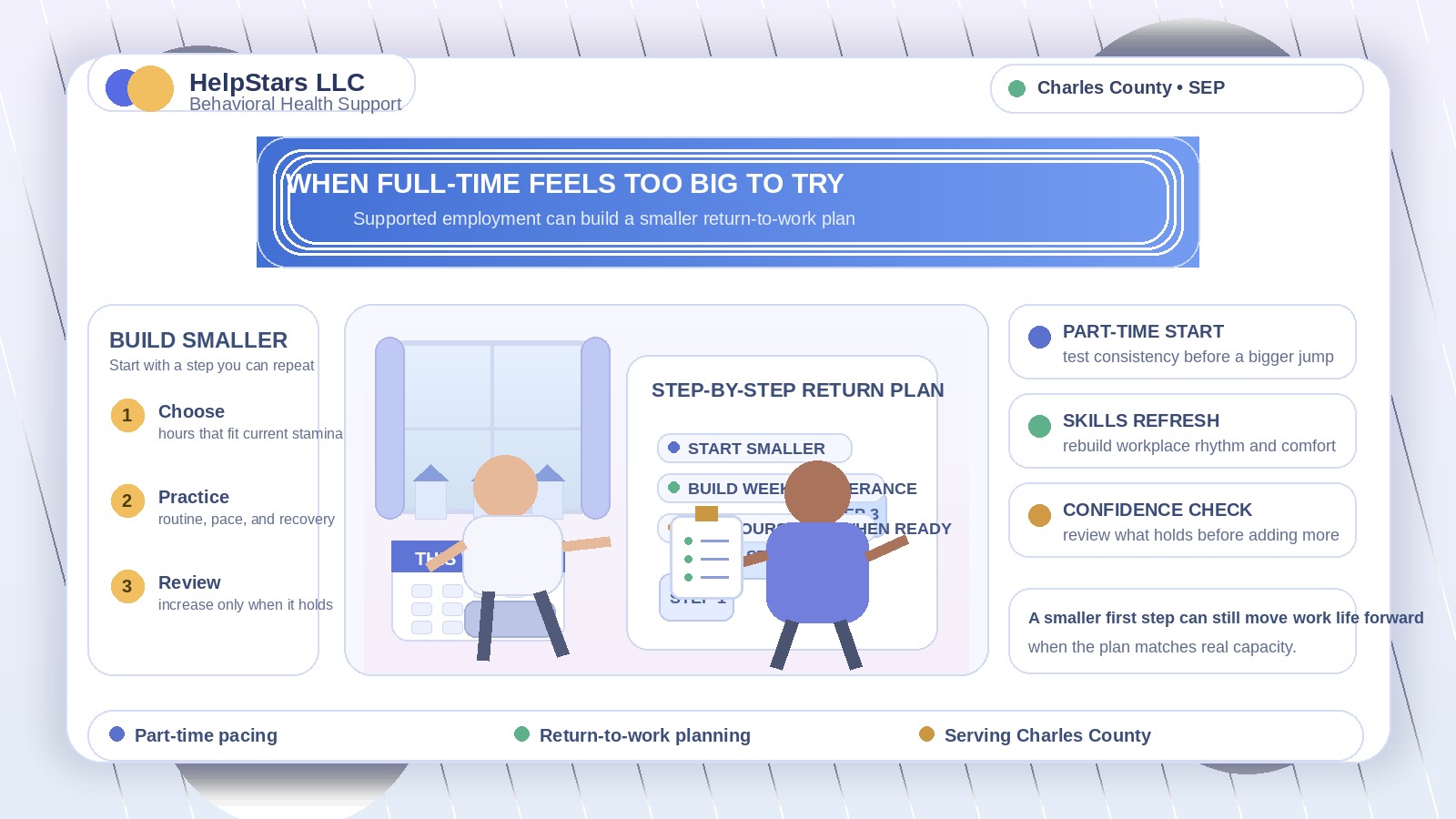
When Full-Time Feels Too Big to Try: How Supported Employment Can Help Adults Serving Charles County, Maryland Build a Smaller Return-to-Work Plan
Sometimes the barrier is not that work no longer matters to you. The barrier is that every option starts sounding too large. A full week. A long shift. A noisy workplace. A new routine that has to hold from day one. When the whole picture feels like too much, many adults stop at the starting line.
For adults serving Charles County, Maryland, supported employment can help make the return-to-work process feel smaller, clearer, and more workable. Instead of treating employment like one giant yes-or-no decision, the process can be broken into steps that match a person’s current stamina, confidence, and recovery needs.
HelpStars LLC supports adults and families across Southern Maryland with compassionate behavioral health services. When a person wants to work again but feels overwhelmed by how big the leap seems, a supported employment plan can help turn that pressure into a more realistic next step.
Why “Going Back to Work” Can Feel Too Vague To Act On
Many adults tell themselves they need to get back to work, but that phrase can hide several separate problems inside one sentence. A person may not only be worried about getting hired. They may also be worried about waking up on time every day, staying steady through a shift, managing transportation, handling social interaction, or recovering after work without crashing for the rest of the week.
When all of those concerns hit at once, the mind often treats work like an all-or-nothing risk. That can sound like:
- “If I cannot handle full-time, I should not try yet,”
- “If I start and fall behind, I will just prove I was not ready,”
- “If the schedule is too much, I will disappoint everyone,” or
- “I do want to work, but I cannot picture how to begin without overloading myself.”
That is one reason supported employment program Charles County searches often reflect more than job-hunting. They reflect the need for a return-to-work path that feels survivable, not just theoretically possible.
A Smaller Work Plan Can Still Be Real Progress
Some adults get stuck because they assume only one kind of success counts: going straight into a fully built schedule and holding it perfectly. In reality, many people need a more gradual work re-entry plan.
That smaller plan may involve:
- starting with fewer hours,
- testing a routine before increasing commitments,
- focusing on consistency before intensity,
- refreshing workplace confidence before pursuing a bigger role, or
- using early work experiences to learn what support helps daily functioning stay steadier.
None of those steps mean a person lacks ambition. They often mean the person is trying to build something that can last.
How Supported Employment Can Help Adults Find the Right Starting Point
Supported employment is not only about landing any job as fast as possible. It can also help adults figure out what kind of job entry point fits their current capacity.
Depending on the person’s needs, support may help with:
- sorting out whether the biggest barrier is confidence, schedule tolerance, concentration, pace, transportation, or fear of starting,
- comparing full-time, part-time, training-based, or step-up options more realistically,
- identifying what kind of work environment feels more manageable at first,
- creating a plan for mornings, follow-through, and recovery after shifts,
- setting progress goals that are measurable without being punishing, and
- adjusting the plan when early attempts reveal a better next step.
The goal is not to force a bigger leap than a person can hold. The goal is to create forward movement that respects both employment goals and mental health recovery.
Three Starting Paths That May Feel More Manageable Than “Jump Back In”
- A lighter-hour work start. Some adults do better when they first test reliability and stamina with a schedule that leaves room to recover and adjust.
- A skill-refresh phase. Others may benefit from rebuilding confidence around workplace communication, recent experience, routines, or expectations before aiming for a bigger commitment.
- A step-up plan. Some people need a structure that begins smaller but includes a clear review point for increasing hours or responsibility once the first stage becomes steadier.
What matters is not which option sounds most impressive. What matters is which option is most likely to help the person keep going instead of withdrawing after an overload.
A Charles County Example: Wanting Work Back Without Repeating the Same Crash Cycle
Imagine an adult serving Waldorf, La Plata, White Plains, or another part of Charles County who knows they do better when they have structure, income, and a reason to leave the house. They miss the stability that work once gave them. At the same time, the idea of returning at full speed feels impossible.
Maybe the last job ended during a period of worsening symptoms. Maybe the person has been out of work long enough that even simple routines feel less automatic. Maybe they can picture themselves working twenty hours before they can picture forty, but they feel embarrassed to say that out loud.
In supported employment, the work may begin by getting more specific. Is the real issue attention span? Social strain? Recovery after a shift? Fear of failing publicly? Trouble sustaining a morning routine five days in a row? Once the problem is clearer, the employment plan can become more practical. Instead of asking, “Am I ready for full-time work, yes or no?” the question becomes, “What first version of work is realistic enough to build from?”
Signs the Main Barrier May Be Pacing, Not Lack of Motivation
Adults are often harder on themselves than they need to be. A person may assume they are unmotivated when the real problem is that their current plan asks for too much at once.
That may be true when someone:
- wants the benefits of working again but shuts down when the schedule looks too large,
- can imagine doing the job tasks but not maintaining the pace around them,
- starts job searching, then stops when every posting feels like an all-day life change,
- does better with structure in theory but has trouble building it alone, or
- keeps waiting to feel fully confident before taking any step at all.
Those patterns do not automatically mean a person is not ready for work in any form. They may mean the entry plan needs to be right-sized.
Why the First Goal Should Be Sustainability, Not Impressiveness
A return-to-work plan works better when it is judged by whether it can be repeated, not whether it looks ambitious from the outside. A smaller win that holds for several weeks can do more for recovery than one oversized attempt that ends in withdrawal, shame, or another long reset.
That is why mental health job support Charles County can be valuable. Many adults do not only need encouragement. They need help designing a work step that fits their real week, energy pattern, and current tolerance for pressure.
Questions Adults Often Ask About Starting Smaller
Does starting part-time mean I am lowering my standards?
Not necessarily. For many adults, a smaller starting point is a strategy for building stability rather than a sign of giving up on larger goals.
What if I am worried a smaller step will keep me stuck there?
That depends on the plan. A good step-up approach usually includes review points so the person can reassess when more hours or responsibility may be realistic.
Can supported employment help if I am unsure what type of job I can currently handle?
Yes. Clarifying job fit, pace, and readiness is often part of the process, especially when the biggest barrier is not willingness but uncertainty.
What if I already tried going back to work once and it did not hold?
That experience can still be useful. It may help identify whether the issue was pace, schedule size, environment, support needs, or the lack of a gradual plan.
A More Workable Return Can Start With a Smaller Decision
Adults do not always need more pressure to work again. Sometimes they need a plan that breaks the pressure into steps they can actually carry. When full-time feels too big to try, supported employment can help create a smaller path that still moves life forward.
HelpStars LLC serves adults and families across Southern Maryland with compassionate behavioral health support. For adults serving Charles County, Maryland who want to return to work without repeating the same overload cycle, supported employment may be a helpful next step to explore.