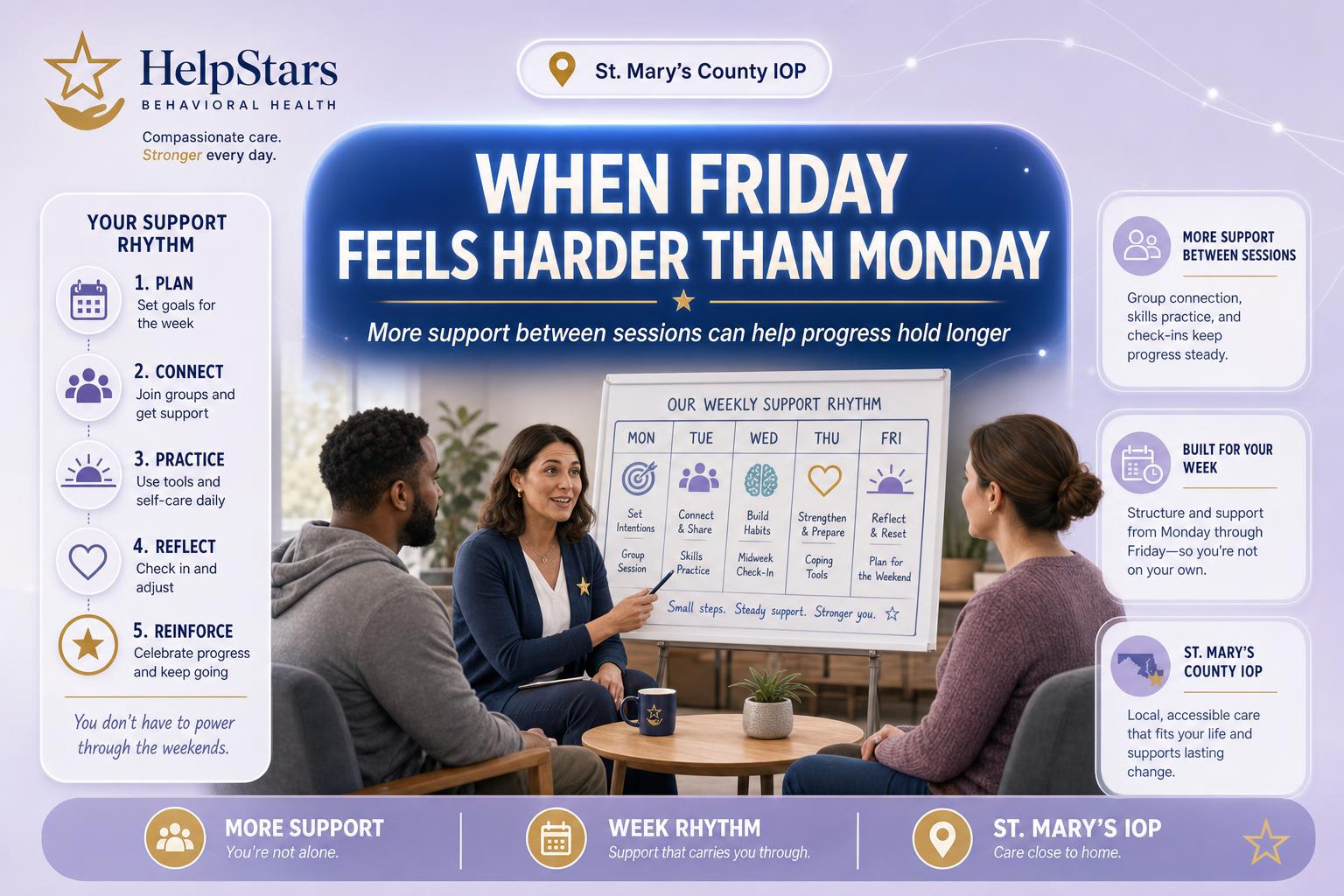
When Friday Always Feels Harder Than Monday: How an Intensive Outpatient Program Can Help Adults in St. Mary’s County, Maryland Hold Onto Progress Between Sessions
Some adults can almost predict the shape of the week before it happens. Early on, things seem manageable. They leave an appointment with a plan, catch up on a few tasks, answer a couple of messages, and think maybe this week will finally be different. Then the back half of the week arrives. Sleep starts slipping, tension gets easier to trigger, routines loosen, and the same person who sounded hopeful on Monday feels drained and disorganized by Friday.
For adults looking for an intensive outpatient program in St. Mary’s County, Maryland, that kind of pattern may matter more than one especially bad day. The issue is not simply whether someone can improve briefly. It is whether support is frequent enough and structured enough to help that improvement survive ordinary life between sessions.
HelpStars LLC serves adults and families across Southern Maryland with compassionate behavioral health support. When the hardest part is not getting one better day but keeping the progress from falling apart before the weekend, an adult mental health IOP may be worth exploring.
The Problem May Be the Back Half of the Week, Not the Beginning
People often picture worsening mental health as a constant downward spiral. For many adults, the harder pattern is less dramatic and more repetitive. They do feel better sometimes. They just do not stay better long enough for the week to become more stable.
That can look like:
- starting the week with decent energy, then losing traction after two or three days,
- understanding coping tools in session but not reaching for them once the week gets crowded,
- handling work or family responsibilities early in the week, then becoming harder to reach later on,
- watching sleep, appetite, mood, or follow-through shift as the weekend gets closer,
- needing more recovery time after ordinary stress than the schedule allows, or
- feeling like every week resets before anything truly builds.
That pattern can be frustrating because it creates just enough hope to keep someone trying, but not enough steadiness to make life feel reliably manageable.
Why One Helpful Appointment May Still Leave Too Much Unsupported Time
A good appointment can absolutely matter. It can help someone feel clearer, calmer, or more motivated. But that does not automatically mean the rest of the week has enough structure around it. Real life keeps applying pressure: work demands, family tension, disrupted sleep, commuting, medication routines, household tasks, loneliness, overstimulation, or old habits that return as soon as stress rises again.
Without enough support points across the week, adults may find themselves:
- missing the moment when a coping skill would have helped most,
- waiting too long to say they are slipping because they were “doing okay yesterday,”
- starting to distrust their own progress because it disappears so quickly,
- feeling ashamed that insight is not translating into consistency, and
- getting through one obligation at a time without building a steadier baseline.
That does not necessarily mean treatment is failing. It may simply mean the current treatment rhythm is too thin for the actual week the person is trying to live.
What an Intensive Outpatient Program Can Add Between Better Moments and Harder Ones
An intensive outpatient program offers a more structured outpatient care rhythm than standard weekly therapy alone. While each treatment plan is individualized, IOP is generally used when an adult needs more support points, more practice, and more reinforcement across the week.
Depending on the situation, IOP may help by:
- adding more treatment contact across the days when progress usually starts slipping,
- giving adults more chances to practice emotional regulation and coping skills before stress peaks,
- helping people notice patterns earlier instead of only reacting once the week has already unraveled,
- creating more structure around routine, communication, and daily functioning,
- supporting reflection on what changes between the beginning and end of the week, and
- making recovery feel less like one isolated conversation and more like a supported process.
The goal is not to create a perfect week. The goal is to reduce how often the same difficult stretch keeps overtaking the second half of the week.
A St. Mary’s County Example: Good Intentions on Tuesday, Shutdown by Friday
Imagine an adult in Leonardtown, Lexington Park, California, Great Mills, or another St. Mary’s County community who leaves a support appointment on Tuesday feeling more organized. They answer a few overdue texts, set out clothes for the next morning, maybe make one phone call they have been avoiding, and think they are finally regaining momentum.
Then Thursday night arrives. Work stress lingers longer than expected. Sleep gets uneven again. A small conflict at home stays in the body for hours. The person starts postponing the very habits that felt possible two days earlier. By Friday, they are quieter, less responsive, harder to motivate, and already telling themselves they just need to survive until the next support point.
That kind of week is not imaginary progress. It is real progress without enough reinforcement around it. An IOP may help adults in that position because it brings more structure to the stretch of time where the plan usually starts collapsing.
Five Signs the Current Support Rhythm May Not Be Holding
- Improvement keeps showing up briefly, then fading before the week ends. The person is not making things up; the gains just are not lasting.
- The hardest hours tend to cluster later in the week. By Thursday, Friday, or the weekend, stress starts outrunning the support plan again.
- Skills make sense during appointments but disappear in real time. The challenge is not understanding. It is maintaining access under pressure.
- Daily functioning swings too much from one part of the week to the next. Sleep, focus, routines, communication, or motivation feel noticeably less stable by the end of the week.
- Weekly care feels meaningful but too far apart. The person benefits from support, but the gap between support points keeps proving too difficult to carry alone.
These signs do not automatically mean IOP is the only answer. They do suggest it may be worth asking whether a more structured outpatient level of care belongs in the conversation.
This Is Different From Crisis-Only Care and Different From a Single Rough Weekend
Some adults assume they should only ask about IOP if everything has become unmistakably severe. Others downplay the pattern because they are still functioning in pieces. The concern here is often neither constant crisis nor one isolated hard weekend. It is the recurring loss of momentum between treatment touchpoints.
That middle ground matters. A person can be trying hard, attending appointments, and still not have enough structure to keep the back half of the week from repeatedly giving way. In those cases, a more structured outpatient level of care may be worth considering before the pattern grows more disruptive.
How Supporters Sometimes Recognize the Pattern First
Family members, partners, and close supporters are sometimes the first to notice the week-to-week rhythm. They may say things like, “You seemed more steady earlier this week,” or “By Friday everything feels heavier again.” That outside perspective can be useful because it points to a timing pattern, not just a bad mood in the moment.
Supporters may help by:
- paying attention to when the week usually starts slipping,
- naming the pattern without blame,
- encouraging honest discussion about how long improvement actually lasts, and
- focusing on whether more structure is needed rather than only urging the person to push harder.
That kind of support can make it easier to see that the issue may be treatment rhythm, not lack of effort.
Why Local Routine Matters in St. Mary’s County
Adults in St. Mary’s County are often balancing mental health symptoms with work schedules, parenting, commuting, household tasks, and obligations spread across Leonardtown, Lexington Park, California, Great Mills, Mechanicsville, Hollywood, and nearby communities. A treatment plan has to survive inside that real calendar, not an ideal one.
That is one reason structured outpatient support can matter. If the hardest stretch keeps showing up after the first couple of days, the solution may not be waiting for more willpower. It may be building more support into the actual days that keep giving way.
Questions Adults Often Ask About IOP
Does asking about IOP mean I am in crisis?
Not necessarily. Some adults explore IOP because their current support schedule is helping, but not often enough to keep progress steady across the week.
Can IOP make sense if I do have better days?
Yes. Sometimes the issue is not the absence of better days. It is that the better days do not hold long enough to protect daily life.
What if I mostly struggle later in the week or on weekends?
That timing pattern still matters. When support repeatedly thins out before the hardest stretch, more structure may be worth discussing.
Can IOP be part of a broader treatment plan?
Depending on the individual situation, structured outpatient care may be considered alongside other behavioral health services as part of a broader support approach.
A More Stable Finish to the Week May Start With More Support Inside the Week
Many adults are not failing because they cannot improve. They are struggling because the improvement keeps getting asked to carry too much unsupported time. When Monday and Tuesday feel possible but Friday keeps taking the ground back, the next step may be to ask whether a more structured level of outpatient care could help progress last longer.
HelpStars LLC serves adults and families across Southern Maryland with compassionate behavioral health support. For adults looking for an intensive outpatient program in St. Mary’s County, Maryland, it may be worth exploring whether more support between sessions could help the back half of the week feel less like something to survive and more like something you can actually hold.