When Everyone Is Trying Not to Start a Fight and Nothing Important Gets Said: Family Therapy for Adults in St. Mary’s County, Maryland
Some homes do not sound loud. They sound careful. People keep the peace, skip the harder sentence, answer with short updates, and tell themselves they will bring up the real concern later. On the surface, that can look better than arguing. Underneath, it often means the most important issues never actually get discussed.
For adults looking for family therapy in St. Mary’s County, Maryland, that pattern can be exhausting. A household may not be yelling, but people still feel tense, misunderstood, and braced for the next bad moment. One person may hold back because they do not want to be blamed. Another may stay vague because they do not trust the conversation to go well. A third may keep switching topics because the real issue feels too loaded to name directly.
HelpStars LLC supports adults across Southern Maryland with practical behavioral health services, including family therapy. When everyone is trying to avoid another blowup but the home still feels strained, structured family support may help turn guarded conversations into clearer and calmer ones.
Quiet Avoidance Can Keep a Family Stuck Just as Much as Open Conflict
Many families assume they are doing better if they are fighting less often. Sometimes that is true. Sometimes the conflict has only changed shape. Instead of open arguments, the house shifts into careful avoidance. Questions stay indirect. Frustration leaks out through tone. Important concerns get brought up at the wrong time or not at all. People start reading meaning into short texts, closed doors, unfinished chores, or clipped replies.
This kind of strain can build slowly. A loved one may think, "I do not want to make things worse," so they say less. The adult who is struggling may think, "If I explain this badly, it will turn into another whole thing," so they shut down faster. Over time, the family stops having real conversations and starts managing each other’s reactions instead.
What This Pattern Can Look Like at Home
Careful silence often shows up in everyday ways:
- a practical question quickly turns tense even though nobody raised their voice,
- someone says "it’s fine" when it clearly is not,
- people wait until they are already overwhelmed to bring up the real issue,
- the conversation stays focused on chores, scheduling, or reminders because the emotional part feels too risky, or
- everyone leaves the discussion feeling unheard even though nobody can point to one dramatic fight.
That does not mean the family lacks love or effort. It often means the household needs a better structure for difficult conversations.
Why Adults May Pull Back Even When They Want More Support
Adults living with anxiety, depression, trauma-related stress, mood instability, or long stretches of mental fatigue may want support and still feel unable to tolerate one more loaded talk at home. They may already feel ashamed, defensive, or exhausted before the conversation even begins. If previous attempts ended in blame, interruption, or panic, the body may start expecting the same result every time.
That is why "just talk about it" is often not enough. The problem is not always willingness. Sometimes the real barrier is that the family does not yet have a workable way to talk about hard things without sliding into old roles.
How Family Therapy Can Help Shift the Conversation
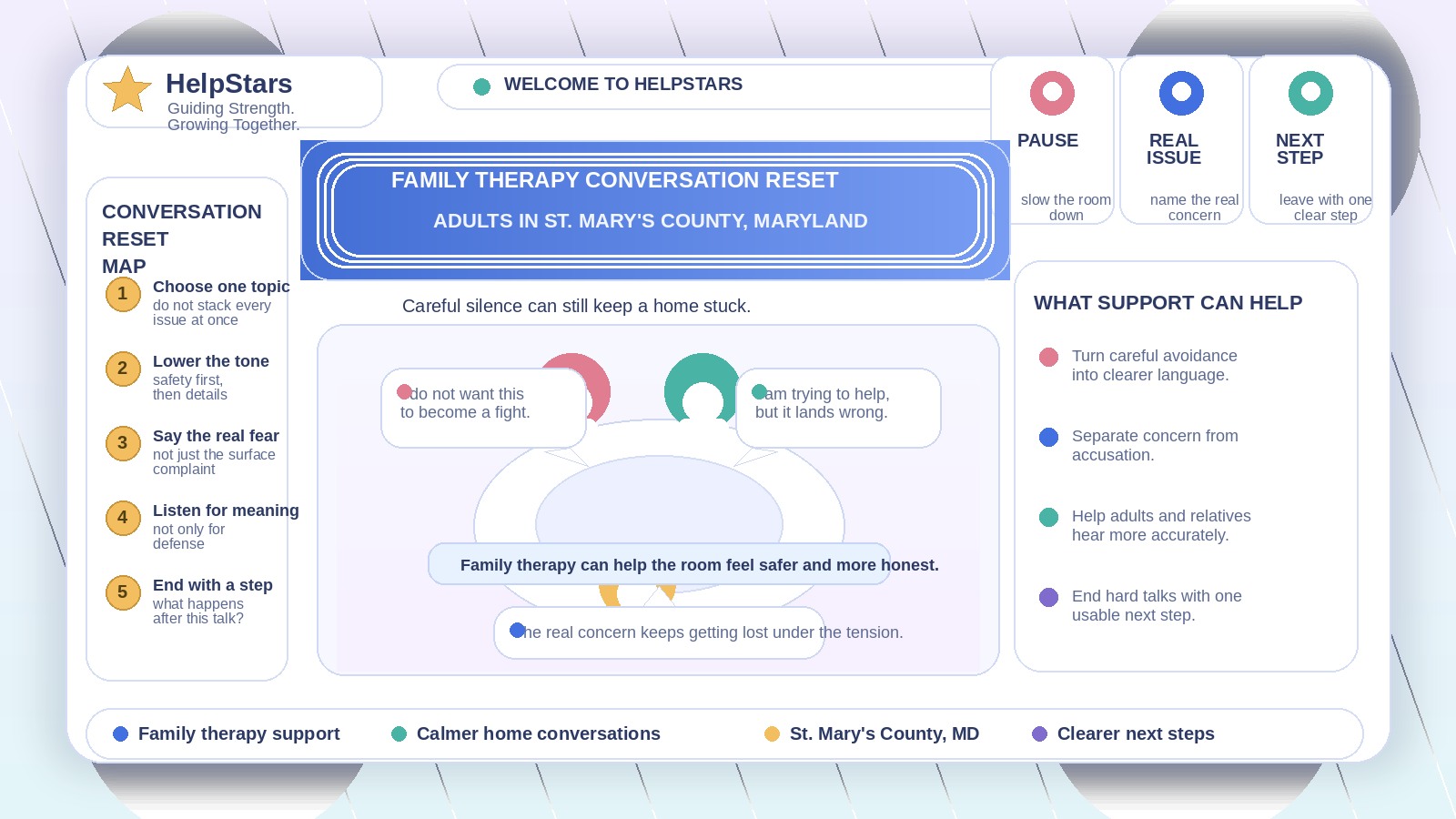
Family therapy is not only for major crises or constant arguments. It can also help when the household feels emotionally gridlocked. The goal is often to make the conversation safer, clearer, and more usable so people do not keep circling the same stuck points.
Depending on the situation, family therapy may help with:
- slowing down conversations before tone takes over,
- separating the real concern from the defensive reaction around it,
- helping relatives say what they mean more directly and less critically,
- making room for the adult’s experience without turning the whole conversation into pressure,
- noticing which topics need planning and which topics need empathy first, and
- building better follow-through after a hard conversation ends.
The point is not to produce a perfect family script. It is to reduce the pattern where everyone leaves the room still carrying the same problem.
A St. Mary’s County Example: No One Is Yelling, but No One Is Really Talking Either
Imagine an adult in St. Mary’s County, Maryland living with relatives while trying to stabilize mood, treatment follow-through, and daily routine. The family cares. The support is real. But every important conversation now feels narrow and tense.
A parent asks about appointments, and the adult hears criticism. The adult says very little, and the parent hears avoidance. Another family member tries to smooth things over by changing the subject. By the end, nobody has actually discussed what help is needed, what feels overwhelming, or what should happen next. The house is technically calm, but the real issue remains exactly where it was.
That kind of pattern can repeat for weeks. Family therapy can help because the need is not only emotional support. The family also needs a more reliable way to move from guarded reactions into a conversation that produces understanding and a next step.
Five Signs the Household May Need a Different Communication Pattern
- The same topic keeps coming up without real progress. People discuss it again and again, but nothing feels resolved afterward.
- Everyone edits themselves too heavily. Relatives are careful for a while, then resentment leaks out sideways.
- Support starts landing like pressure. Even practical questions feel loaded because the emotional tone is already tense.
- The adult shuts down before the real issue is reached. The conversation ends on the surface layer because going deeper feels unsafe or exhausting.
- There is no shared plan after a hard moment. People leave with feelings, but not with a clearer path.
These signs do not prove anyone is the problem. They suggest the family may need a better process.
What Loved Ones Can Practice Before the Next Hard Talk
Families often try to help by pushing for clarity quickly. That can backfire when the adult already feels cornered. A steadier approach may include:
- asking one real question instead of stacking several at once,
- naming concern without adding accusation,
- checking whether the conversation needs listening, planning, or both,
- staying with one topic long enough to understand it, and
- ending with one agreed next step instead of a vague promise to "do better."
Those shifts may sound small, but they can change the emotional temperature of the whole discussion.
Why This Matters in St. Mary’s County
Adults and families in Leonardtown, Lexington Park, California, Great Mills, Hollywood, Mechanicsville, Charlotte Hall, and nearby St. Mary’s County communities are often balancing treatment, transportation, work pressure, household roles, and recovery stress all at once. Communication problems at home do not stay at home. They can affect appointment follow-through, medication consistency, sleep, work readiness, and daily stability.
That is part of why family therapy in St. Mary’s County, Maryland can matter. A calmer household conversation is not only about getting along better. It can also make the rest of the week more workable.
Questions Families Often Ask
Do we need family therapy if we are not constantly arguing?
Not necessarily. Some families need help because conversations stay too tense, too shallow, or too avoidant to solve real problems even without major fights.
What if one person shuts down every time the topic gets serious?
That shutdown may be part of the pattern family therapy can help address. It often reflects overwhelm, fear, or distrust of how the conversation will go, not simple unwillingness.
Can family therapy help adults and relatives who care but keep misreading each other?
Yes. Supportive intent does not always translate into supportive communication. Family therapy may help people hear each other more accurately and respond with more structure.
Does this mean one person in the family is the problem?
No. In many families, the main issue is the pattern between people rather than one person acting alone.
A Better Conversation Can Start Before the Next Blowup
Some households do not need louder honesty. They need safer honesty. When everyone is working hard not to trigger another fight, the home can still end up full of tension, guessing, and unfinished conversations. That pattern can change.
HelpStars LLC supports adults across Southern Maryland with practical behavioral health services, including family therapy. For adults seeking family therapy in St. Mary’s County, Maryland, support may help families move from careful silence and repeated misfires toward clearer conversations, steadier follow-through, and a more workable home environment.