When Every Mental Health Check-In Turns Tense: Family Therapy for Parents and Adult Children in St. Mary’s County, Maryland
Some of the hardest family conflict does not start with shouting. It starts with a text that says, “Did you call them back yet?” A parent means it as concern. An adult son or daughter hears pressure. A missed call feels loaded. A reminder about sleep, medication, or an appointment lands like criticism. Before long, even ordinary check-ins start carrying more tension than help.
For families looking for family therapy in St. Mary’s County, Maryland, this pattern can be important to notice early. The problem is not always lack of love. Often, the problem is that concern and independence keep colliding in the same conversation. Family therapy can help parents and adult children speak more clearly, set more workable boundaries, and create a calmer way to stay connected around mental health support.
HelpStars LLC provides professional, compassionate behavioral health services for adults and families across Southern Maryland. When every mental health check-in seems to become an argument, structured family support may be worth exploring.
The Conversation Usually Gets Tense Before the Real Issue Is Named
Many families focus on the last sharp comment and miss the pattern underneath it. A parent may be trying to make sure nothing important slips. An adult child may be trying to protect a sense of control while already feeling overwhelmed, ashamed, or tired of explaining the same struggle. Both people may believe they are talking about one missed task when they are really reacting to fear, frustration, privacy, and past conversations all at once.
That can sound like:
- “I was only checking on you.”
- “You always ask like I have done something wrong.”
- “If I do not remind you, nothing happens.”
- “I need support, not constant monitoring.”
- “Why do our calls always become about appointments?”
When a family gets stuck there, the practical issue often stops getting solved. People begin protecting themselves from the conversation instead of working through it.
Why Parents and Adult Children Can Get Stuck in the Same Loop
This tension is common because parents and adult children are balancing two truths at once. Mental health concerns may be real and deserve attention. At the same time, adulthood comes with a need for dignity, privacy, and self-direction. When those truths are not handled carefully, families can fall into a cycle where one person pushes harder for reassurance and the other pulls away harder for breathing room.
Over time, the pattern may include:
- parents asking more frequent questions because they are worried about what they cannot see,
- adult children sharing less because every update feels emotionally expensive,
- arguments about tone rather than the actual need,
- confusion about when help is wanted versus when it feels intrusive, and
- both people leaving the conversation feeling misunderstood.
That does not mean the family is failing. It often means they need a different structure for contact, boundaries, and support.
What Family Therapy Can Help Untangle
Family therapy is often helpful when caring conversations keep turning reactive. Instead of deciding who is right in the moment, therapy can help the family understand what repeatedly makes the exchange go off track.
Depending on the situation, work in therapy may include:
- clarifying what kind of check-in feels supportive instead of supervisory,
- separating urgent concerns from routine updates,
- reducing all-or-nothing communication such as constant reminders followed by silence,
- helping parents express concern without escalating pressure,
- helping adult children ask for space without cutting off the relationship, and
- creating a steadier plan for conversations about appointments, medication, stress changes, or daily functioning.
The goal is not to remove concern from the relationship. The goal is to make concern easier to receive and easier to use.
A St. Mary’s County Example: Every Reminder Feels Bigger Than the Reminder
Imagine a parent in St. Mary’s County trying to support an adult daughter who has been having a harder time keeping appointments and staying organized when stress rises. The parent sends a short text in the morning asking whether the follow-up call was made. The daughter reads it while already feeling behind, closes the message, and answers hours later with one-word replies. By dinner, both people are upset for different reasons.
The parent feels shut out and becomes more direct. The daughter feels watched and becomes more defensive. Soon, a conversation about one phone call turns into a bigger fight about trust, effort, respect, and whether anyone feels listened to.
In family therapy, the useful question is not only, “Who started it?” It is, “What makes this exact kind of check-in blow up so reliably?” Once the pattern is named, the family can start building a better one.
Four Agreements That Often Make Check-Ins More Useful
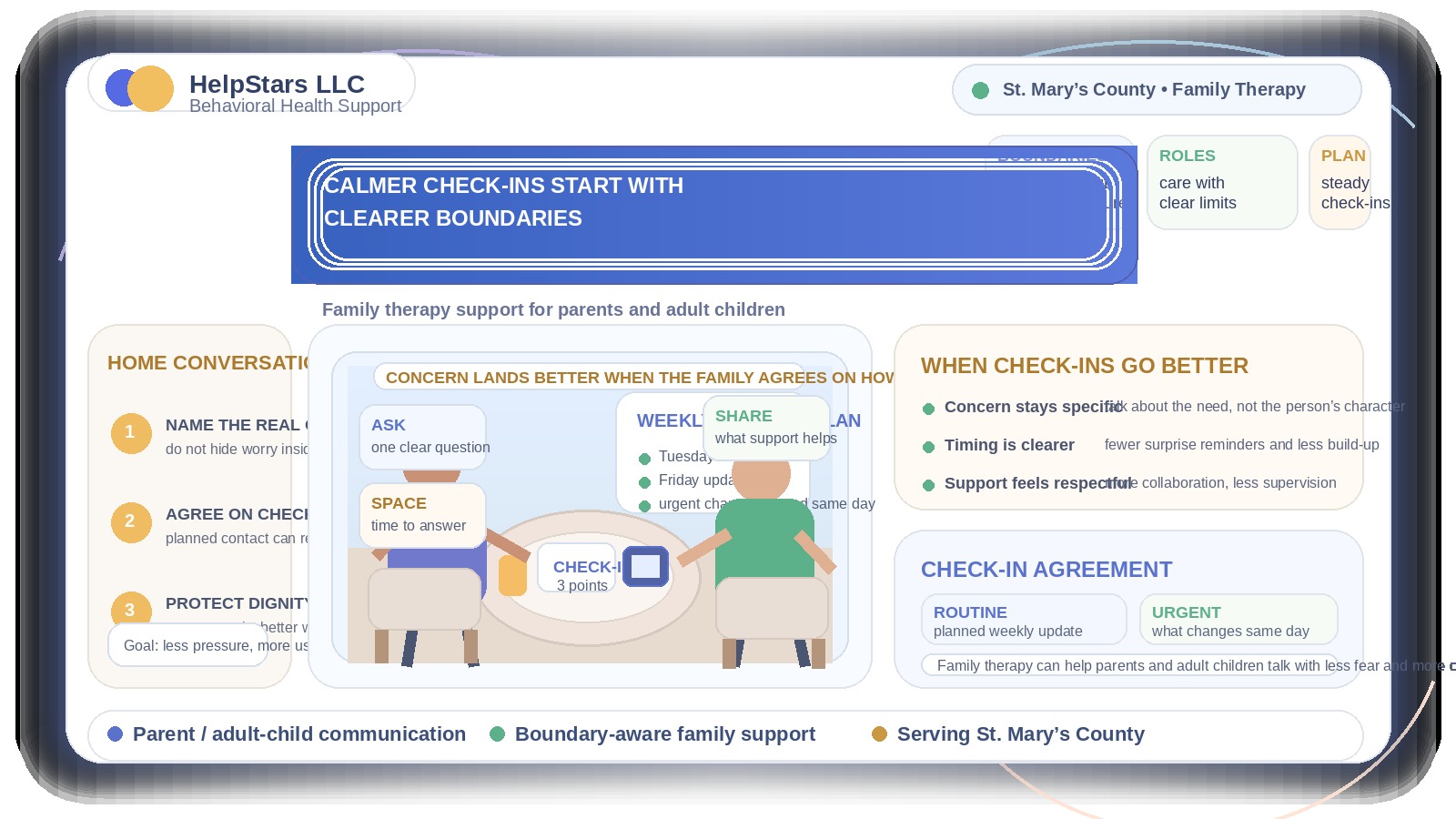
- Decide what deserves a real-time check-in. Not every missed task needs the same level of response. Families may do better when they define what is routine, what is concerning, and what is urgent.
- Choose the least loaded communication channel. For some families, texting increases misunderstanding. For others, surprise phone calls create pressure. A planned check-in may work better than repeated unplanned contact.
- Name what support is actually being requested. Some people want reminders. Others want help breaking a task into steps. Others mainly want someone to listen without taking over.
- Protect dignity while staying honest. Adults often engage more when support preserves choice, privacy, and respect rather than sounding like supervision.
These agreements are simple on paper, but many families need help practicing them consistently when emotions are already high.
Signs the Family May Need More Than Better Intentions
Support may be worth exploring when the relationship is being strained by repeated mental health check-ins, even if nobody would describe the household as being in crisis. It may help to ask about family therapy when:
- the same argument happens around appointments, medication, routines, or follow-through,
- a parent feels they have to keep pushing just to stay informed,
- an adult child avoids calls or texts because every conversation feels loaded,
- both people care, but neither feels calmer after talking,
- support keeps sliding between over-involvement and withdrawal, or
- practical help is being lost because the communication pattern has become the bigger problem.
Family therapy can be useful before the relationship grows more brittle. Waiting for a major blowup is not the only time to reach out.
Questions Families Often Ask When an Adult Child Wants More Space
Can family therapy help if the adult child says the parent is too involved?
Yes. That is often one of the clearest reasons to explore support. Therapy can help the family talk about involvement, limits, and expectations in a more structured way.
Does asking for boundaries mean the adult child does not want help?
Not necessarily. In many families, boundaries make support more usable because the adult does not feel they have to defend their independence in every conversation.
What if the parent is worried that backing off means missing something important?
That fear is understandable. Therapy can help families create a more specific plan for what should be communicated, what can wait, and how concern can be expressed without constant escalation.
Can family therapy fit alongside other behavioral health services?
It often can. Depending on the person’s treatment plan, family therapy may complement outpatient counseling, medication management, PRP, IOP, or other behavioral health support by improving what happens between appointments at home.
Why Local Routine Matters in St. Mary’s County
Family stress does not happen in a vacuum. Adults and parents in St. Mary’s County may be managing work schedules, long commutes across Leonardtown, California, Lexington Park, Great Mills, and nearby communities, plus caregiving, household tasks, and other appointments. A support plan that sounds reasonable in theory can break down quickly if it does not match real daily routines.
That is one reason local family support matters. Better communication is easier to maintain when it fits the actual week a family is living, including who is available, when check-ins tend to go best, and what kind of follow-through is realistic.
Support Can Feel Calmer Without Feeling Distant
Parents do not have to stop caring, and adult children do not have to give up independence, for the relationship to improve. What often changes first is the pattern: fewer loaded reminders, fewer defensive reactions, and more conversations that actually match the need in front of the family.
HelpStars LLC serves adults and families across Southern Maryland with compassionate behavioral health support. If every mental health check-in seems to turn tense, family therapy in St. Mary’s County may help your family build a steadier and more respectful way to stay connected.