When Every Explanation Fits for a Few Days and None of Them Explain the Whole Pattern: Psychiatric Evaluation for Adults Serving Port Republic, Maryland
One week it feels like stress. A few days later it seems more like poor sleep. Then irritability becomes the loudest problem, or concentration starts slipping enough that work, errands, and ordinary conversations take more effort than they should. Many adults live in that in-between place for longer than people realize. The issue is not always one dramatic symptom or one obvious turning point. Sometimes the harder part is that several explanations feel partially true, and none of them fully account for how the whole pattern has been unfolding.
For adults seeking psychiatric evaluation serving Port Republic, Maryland, that kind of overlap can make it difficult to know what step should come first. People often wonder whether they are dealing with anxiety, depression, burnout, sleep disruption, medication concerns, or simply too much pressure all at once. A thoughtful psychiatric evaluation can help slow that swirl down and organize what has changed, how long it has been happening, and what parts of life are being affected most.
HelpStars LLC supports adults and families across Southern Maryland with compassionate behavioral health services. When your explanation keeps changing from week to week, that does not mean the problem is not real. It usually means the pattern deserves a closer look.
When One Explanation Keeps Replacing Another
Adults often try to make sense of distress by choosing the most obvious explanation available in the moment. After a few rough nights, everything may get labeled as exhaustion. After one tense conversation, it may seem like the problem is purely stress. If motivation drops, people may blame themselves for losing discipline. If emotions feel flatter, they may wonder whether they are simply disconnected or worn down. Each explanation may contain some truth, but changing the label every few days can make it harder to see the larger picture.
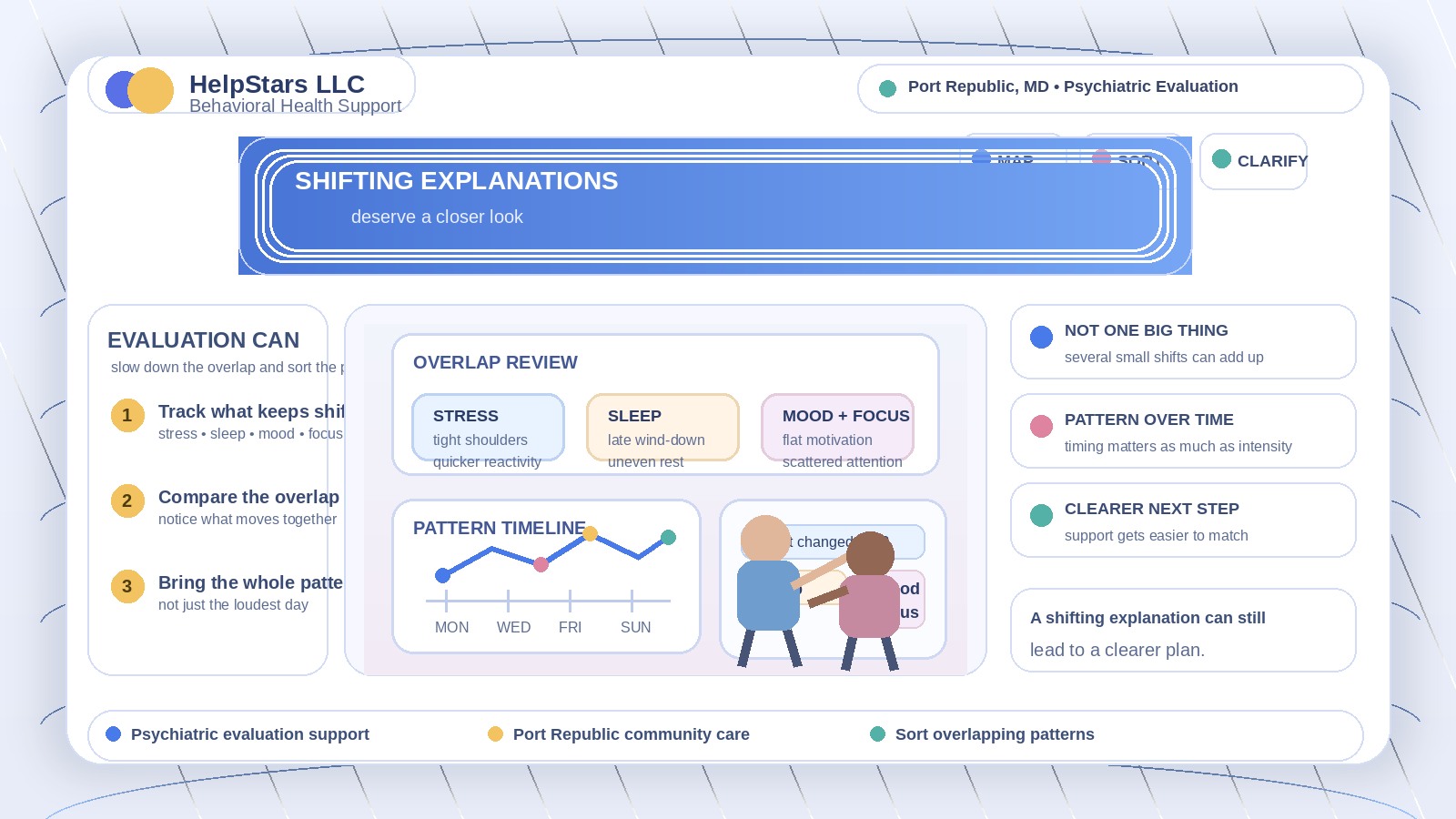
The larger picture may include several issues moving together: disrupted sleep lowering patience, anxiety increasing physical tension, low mood reducing follow-through, or concentration changes making ordinary tasks take longer. When those layers are looked at separately, the week can feel confusing. When they are reviewed together, a more useful pattern can begin to appear.
What a Psychiatric Evaluation Can Help Untangle
A psychiatric evaluation is not only for crisis situations or severe symptoms. It can also be helpful when the problem feels muddy, inconsistent, or hard to name. The purpose is to review symptoms, timing, routines, stressors, history, and functioning carefully enough that support decisions are based on more than one bad day.
Depending on the person, an evaluation may help clarify questions like these:
- Are sleep changes driving the emotional pattern, or are they one part of a broader concern?
- Does the stress response look temporary, or has it started affecting daily functioning in a more persistent way?
- Are mood shifts, concentration changes, and irritability clustering together in a way that deserves more structured follow-up?
- Would counseling alone be a reasonable starting point, or should other behavioral health supports also be discussed?
The goal is not to force every experience into a quick label. It is to build a clearer understanding of what is happening so the next step feels more grounded.
A Port Republic Pattern: Nothing Is Extreme, but Everything Feels Less Predictable
Imagine an adult in Port Republic who keeps describing the last month with different words every time someone asks. Some mornings start with a heavy, unfocused feeling that makes getting moving harder than usual. Midday may improve just enough to get through responsibilities, but small interruptions feel sharper than they used to. Evenings bring racing thoughts, scattered task-switching, or a sense that the day never settled. No single symptom seems severe enough to justify urgent language, yet the overall pattern keeps making life less manageable.
That kind of experience is easy to minimize because each piece can sound ordinary by itself. Trouble sleeping happens. Stress happens. Irritability happens. Difficulty focusing happens. But when ordinary struggles begin stacking in a way that changes routines, productivity, patience, or emotional steadiness, it can be useful to step back and evaluate the pattern instead of debating which single word fits best.
What To Bring Even If You Do Not Know What To Call It
Adults sometimes delay an evaluation because they feel they should show up with a neat summary. In reality, helpful information often sounds much less polished. It may be more useful to notice timing, triggers, and functional changes than to decide on the perfect explanation ahead of time.
Examples of useful details include:
- when the pattern tends to be worst during the day or week
- whether sleep, appetite, focus, tension, or mood have shifted together or separately
- which routines now take more effort than they used to
- whether work, parenting, relationships, or self-care are becoming harder to sustain
- what has already been tried, even if it only helped a little
You do not need a final answer before asking for help. The uncertainty itself is often part of why an evaluation becomes useful.
Signs a Closer Look May Be Worth Scheduling
Some adults benefit from a psychiatric evaluation when the problem is not getting dramatically worse but is becoming harder to make sense of. A closer look may be worth considering if your explanation changes constantly, if several symptoms are overlapping in a way that affects daily life, or if the same coping strategies are no longer giving the relief they used to provide.
It may also be time to schedule an evaluation if people around you keep noticing changes in your pace, patience, energy, or follow-through before you feel ready to name them yourself. Outside observations do not replace your experience, but they can highlight patterns that are easier to miss from inside the week.
Why Local Follow-Through Still Matters After the First Appointment
Even a strong evaluation is most helpful when it leads into support that feels possible to continue. Adults in Port Republic and nearby Calvert County communities often balance work, commuting, caregiving, and household demands that make follow-through harder when care feels too far away or too disconnected from daily routines.
Local behavioral health support can make it easier to move from uncertainty into a steadier plan. That next step may involve outpatient counseling, medication-management follow-up, a higher level of structure, or another service based on the person’s needs. The best plan is not the most impressive-sounding one. It is the one that matches what life is actually requiring right now.
A Clearer Pattern Can Lead to a Clearer Next Step
When every explanation fits for a few days, it is easy to assume there is no solid place to begin. In many cases, the overlap is the reason to begin. A careful psychiatric evaluation can help adults organize what has changed, understand how symptoms are interacting, and move toward support with more confidence and less guesswork.
HelpStars LLC provides compassionate behavioral health support for adults and families across Southern Maryland. If stress, sleep changes, mood shifts, or concentration problems no longer fit into one simple explanation, a closer evaluation may be a useful next step toward a steadier plan.