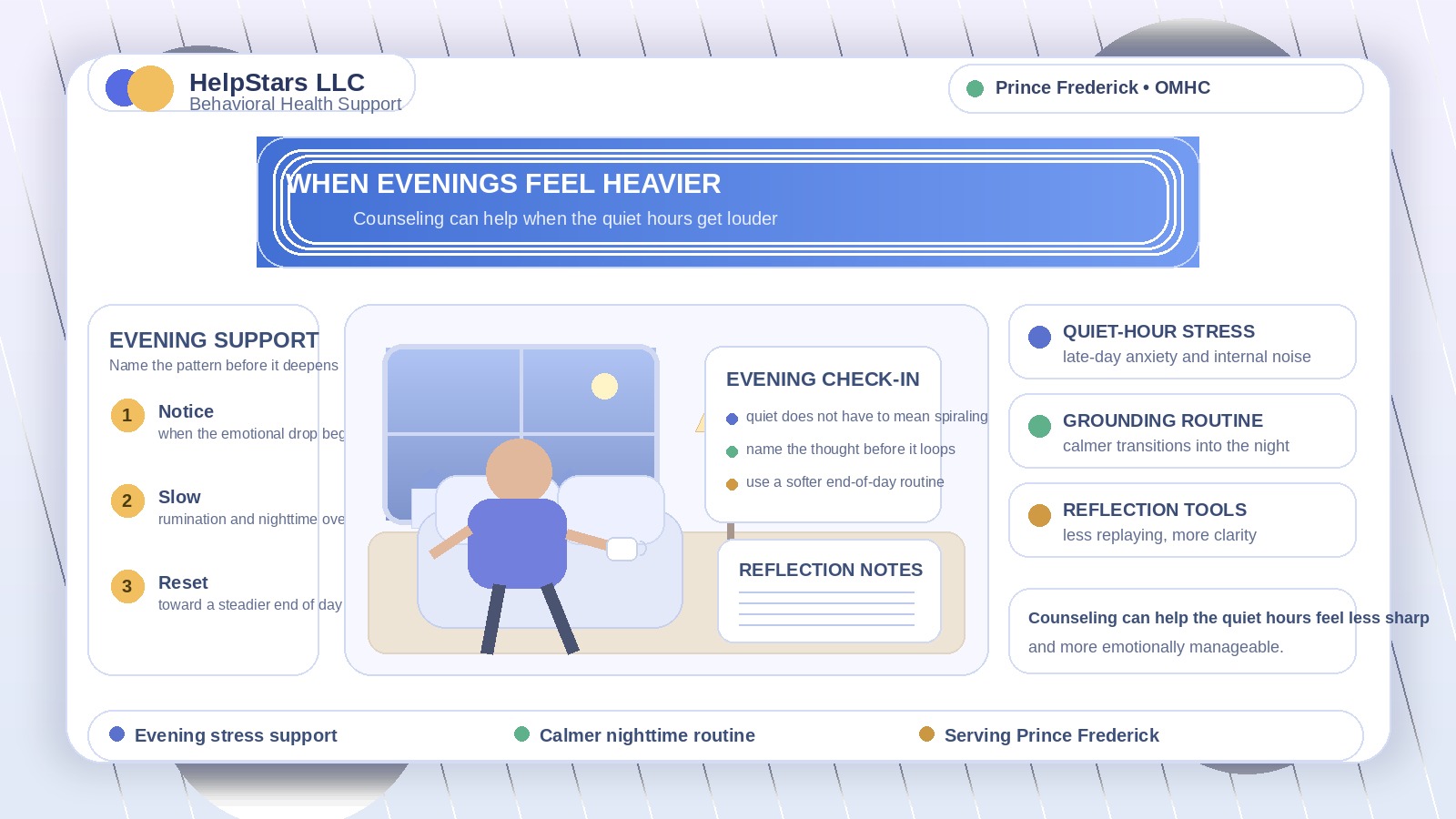
When Evenings Feel Heavier Than the Rest of the Day: How Outpatient Mental Health Counseling Can Help Adults Serving Prince Frederick, Maryland
Some adults make it through the workday, answer the text messages, handle the errands, and say the right things in public — only to feel their mood change the moment the evening gets quiet. The pressure is not always at its worst when life is busiest. For many people, it gets louder when the day finally slows down.
For adults serving Prince Frederick, Maryland, outpatient mental health counseling can help when evenings bring a heavier wave of anxiety, emotional letdown, rumination, or stress than the rest of the day. A person may look functional from the outside while still dreading the hours between dinner and sleep.
HelpStars LLC supports adults and families across Southern Maryland with compassionate behavioral health services. When nighttime routines start feeling emotionally harder than the visible part of the day, counseling can help people understand the pattern and build steadier ways to move through it.
Why Late-Day Stress Can Feel Different From Daytime Stress
Daytime stress often has structure around it. Work, appointments, traffic, parenting, chores, and conversations all create movement. Even when a person is strained, they may stay focused because the next task keeps arriving. Evening can feel different. The external demands drop off, but the internal noise has more room to take over.
That can look like:
- feeling noticeably more anxious once the house gets quiet,
- replaying conversations or mistakes from earlier in the day,
- struggling to settle into rest even when nothing urgent is happening,
- feeling unexpectedly sad, tense, or lonely during ordinary nighttime routines,
- avoiding bedtime because quiet feels emotionally harder than being busy, or
- noticing that evenings are when self-criticism gets the loudest.
This pattern does not mean the person handled the day well and is “overreacting” later. It may mean the day required so much holding together that evening is when the emotional backlog shows up.
What Makes Evening Hours So Vulnerable for Some Adults
When the pace of the day drops, people often lose the distractions that kept them moving. That shift can expose stress that was present all along. For some adults, evening creates more space to notice unresolved conflict, unmet expectations, fear about tomorrow, or the emotional weight of living on autopilot.
In other cases, the body is simply worn down. Once energy falls, coping gets thinner. Small worries feel bigger. The mind becomes more repetitive. A person who stayed calm at noon may feel emotionally flooded by 9:00 PM.
That is one reason behavioral health counseling in Calvert County can be helpful. Support is not only for people who are visibly falling apart during the busiest part of the day. It can also help adults whose hardest hours happen after everyone else assumes the stressful part is over.
How Counseling Can Help When Evenings Keep Turning Heavy
Outpatient mental health counseling can help adults look more closely at what evening distress is tied to. Instead of treating it as a mysterious mood swing, counseling can help identify the patterns underneath it.
Depending on the individual situation, support may help adults:
- notice whether anxiety, depression, grief, burnout, trauma-related stress, or isolation are driving the nighttime shift,
- identify what time of day the emotional drop usually begins and what tends to trigger it,
- separate real-life concerns from looping thought patterns that intensify after dark,
- build evening routines that feel grounding instead of emotionally unstructured,
- practice ways to transition out of performance mode and into a calmer end of day, and
- explore whether other behavioral health supports should also be part of the conversation.
The goal is not to create perfect evenings. The goal is to make the last part of the day feel less like an emotional ambush.
A Prince Frederick Example: Fine at 3 PM, Restless by 9 PM
Imagine an adult serving Prince Frederick, Huntingtown, Lusby, or another part of Calvert County who looks steady during the day. They respond to people. They get through work. They keep the house moving. But once dinner is over and the evening opens up, their mind becomes harder to manage.
Maybe they start mentally reviewing every conversation from earlier. Maybe tomorrow’s tasks suddenly feel impossible. Maybe the quiet of the living room makes stress feel more obvious than it did in a busy office or while driving. Maybe they tell themselves they should enjoy the downtime, which only makes the distress feel more frustrating.
In counseling, the work may begin by naming the shift more precisely. Is the problem loneliness, anticipatory anxiety, unprocessed stress, emotional letdown, fear of sleep, or the loss of structure? Once the pattern has words around it, it becomes easier to respond to than a vague sense that “nights are just hard.”
Five Signs Evening Distress May Be More Than Ordinary Tiredness
- You feel worse when the day gets quieter, not better. Relief does not arrive when obligations end.
- Your mind starts replaying or predicting. The evening becomes a prime time for rumination, second-guessing, or dread about the next day.
- Rest feels emotionally hard to enter. It is not only about being tired; it is about feeling unable to settle.
- You stretch out bedtime to avoid the quiet. Screens, chores, or random tasks may become ways to outrun the drop in mood.
- The pattern keeps repeating. It is not just one rough night. It is becoming part of the week.
These signs do not point to one single explanation, but they do suggest that extra support may be worth considering.
Why This Pattern Is Easy To Miss
Evening distress can be hard to explain because the person may still look responsible and productive. They may tell themselves they cannot really be struggling because they got through the day. Loved ones may also miss the pattern if they mostly see the person during daytime functioning.
That is part of what makes this issue so frustrating. The harder hours may be happening privately, in the exact part of the day when support feels farthest away. Counseling can help because it gives the person a place to talk honestly about what nighttime actually feels like instead of judging the problem only by daytime performance.
How Local Routine in Calvert County Can Shape the Pattern
Adults serving Prince Frederick and nearby Calvert County communities are often balancing work schedules, caregiving, commuting, family demands, and household management across the day. By evening, there may finally be fewer interruptions — but also less external structure. That local routine matters because the emotional drop often happens in the transition from constant doing to relative quiet.
Support tends to be more useful when it reflects that real-life rhythm. A counseling plan can look at how evenings unfold in the person’s actual week rather than treating nighttime distress as an abstract symptom.
Questions Adults Often Ask About Hard Evenings
Does this mean I have anxiety even if I seem okay during the day?
Not necessarily, but it can. Evening distress may be related to anxiety, depression, burnout, grief, trauma-related stress, or other emotional patterns. A professional can help sort out the bigger picture.
What if I only struggle once everything is quiet?
That still matters. Emotional strain does not have to appear during business hours to deserve support.
Can counseling help if the problem is mostly rumination at night?
Yes. Counseling may help adults understand what fuels the loops, identify triggers, and develop more grounded ways to move through the evening.
Do I need to wait until sleep is seriously affected?
No. Many adults benefit from support before the pattern becomes a more severe cycle of dread, insomnia, or daily depletion.
A Calmer End of Day Can Start With Understanding the Pattern
When evenings feel heavier than the rest of the day, people often blame themselves for not relaxing correctly, not being grateful enough for quiet, or not handling stress as well as they should. But repeated nighttime distress is not a personal failure. It is a pattern that may need care.
If you keep noticing that your hardest hours begin after the visible part of the day is over, outpatient mental health counseling serving Prince Frederick, Maryland may help you better understand the shift and build steadier evening routines. HelpStars LLC provides compassionate behavioral health support for adults and families across Southern Maryland.