When Even Small Choices Start Feeling Too Expensive: Outpatient Mental Health Counseling for Adults in Leonardtown, Maryland
The question itself may be simple. What should you make for dinner? Which message should you answer first? Should you go to the store tonight or wait until tomorrow? Do you say yes to the invitation, ask for more time, or cancel now before you disappoint anyone later? None of these choices should drain the whole evening, but sometimes they do.
For some adults, the problem is not a lack of options. It is that every option starts to feel like one more demand on an already overloaded mind. By the end of the day, even routine decisions can feel oddly high-stakes. Outpatient mental health counseling can help adults in Leonardtown, Maryland understand why decision fatigue builds, what keeps it going, and how to create more workable routines around everyday choices.
HelpStars LLC provides compassionate behavioral health support for adults and families across Southern Maryland. When simple decisions keep turning into delay, guilt, second-guessing, or shutdown, counseling may be a useful next step to explore.
Decision Fatigue Does Not Always Look Dramatic From the Outside
Many adults with decision fatigue still look functional. They may get the kids where they need to go, answer work messages, attend appointments, or keep the household moving well enough that other people do not realize how hard the smaller choices have become. But inside, the strain adds up.
It can sound like:
- "I cannot tell whether I need a break or just need to push through,"
- "I keep reopening the same text because I do not know how to answer it,"
- "Even basic errands feel harder once I have to choose the order,"
- "I am tired of making decisions for everyone," or
- "I know none of this is a big deal, but it still feels heavy."
This pattern can show up with anxiety, depression, burnout, trauma-related stress, grief, sleep disruption, role overload, and other mental health pressures. The issue is not simply being bad at choosing. Often, it is the mental cost of choosing after too many other demands have already used up the day's bandwidth.
Why Ordinary Choices Can Start Carrying So Much Weight
When the nervous system is already strained, each choice can feel like it has more consequences than it probably does. A person may worry about wasting money, upsetting someone, making the wrong call, losing momentum, forgetting another responsibility, or triggering a bigger problem later. Over time, routine decisions stop feeling routine.
That pressure often grows faster when someone is:
- making frequent care, work, or family decisions without enough recovery time,
- trying to prevent mistakes after a stressful stretch,
- carrying guilt about disappointing people,
- already behind on sleep, chores, or follow-through, or
- living in a pattern where every choice seems to affect several other tasks.
Eventually, people may begin avoiding choices not because they do not care, but because each decision feels too costly to touch.
How Counseling Can Help When the Mind Keeps Stalling at the Fork in the Road
Outpatient counseling can help adults slow the pattern down and look at what is making everyday decisions feel so loaded. Sometimes the main issue is anxiety about consequences. Sometimes it is depressive depletion, perfectionism, people-pleasing, chronic stress, or a long stretch of carrying too much for too long. In many cases, it is a mix.
Support may include:
- identifying which kinds of decisions create the most stress and why,
- noticing when the real problem is overwhelm rather than the decision itself,
- building shorter decision routines so not every choice requires a fresh internal debate,
- learning language for boundaries, delays, or simpler responses,
- working on guilt and self-criticism that follow ordinary choices, and
- rebuilding energy, recovery time, and emotional steadiness so choices feel less punishing.
The goal is not to become perfectly decisive. The goal is to reduce the mental friction that turns normal life into one long chain of exhausting judgments.
A Leonardtown Example: The Errands Are Manageable, but Choosing the Sequence Is Not
Imagine an adult in Leonardtown who can picture exactly what needs to happen before the weekend feels under control. Groceries need to be picked up. One family text needs an answer. A prescription question needs a callback. Laundry needs to start before bedtime. None of the tasks are impossible by themselves.
The trouble begins when the person tries to decide what to do first. If they go to the store now, they may miss the callback window. If they answer the family text first, the conversation may expand and eat the hour. If they start laundry, they may lose the little momentum they have for leaving the house. Ten minutes later, they are still standing in the kitchen, more depleted than when they began.
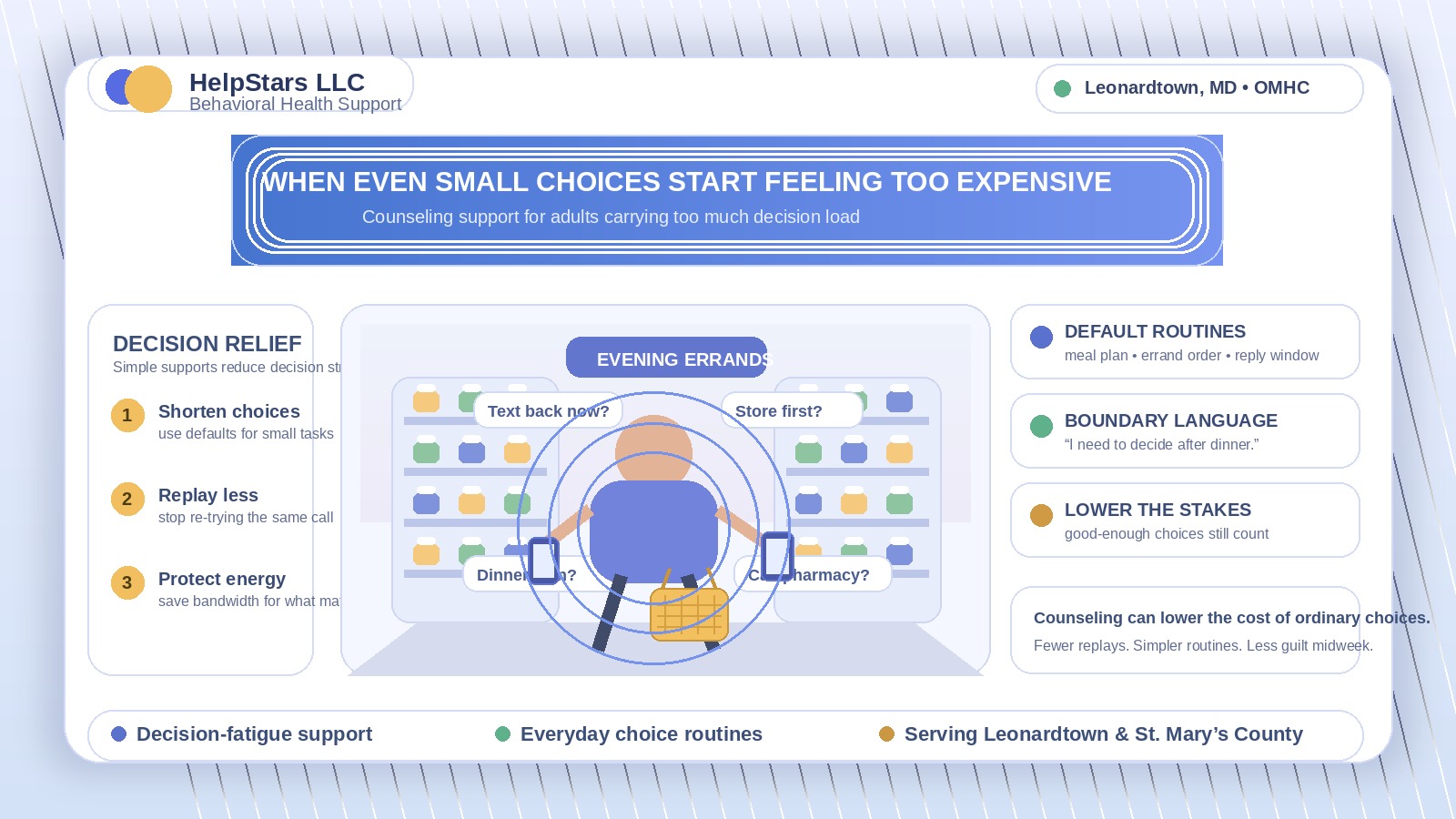
In counseling, the work may focus less on forcing motivation and more on making the decision path lighter. Which choices can be made earlier in the day? Which can be simplified into default routines? Which need a boundary statement rather than another round of internal debate? Once the hidden pressure points are clearer, the whole evening often becomes easier to move through.
Three Places the Pattern Often Gets Stuck
- Too many decisions happen too late. Adults often postpone small choices until energy is already gone, then judge themselves for struggling when the brain is depleted.
- Every option feels like a character test. Instead of choosing between two ordinary actions, the person feels as if they are choosing between being responsible or careless, generous or selfish, productive or failing.
- No choice feels finished once it is made. Some adults decide and then keep replaying the choice afterward, which teaches the brain that deciding is never actually over.
These stuck points can be changed, but they usually change better through awareness and structure than through self-pressure alone.
What a More Sustainable Decision Routine Can Look Like
Counseling may help adults build a daily rhythm in which fewer choices have to be made from scratch. That can include meal templates, simpler errand categories, planned response windows, boundary phrases, and recovery time that protects the brain from reaching empty before the day is done.
A more sustainable routine might sound like:
- "I answer non-urgent texts after dinner, not all day,"
- "I use a short grocery list template when I am tired,"
- "If I cannot decide right now, I give myself one next step instead of ten,"
- "I do not need to solve other people's urgency immediately," or
- "A good-enough choice today is better than an ideal choice that never gets made."
These shifts may sound small, but they can make daily life feel noticeably less punishing.
When It May Be Worth Asking for Support
Adults and families may want to ask about counseling when decision fatigue is starting to interfere with more than convenience. Support may be worth exploring when someone is:
- delaying basic tasks because choosing where to begin feels overwhelming,
- getting stuck in repeated second-guessing after ordinary decisions,
- feeling guilty, irritable, or shut down after small requests,
- avoiding errands, calls, or plans because the mental setup feels too heavy,
- taking on too many choices for other people and running out of energy, or
- noticing that daily decision strain is worsening anxiety, mood, or follow-through.
Support does not have to wait until someone is completely frozen. Many adults benefit while the pattern is still flexible enough to interrupt.
Why Local Routine Matters in Leonardtown and Across St. Mary’s County
Decision fatigue does not happen in a vacuum. Adults in Leonardtown and nearby St. Mary’s County communities are often balancing commuting, school schedules, family needs, appointments, errands, caregiving, and work responsibilities that all compete for limited mental energy. A counseling plan works better when it reflects those real-life demands instead of assuming every adult has wide-open time and a quiet brain at 6:00 PM.
That local routine matters because the best strategies are the ones that fit an actual week: the drive home, the stop at the store, the text thread that always expands, the evening window before the pharmacy closes, or the point in the weekend when the brain is already tired of deciding. Counseling can help adults build around real friction points instead of judging themselves for having them.
Questions Adults Often Ask About Decision Fatigue
Is this just stress, or could counseling still help?
It may be related to stress, but counseling can still help if the pattern is affecting mood, follow-through, relationships, or the ability to move through ordinary daily tasks with less friction.
What if I can make big decisions but get stuck on small ones?
That is common. Small decisions often arrive in clusters and at low-energy moments, which can make them feel strangely harder than major choices that get more time and attention.
Does decision fatigue mean I am disorganized or lazy?
No. It often reflects overload, depletion, anxiety, perfectionism, or emotional strain rather than lack of effort or character.
Can counseling help if my choices mostly involve other people’s needs?
Often, yes. Counseling can help adults notice where responsibility, guilt, and boundary strain are making everyday decisions heavier than they need to be.
Life Usually Feels Lighter When Every Choice Stops Carrying the Whole Week
Not every decision needs a full internal trial. Sometimes the most meaningful improvement is not making better choices in some perfect abstract sense. It is creating a way of living where ordinary choices stop draining so much emotional energy.
HelpStars LLC serves adults and families across Southern Maryland with professional, compassionate behavioral health support. For adults in Leonardtown whose evenings, errands, and simple decisions keep feeling heavier than they should, outpatient mental health counseling may help create a steadier path forward.