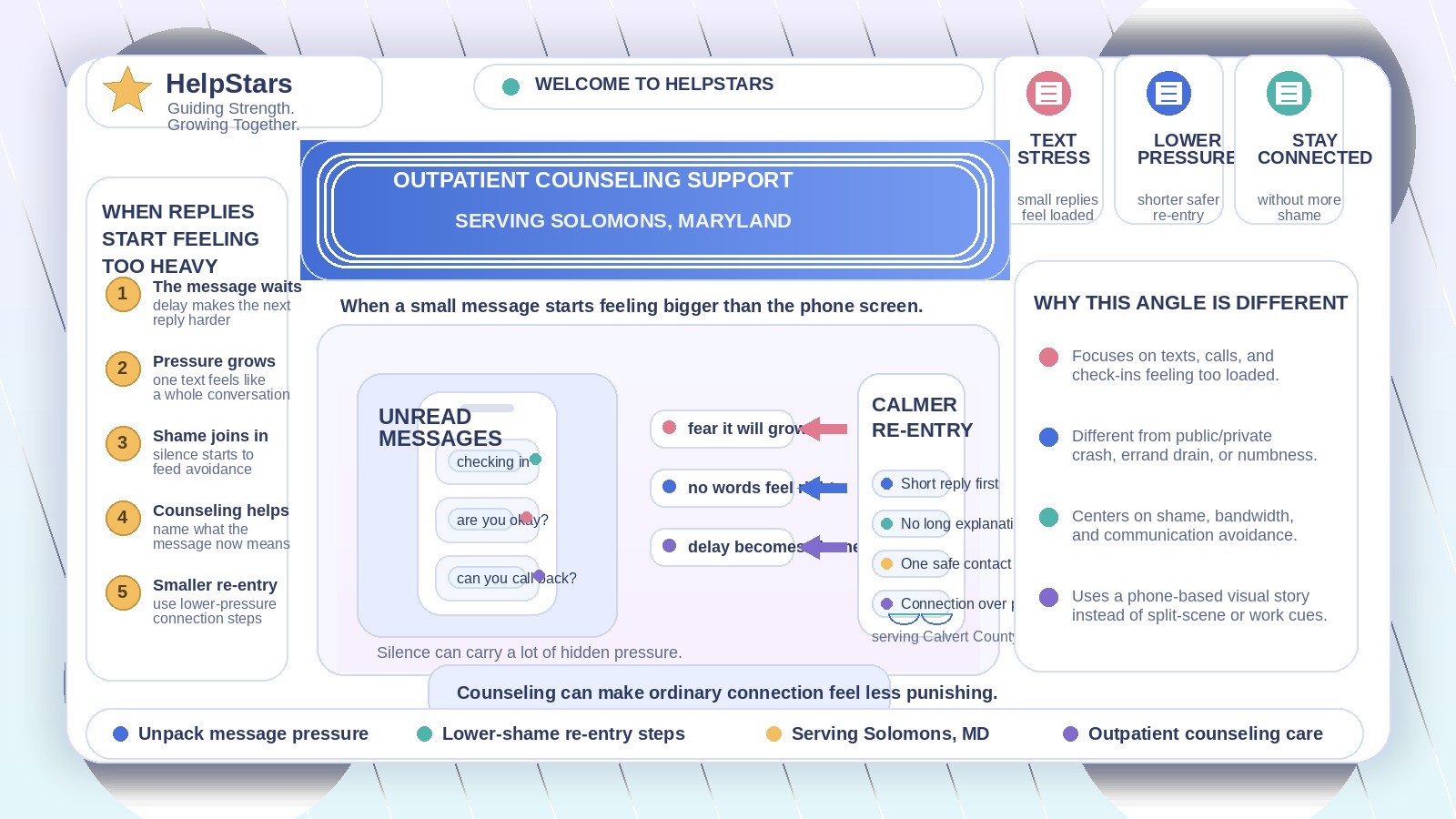
When a Simple Reply Starts Feeling Too Heavy: Outpatient Mental Health Counseling for Adults Serving Solomons, Maryland
Sometimes the hardest part of the day is not the biggest responsibility on the calendar. It is the small message that should only take thirty seconds to answer. A friend checks in. A family member asks a normal question. Someone sends a kind follow-up after you said you would get back to them. The phone lights up, and instead of replying, you feel your whole body hesitate.
For adults seeking outpatient mental health counseling serving Solomons, Maryland, that kind of communication shutdown can be more than a bad habit. A short message may start feeling emotionally expensive when anxiety, depression, burnout, grief, shame, or mental overload are already making ordinary interactions harder to carry. The person often still cares about the relationship. The problem is that even one small reply can start feeling like a doorway into more pressure than they have energy for right now.
HelpStars LLC supports adults and families across Southern Maryland with compassionate behavioral health services. When ordinary messages begin feeling too loaded to open, answer, or keep up with, counseling can help adults understand what is getting activated underneath the silence and build a more workable response pattern.
The Problem Is Often Bigger Than the Message Itself
From the outside, this pattern can look minor. Someone just needs to answer the text. But inside the moment, the message may carry much more weight than the words on the screen. A quick reply can feel like the start of a longer conversation, one more decision to make, one more social performance to manage, or one more reminder that other parts of life are already behind too.
That may sound like:
- “I saw it right away, and the longer I waited, the harder it got,”
- “It is not that I do not want to answer. I just do not know how to step into it,”
- “Every message feels like it comes attached to more than the actual message,”
- “I keep thinking I will answer when I feel clearer, but I never quite do,” or
- “Now I feel rude, and that makes me want to avoid it even more.”
When this repeats, people often start blaming themselves for being flaky, distant, or inconsiderate. In reality, the silence may be tied to emotional strain that is making social follow-through feel much heavier than it looks from the outside.
Why Small Communication Tasks Can Start Feeling So Loaded
Messages are rarely just messages when someone is already running low. A person may be mentally translating several questions at once without realizing it. If I answer now, will they want to talk longer? Will I need to explain why I have been quiet? Am I going to disappoint them? Will this turn into a plan I do not have energy for? What if my reply sounds flat, late, awkward, or unlike me?
That inner buildup can happen for many different reasons. Anxiety may make the conversation feel risky before it even starts. Depression may flatten the energy needed to engage. Burnout may make even kind connection feel like one more demand. Shame may make the person worry they already waited too long to respond “correctly.” Grief, family tension, or emotional exhaustion can make every new contact feel harder to absorb.
Over time, the pattern can become self-reinforcing. The longer a message sits, the more emotional static gathers around it. A simple check-in that felt answerable at 2:00 PM may feel much harder by 9:00 PM, and nearly impossible two days later.
Counseling Can Help Untangle What the Silence Is Protecting
Outpatient mental health counseling is not only for dramatic crises or constant conflict. It can also help adults who have quietly started pulling back from everyday communication because it feels too draining, too exposing, or too hard to manage consistently.
Depending on the person’s needs, counseling may help with:
- identifying whether anxiety, depression, shame, overload, grief, or another emotional pattern is driving the avoidance,
- noticing what kinds of messages feel hardest and what they seem to represent internally,
- reducing the all-or-nothing pressure that makes every reply feel like a major social event,
- practicing ways to respond without needing the “perfect” words first,
- building emotional recovery after communication instead of bracing for it as depletion, and
- finding steadier ways to stay connected without overpromising energy that is not really there.
The goal is not to force constant availability. The goal is to make connection feel less punishing, less loaded, and more manageable inside real daily life.
A Solomons Example: The Phone Is Quiet, but the Stress Around It Is Not
Imagine an adult serving Solomons, Maryland and nearby Calvert County communities who has become known as someone who “just disappears for a while.” They do not mean to disappear. They still read the messages. They think about answering. They even draft replies in their head while driving, showering, or trying to fall asleep. But when it is time to actually send something, the moment feels heavier than it should.
One text asks whether they want to stop by this weekend. Another asks whether they are doing okay. A sibling sends a practical question that should have an easy answer. None of these messages are aggressive. None of them are huge. But each one seems to ask for emotional presence the person is not sure they can offer without setting off more conversation, more explanation, or more guilt.
In counseling, the work may begin with a different question than “Why can’t I just answer?” It may begin with, “What does each reply start to mean inside me once stress is already high?” That shift matters. The issue is often not a lack of caring. It is the amount of tension, self-monitoring, or emotional obligation that now seems attached to ordinary contact.
Four Patterns That Often Show Up Under Text and Call Avoidance
- Fear of the conversation expanding. A person may be able to picture answering one sentence, but not everything that reply might open next.
- Pressure to explain the quiet. The message itself may be easy; the expected explanation for delayed communication feels harder.
- Low emotional bandwidth for social performance. Even kind interaction may feel draining when someone is already trying hard just to get through the day.
- Shame after waiting too long. The person may want to reconnect, but embarrassment about the delay turns a manageable reply into something that feels socially dangerous.
These patterns do not all point to the same diagnosis. They do show why communication avoidance can be a meaningful emotional signal rather than a small personality flaw.
Silence Can Affect More Than Relationships Alone
When someone starts withdrawing from messages, the impact often spreads past the phone. Support becomes harder to receive. Planning gets more stressful. Family members may start guessing instead of knowing what is going on. Friendships can feel shakier even when no one intends harm. The person avoiding communication may also lose confidence in their own ability to stay connected, which adds one more layer of self-criticism to an already hard stretch.
For adults serving Solomons, Lusby, Prince Frederick, North Beach, Chesapeake Beach, and surrounding Calvert County communities, this pattern often unfolds alongside commuting, work shifts, parenting, caregiving, appointments, and the ordinary mental load of daily life. A short reply may look easy from the outside while feeling like one task too many inside a crowded week.
Behavioral health counseling serving Calvert County can help because it creates room to look at communication shutdown as part of a bigger emotional pattern, not just a bad phone habit that needs more discipline.
What Can Help Before the Gap Gets Bigger
Adults often wait until they feel socially “caught up” before reaching out again. The problem is that catch-up rarely comes first. More often, the relief starts after the pressure around communication is understood and reduced a little. Counseling can help adults practice smaller reentry steps that feel possible before the shame spiral grows.
That might include:
- using shorter, lower-pressure replies instead of mentally drafting a perfect conversation,
- separating genuine lack of capacity from automatic avoidance,
- recognizing which relationships feel safer to restart with first,
- building language that is honest without overexplaining, and
- learning how to stay connected in ways that respect emotional bandwidth instead of pretending it does not matter.
These steps can sound small, but they often matter because they reduce the emotional cost of re-engagement enough for connection to start feeling possible again.
Questions Adults Often Ask About This Pattern
Does avoiding texts and calls always mean someone is depressed or anxious?
Not always, but it can be related to anxiety, depression, burnout, grief, shame, trauma-related stress, or emotional overload. The bigger question is what the avoidance seems to be protecting the person from in that moment.
What if I care about people and still keep going quiet?
That is common. Caring about people does not automatically remove the emotional strain that can build around communication when someone is already overloaded.
Is counseling helpful if the problem seems small compared with other mental health issues?
Yes. Seemingly small patterns can still matter when they affect support, follow-through, relationships, and how alone a person feels during difficult weeks.
What if I do answer eventually, just much later than I mean to?
That still counts as a real pattern if the delay keeps bringing stress, guilt, and disconnection into the week. Counseling can help reduce the weight that builds before the reply goes out.
Connection Can Feel Lighter Again
When a simple reply starts feeling too heavy, people often assume they need to become tougher, faster, or better at pushing through. Sometimes the more useful step is understanding why ordinary contact began feeling so costly in the first place. The silence usually has a story behind it.
HelpStars LLC serves adults and families across Southern Maryland with compassionate behavioral health services. For adults seeking outpatient mental health counseling serving Solomons, Maryland, support may help make everyday connection feel less loaded, more honest, and easier to reenter one small step at a time.