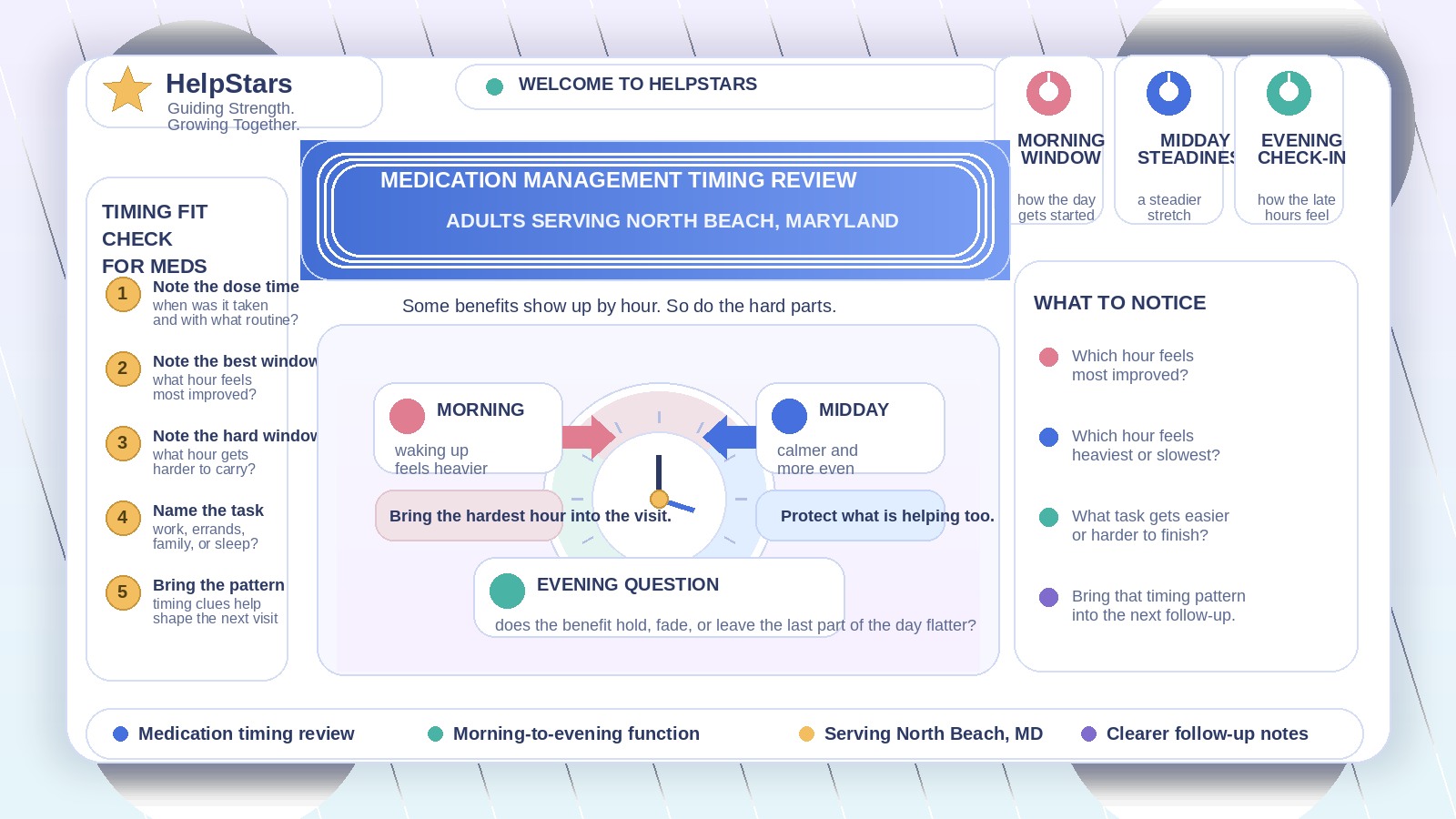
When a Medication Seems Helpful at One Time of Day and Off at Another: Medication Management for Adults Serving North Beach, Maryland
Sometimes a medication does not fail across the whole day. It fits one part of the day and clashes with another. A person may feel steadier by late morning, more patient through part of the afternoon, or less internally keyed up during work hours. At the same time, the early hours may feel heavy, the evening may feel flat, or the benefit may seem to wear off before the day is actually done.
For adults seeking medication management serving North Beach, Maryland, that kind of uneven pattern matters. The question is not only whether the medication helps in some general sense. The more useful question may be when it helps, when it complicates daily functioning, and what that timing says about the next treatment conversation.
HelpStars LLC supports adults and families across Southern Maryland with compassionate behavioral health care. When a prescription seems to line up with one part of the day but not another, medication-management follow-up may help turn that uneven experience into clearer observations and a more workable next step.
A Medication Can Be Partly Helpful and Still Be Hard To Live With
Adults often feel pressure to describe medication in a simple way: working or not working, better or worse, keep it or stop it. Real life is usually more complicated. A prescription may ease racing thoughts but leave the morning routine slower than usual. It may soften irritability during the workday but leave a person feeling drained by dinner. It may help with emotional intensity while making focus, appetite, or motivation harder to read.
That does not automatically mean the medication is wrong. It does mean the day should be looked at in sections instead of as one single verdict. A follow-up visit can be more useful when the person is not forced to summarize the whole experience with one broad answer.
Why Timing Problems Get Missed So Easily
Time-of-day patterns are easy to lose between appointments. People remember the strongest feeling from the week, not always the most informative one. A person may say, “I think it helps,” because they truly do feel calmer at work, while forgetting that getting out the door has become much harder. Someone else may say, “I do not like how I feel on it,” because evenings now feel dull or uncomfortable, while overlooking the fact that midday anxiety has clearly improved.
Timing issues also get blurred by regular life. Sleep quality, commuting, caffeine, meals, stress at home, and work demands can all shape how a person reads a medication response. That is one reason medication management matters. The goal is not only symptom review. It is also sorting out how the medication is landing inside a real daily rhythm.
Three Timing Questions That Often Clarify the Picture
- What part of the day feels most improved? If one stretch of the day is clearly steadier, that matters and should not get lost.
- What part of the day now feels harder to carry? A useful treatment decision depends on knowing where the burden shows up, not only where the relief appears.
- Does the pattern feel consistent or does it move around? A steady morning problem is different from a benefit that fades unpredictably or a side effect that only appears on certain days.
Those questions can give a follow-up appointment more structure than simply asking whether the week was better.
A North Beach Example: Calmer by Noon, Slower Before Work
Imagine an adult serving North Beach, Maryland and nearby Calvert County communities who recently started a medication or adjusted an existing one. By midday, they notice something real has shifted. Meetings feel less tense. Small frustrations are not escalating as quickly. Their mind feels less crowded, and they are a little easier to be around by afternoon.
But the morning tells a different story. Waking up feels heavier. The first hour of the day moves slowly. Starting tasks takes longer than expected, and the person cannot tell whether that drag is temporary, situational, or part of how the medication is settling in. By evening, the benefit is also harder to read. They may not feel awful, but they do not feel fully steady either.
That is exactly the kind of mixed pattern medication management can help organize. The point is not to panic over every uneven reaction. The point is to describe the day accurately enough that the next decision is based on more than a vague impression.
What To Track Before the Next Follow-Up
Adults do not need a perfect spreadsheet to have a better appointment. A few concrete notes can go a long way. Useful details may include:
- what time the medication is taken,
- when the person first notices a benefit, if any,
- what time of day the harder part shows up,
- whether mornings, afternoons, or evenings feel most functional,
- what changed in appetite, restlessness, patience, or mental speed, and
- which daily task became easier or harder in a noticeable way.
These observations are helpful because they connect the medication response to daily life. It is easier to make sense of a treatment plan when someone can say, “I am calmer at 1:00 PM but I am dragging between 7:00 and 9:00 AM,” than when they only say, “It is kind of helping.”
Daily Function Matters More Than a Vague Overall Impression
Medication-management conversations become more grounded when they focus on function. Is the person getting through the morning routine more smoothly or more slowly? Are work conversations easier? Is follow-through improving? Does the evening still leave enough energy for home responsibilities, relationships, or basic planning for tomorrow?
These are often better clues than a global rating of good or bad. A medication can reduce one symptom while still interfering with a crucial part of the day. Another medication can feel subtle emotionally while making work, patience, or consistency noticeably easier. The real-life effect matters.
What Adults in Calvert County Often Need From the Conversation
For adults serving North Beach, Chesapeake Beach, Dunkirk, Huntingtown, Prince Frederick, and nearby Calvert County communities, medication effects show up inside ordinary routines. Morning preparation, school drop-off, commuting, family conversations, errands, and the final stretch of the evening all place different demands on energy and focus. A plan that seems acceptable in theory may still be a poor fit for the actual shape of the day.
That is why timing deserves real attention. Treatment decisions are stronger when they reflect the hours that matter most to the person’s life, not only the moments that are easiest to describe in an appointment.
Questions Adults Often Ask
Does a medication have to feel evenly helpful all day to be considered useful?
No. Many responses are more uneven than people expect. What matters is understanding the pattern clearly enough to decide whether the current fit is workable or needs closer review.
What if one part of the day is better and another is worse?
That is a common reason to bring detailed observations into medication management. Mixed results do not automatically mean the treatment failed. They often mean the timing and daily impact need a more careful look.
Do I need to track every hour perfectly?
No. Even simple notes about mornings, afternoons, evenings, and what changed in daily functioning can make the follow-up conversation much more useful.
Can medication management help if I am not sure whether the problem is the prescription or just stress?
Yes. That kind of uncertainty is part of why follow-up support can matter. The goal is to separate patterns, not force a quick conclusion before the details are clear.
Clearer Timing Can Lead to Clearer Decisions
Adults do not need a dramatic medication problem before follow-up becomes worthwhile. Sometimes the issue is simply that the prescription seems to fit one part of the day better than another. Naming that pattern can reduce second-guessing and make the next conversation more practical.
HelpStars LLC serves adults and families across Southern Maryland with compassionate behavioral health support. For adults seeking medication management serving North Beach, Maryland, a closer look at timing, daily function, and uneven benefit may help turn a confusing week into a clearer treatment decision.