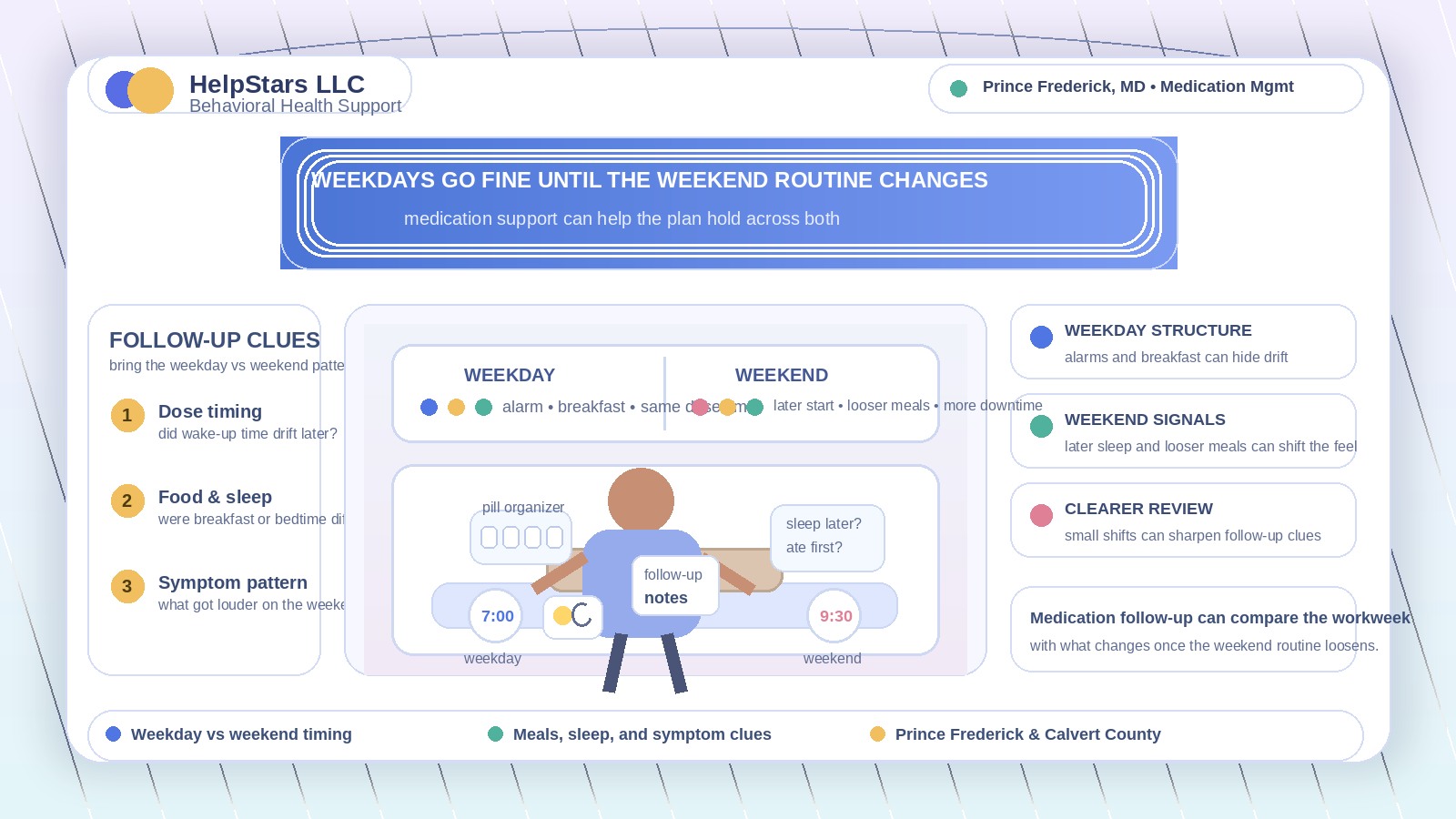
Weekdays Go Fine Until the Weekend Routine Changes: Medication Management for Adults Serving Prince Frederick, Maryland
Some medication concerns do not show up the same way every day. A person may feel reasonably steady from Monday through Friday, especially when the work alarm, school drop-off, commute, meals, and bedtime all happen in a fairly repeatable order. Then the weekend arrives, the structure changes, and the same plan suddenly feels less predictable. Sleep shifts later. Meals move around. The morning starts slower. An errand runs long. By Sunday evening, the person is left wondering why a medication that seemed manageable during the week now feels less reliable.
For adults seeking medication management serving Prince Frederick, Maryland, that pattern can be important. The issue may not be that the prescription only works or only fails. It may be that the medication is landing inside two very different routines. If the weekday structure hides problems that become more obvious on weekends, a follow-up appointment can help sort out whether timing, consistency, side effects, or daily habits need a closer look.
HelpStars LLC supports adults across Southern Maryland with practical behavioral health services, including medication management. When a treatment plan feels steadier on workdays than on unstructured days, clearer review may help turn that confusing pattern into a more usable next step.
Why the Same Medication Can Feel Different Once the Routine Loosens
Medication does not happen in a vacuum. It interacts with sleep, food, stress level, timing, hydration, physical activity, and the pace of the day. During the week, many adults take medication at roughly the same hour because the rest of life keeps moving on a schedule. On the weekend, that structure may loosen just enough to expose problems that were already there.
The person may sleep later and take the medication later. They may skip breakfast, nap at a different time, stay up later Saturday night, or spend more of the day in a less active environment. Some adults also notice that symptoms feel louder on weekends because there are fewer external demands distracting them. The mind has more room to notice anxiety, irritability, sedation, emotional flatness, or the sense that the medication is not carrying them as evenly as they thought.
That does not automatically mean the prescription is wrong. It does mean the full weekly pattern deserves attention rather than only asking, "How is it going?" in a general way.
What This Pattern May Look Like in Real Life
Adults who run into this issue may notice things like:
- feeling more groggy or off-balance on weekends because medication and wake-up time drift later together,
- realizing the prescription seems harsher on an emptier stomach when weekday breakfast routines are missing,
- feeling more emotionally flat or restless during long unscheduled stretches than during busier workdays,
- having trouble falling asleep Sunday night after a weekend of inconsistent timing,
- wondering whether the medication is actually helping or whether weekday structure has simply been carrying more of the load, or
- starting Monday already unsettled because the weekend pattern threw off the whole reset.
These details matter because they can reveal that the question is not only whether the medication helps. The question may be under what conditions it helps most consistently.
A Prince Frederick Example: The Workweek Feels Manageable, but Sunday Feels Strange
Imagine an adult serving Prince Frederick, Maryland who takes medication regularly and believes the plan is going reasonably well. During the workweek, they wake up around the same time, grab breakfast, take the prescription, and move through a familiar sequence of responsibilities. They still have stress, but the days feel structured enough to hold together.
Then the weekend looks different. Saturday starts later. Breakfast gets delayed. Medication is taken at a different time. There is more downtime, less external structure, and more room to notice every internal shift. By afternoon, the person feels heavier, flatter, or more irritable than expected. Sunday night becomes its own problem because sleep timing has changed and the person does not feel ready to restart the week.
They may tell themselves the medication is probably fine because the workweek is mostly functional. At the same time, the weekend keeps producing the same confusing signals. That is the kind of pattern where medication management serving Prince Frederick, Maryland can help. A follow-up can look at whether the issue involves timing, food routines, side effects, symptom coverage, or the reality that an unstructured day reveals needs the current plan is not covering well enough.
How Medication Management Can Help Clarify a Weekday-Weekend Difference
Medication management can be especially useful when a person has more observations than conclusions. Depending on the situation, follow-up may help with:
- tracking whether the prescription feels different because of later doses, inconsistent meals, or sleep changes,
- sorting out side effects that only become obvious when the day is quieter or less scheduled,
- understanding whether weekend symptoms reflect medication timing, incomplete symptom control, or both,
- identifying habits that make the treatment plan more stable across all seven days,
- preparing clearer examples for the prescribing conversation instead of giving a vague "mostly okay," and
- deciding whether the current plan feels truly reliable or only reliable inside a narrow routine.
The goal is not to make weekends feel perfectly controlled. It is to understand why the plan shifts and what adjustments, if any, may help it hold more consistently.
Three Signs the Weekend Pattern Is Worth Bringing Up
- The medication seems to change with your schedule more than you expected. If later mornings or different meal timing reliably shift how the prescription feels, that is useful information.
- You keep describing the plan as fine "during the week." That qualifier may be the most important part of the story.
- Sunday night or Monday morning keeps getting harder after a looser weekend. A plan that works should not depend so heavily on one exact weekday rhythm that it falls apart whenever life relaxes a little.
These signs do not automatically mean a medication has failed. They do suggest that the current plan may need a closer, more detailed conversation.
What Can Make the Next Follow-Up More Useful
A person does not need perfect tracking to make this clearer. It often helps to bring a few concrete observations such as:
- what time the medication is usually taken on weekdays versus weekends,
- whether meals, caffeine, naps, or bedtime shift noticeably on days off,
- which symptoms become more obvious during unstructured time,
- whether the hardest part is Saturday morning, Sunday evening, or Monday restart, and
- what the person means when they say the medication feels "different" outside the workweek.
These examples help turn a vague concern into something clinically useful. The more specific the pattern, the easier it is to evaluate whether the issue is routine-related, side-effect-related, symptom-related, or some mix of all three.
Why This Matters in Calvert County
Adults serving Prince Frederick, Huntingtown, Chesapeake Beach, North Beach, Dunkirk, Lusby, and nearby Calvert County communities often balance work schedules, commuting, family responsibilities, errands, and treatment follow-through inside the same week. It is common for weekdays to feel more structured than weekends, especially when the person is trying to rest, catch up, or simply operate without the same external pacing.
That is part of why medication management serving Prince Frederick, Maryland can matter. If a treatment plan only feels stable when the week is tightly organized, it may be worth asking how well it is really supporting everyday life across different kinds of days.
Questions Adults Often Ask
Does this mean my medication is not working?
Not necessarily. It may mean the medication, timing, meals, sleep, or weekly routine need a closer look. A pattern that changes on weekends is still important to discuss.
What if I only notice problems when I have more downtime?
That can still be meaningful. Less busy time may make side effects or symptoms easier to notice, not less real.
Should I wait and see if it evens out on its own?
Sometimes more time helps, but recurring weekday-versus-weekend differences are worth tracking and bringing to follow-up rather than assuming they do not matter.
What if my schedule is never exactly consistent?
That is common. Medication management can still help by identifying which shifts seem to matter most and how to make the plan steadier across real-life routines.
A Reliable Plan Should Make Sense on More Than One Kind of Day
Many adults do not need a medication plan that only works inside one exact weekday script. They need a plan that still makes sense when life runs a little later, slower, quieter, or less predictable.
HelpStars LLC supports adults across Southern Maryland with practical behavioral health care, including medication management. For adults seeking medication management serving Prince Frederick, Maryland, clearer follow-up around weekend shifts, routine changes, and symptom timing may help turn a confusing pattern into a steadier treatment plan.