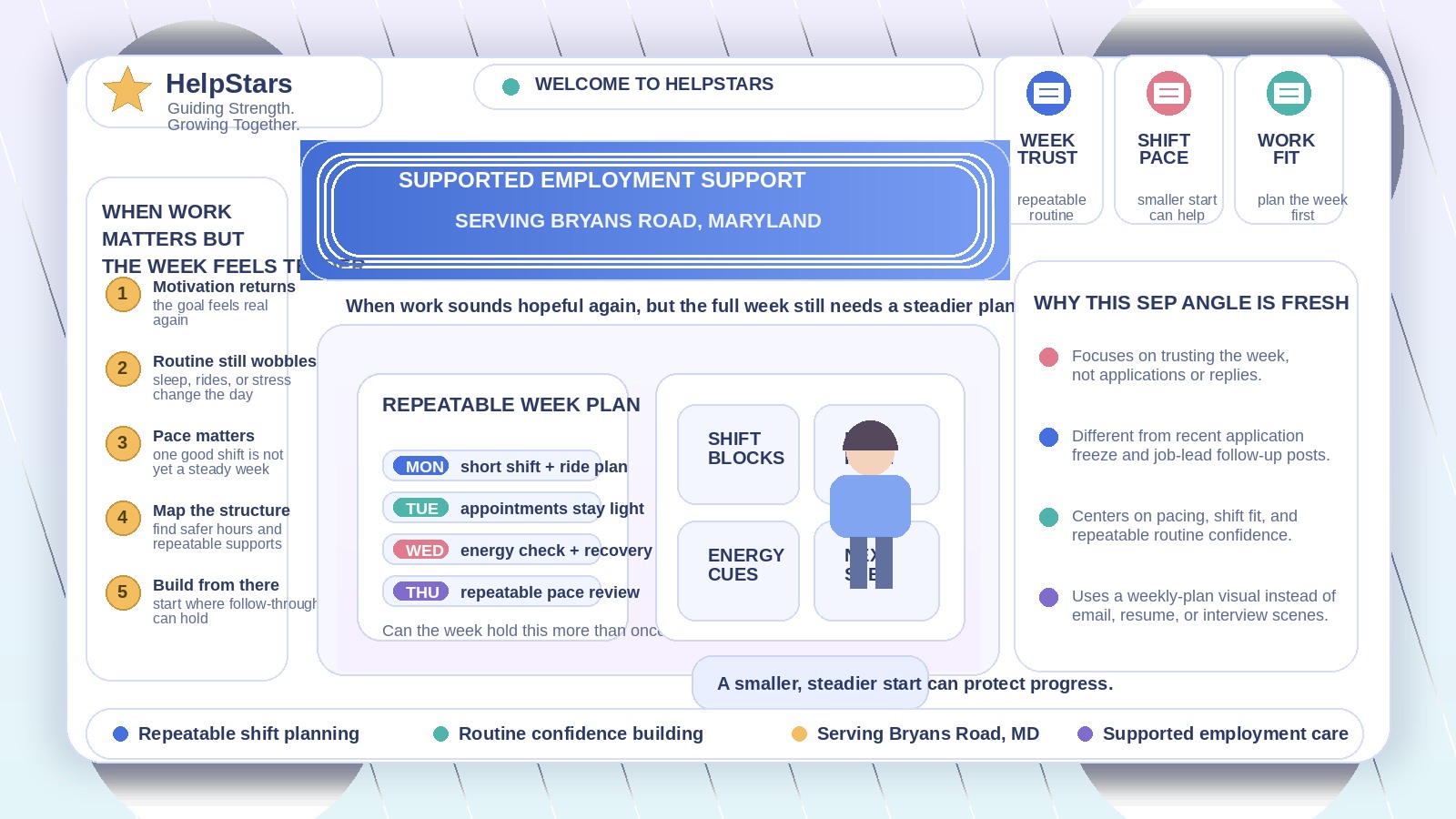
Wanting a Job Is Not the Same as Trusting Your Week Yet: Supported Employment for Adults Serving Bryans Road, Maryland
Some adults reach a point where the desire to work has already come back, but confidence in the week itself has not. They want structure, income, movement, and a reason to get up with direction again. What still feels uncertain is whether Monday energy will still be there on Wednesday, whether appointments and responsibilities can hold together across several days in a row, and whether one stressful moment will knock the whole routine sideways.
For adults seeking supported employment serving Bryans Road, Maryland, that gap matters. Wanting a job is important, but it is not the same as trusting that daily life is steady enough to carry one. Supported employment can help people move from vague hope toward a more realistic workweek plan by focusing on pacing, reliability, routine, and the practical supports that make employment easier to sustain.
HelpStars LLC serves adults and families across Southern Maryland with compassionate behavioral health support. When motivation is returning but schedule confidence is still fragile, employment-focused support can help adults sort out what kind of work pace fits the life they are rebuilding.
Why Readiness Can Feel Real One Day and Uncertain the Next
Returning to work is not always blocked by a lack of interest. Often, the harder question is whether the person trusts their own consistency yet. A good morning can make employment feel possible. A hard afternoon, missed task, rough night of sleep, or overloaded appointment week can make the same goal feel too risky again.
That push-pull can sound like:
- “I want to start working, but I do not know if my routine can hold,”
- “I can picture the job, but I cannot picture the whole week,”
- “If I commit too fast and fall apart, I will feel worse than before,”
- “I am more motivated now, but motivation is not my only issue,” or
- “I need something I can repeat, not just something I can do on one good day.”
Those worries are not laziness. They are often a sign that the person is thinking beyond the excitement of getting hired and considering what it would take to stay steady after starting.
Supported Employment Can Help Test the Week, Not Just Chase the Job
Some employment advice moves too quickly from “Do you want to work?” to applications, interviews, and openings. But for adults recovering stability, the more useful work may begin earlier. Supported employment can help break readiness into smaller, practical questions:
- What time of day is most dependable right now?
- How many structured commitments can the week carry before stress spikes?
- What transportation, sleep, medication, appointment, or family factors make mornings or afternoons harder?
- Would part-time, fewer shifts, or a narrower role create a better starting point?
- What signs show the routine is becoming repeatable instead of fragile?
This changes the goal. Instead of proving readiness in one leap, the person can start building evidence that the week is becoming more workable.
A Bryans Road Example: The Goal Is Back, but the Schedule Still Feels Delicate
Imagine an adult serving Bryans Road, Maryland and nearby Charles County communities who has begun feeling more interested in work again after a hard period. Their sleep is more stable than it was. They are getting through more errands. They are more open to routine. On the surface, it looks like it might be time to jump back in.
But when they picture an actual job, the real worry surfaces: not the interview itself, but the repeatability of the week. Will the early mornings hold? What happens if one appointment runs late? What if the commute drains too much energy by day three? What if a stressful interaction changes the rest of the shift? The person is not saying no to work. They are saying they do not yet want to build a return on wishful thinking alone.
Supported employment can help because it makes room for that realism. The work may begin with weekly structure, capacity, and pacing instead of pushing the person straight into an all-or-nothing decision.
Four Signs the Main Need Is Schedule Confidence, Not More Motivation
- You can imagine working, but not a full repeatable week. The idea of employment feels possible in theory, while the day-to-day rhythm still feels hard to trust.
- One disrupted routine affects the whole day. Sleep changes, transportation stress, appointments, or emotional overload still have a bigger ripple effect than they used to.
- You are more afraid of losing momentum than of trying. The fear is not only rejection. It is starting too fast, burning out, and feeling set back.
- You need a job plan that matches recovery, not just ambition. A role can sound good on paper and still be poorly timed if it ignores current energy, routine, and support needs.
These signs do not mean work is off the table. They suggest that supported pacing may matter more than pressure.
What Supported Employment Can Help Build Before and During Re-Entry
Employment-focused support can be useful not only for finding openings, but for shaping a steadier launch. Depending on the person’s situation, that may include:
- mapping a weekly schedule to see where work could fit without overwhelming the rest of life,
- identifying the most sustainable shift windows rather than the most impressive option,
- planning transportation, recovery time, and routine supports around work expectations,
- starting with a smaller pace that protects consistency,
- tracking what helps the week stay more predictable, and
- building confidence through repeatable follow-through instead of pressure-heavy leaps.
The goal is not to lower standards for the person. It is to help the work plan fit reality closely enough that success becomes easier to repeat.
Why Part-Time or Gradual Re-Entry Can Be a Strength, Not a Failure
Some adults worry that if they do not jump straight into the fullest schedule available, they are already falling behind. But a smaller starting point can sometimes protect the bigger goal. When someone is rebuilding trust in their routine, a gradual re-entry may create the consistency needed for longer-term stability.
That may mean fewer shifts at first, more predictable hours, a role with clearer task structure, or a job search focused on sustainability rather than speed alone. Supported employment can help frame those decisions as strategic rather than shameful.
Why Daily-Life Stability Matters in Charles County
For adults serving Bryans Road, Indian Head, Waldorf, White Plains, La Plata, and nearby Charles County communities, employment decisions live inside real schedules. Transportation, appointments, family responsibilities, medication routines, sleep quality, and stress recovery all shape what a workable job plan actually looks like. A return-to-work decision is stronger when it respects those details instead of pretending they are minor.
This is one reason schedule trust matters so much. A person may be ready in spirit long before they feel ready in structure. Supported employment can help close that gap by turning recovery progress into a more concrete weekly plan.
Questions Adults Often Ask About Return-to-Work Readiness
What if I want to work but still doubt my consistency?
That is a common reason people look for employment support. The next step may be building a more realistic starting plan rather than forcing a bigger commitment too soon.
Does supported employment only help with applications and interviews?
No. It can also help with pacing, schedule planning, job fit, and the practical structure needed to make work more sustainable.
What if part-time feels safer than full-time right now?
That can still be a valid and strategic starting point. A smaller, steadier beginning may support stronger follow-through over time.
How do I know whether the week is ready enough?
Often, the answer comes from looking at repeatable routine patterns: sleep, transportation, energy, appointments, recovery time, and how much disruption the week can absorb without unraveling.
A Work Plan Can Start With Trusting the Week More Than Yesterday
Returning to work does not always begin with the perfect opening. Sometimes it begins with a more honest schedule, a smaller starting point, and better proof that the week can hold what the person hopes to build. That kind of trust can matter just as much as motivation.
HelpStars LLC serves adults and families across Southern Maryland with compassionate behavioral health support. For adults seeking supported employment serving Bryans Road, Maryland, support around pacing, routine, and return-to-work planning may help turn a fragile goal into a steadier next step.