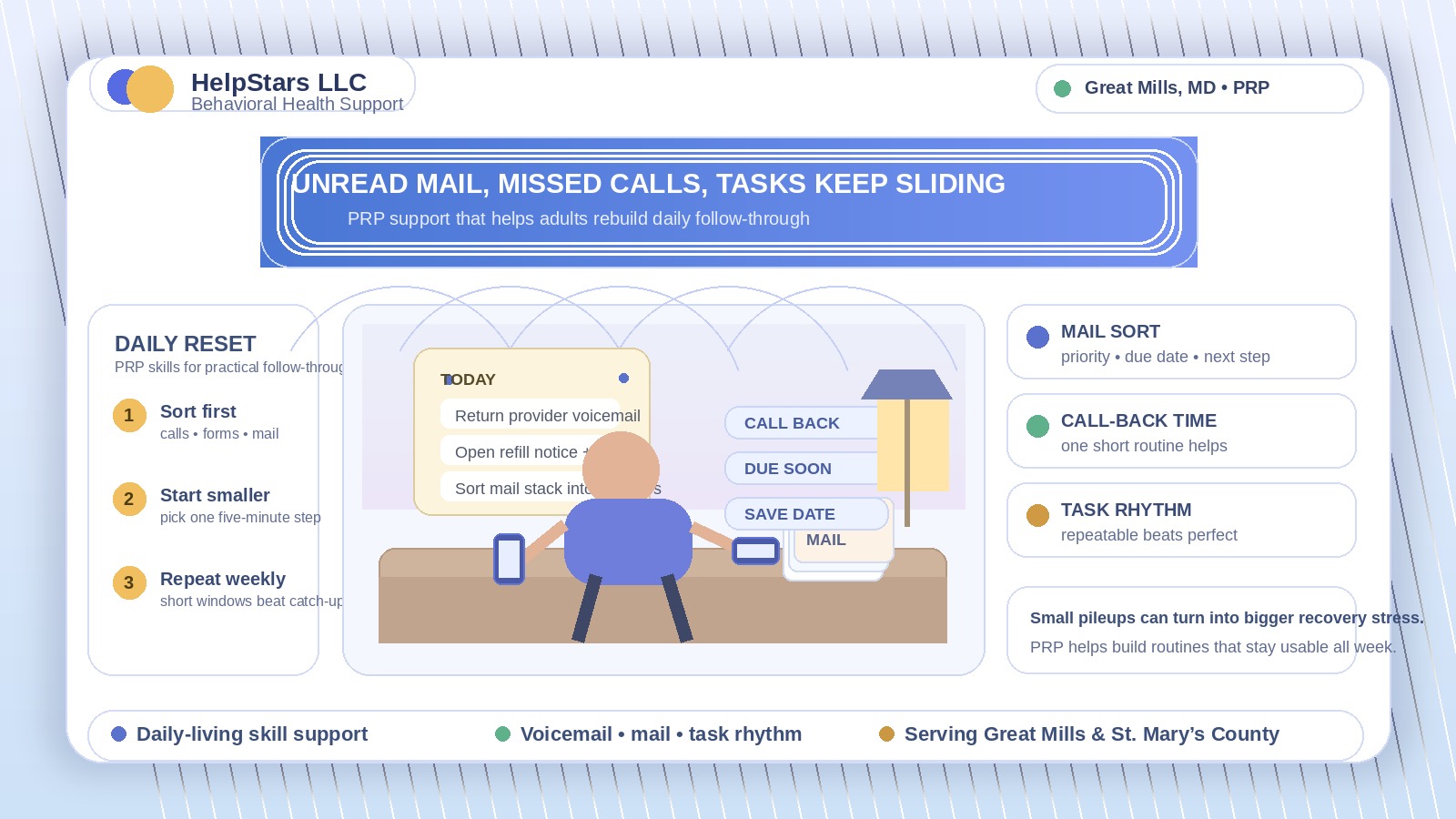
Unread Mail, Missed Calls, and Tasks That Keep Sliding: PRP Support for Adults in Great Mills, Maryland
The stack usually starts with something small. One envelope gets set aside after dinner. One voicemail can wait until tomorrow. One pharmacy question feels easier to handle later in the week. Then later keeps moving. Before long, the kitchen counter is crowded, the missed call list feels accusatory, and simple follow-through starts carrying more pressure than the original tasks ever did.
For adults in Great Mills, Maryland, that pattern is not always about laziness or lack of care. Sometimes depression, anxiety, medication changes, burnout, executive-function strain, or a hard season of life can make ordinary household follow-through feel much harder to start and much harder to finish. PRP services can help when daily living tasks keep slipping often enough that stress starts building on top of stress.
At HelpStars LLC, psychiatric rehabilitation support is meant to be practical. The goal is not to create a perfect system overnight. The goal is to help adults build steadier routines, reduce avoidable pileups, and make day-to-day life feel more manageable again.
Why Small Tasks Can Start Feeling Bigger Every Week
Most people have put off a phone call or ignored a letter at some point. The problem is not one delayed task. The problem is what happens when delays begin linking together. A missed callback can postpone an appointment. A postponed appointment can affect medication follow-up, paperwork, or transportation planning. An unopened letter can sit long enough to become something that feels scary to face. The longer the pile sits, the more emotional weight it tends to gather.
Adults often describe this as knowing exactly what needs to be done but feeling stuck at the point of starting. That stuck point may sound like:
- "I keep thinking about it, but I still do not do it,"
- "If I open that letter, I am worried there will be three more problems inside,"
- "I miss the best time to call back, then I avoid it for another day,"
- "Every unfinished task makes the whole apartment feel heavier," or
- "By the time I have energy again, there is too much to sort through."
When this pattern keeps repeating, daily life can start feeling less stable even if the individual is trying hard. That is where structured rehabilitation support can matter.
What PRP Support Can Look Like When Follow-Through Is Breaking Down
Psychiatric Rehabilitation Program services focus on the practical side of recovery and daily functioning. For one person, that may mean building a weekly rhythm for handling mail, reminders, and appointment tasks. For another, it may mean reducing the chaos around phone calls, medication pickups, forms, and home routines so that problems stop snowballing.
Depending on the person's needs, PRP support may help with:
- breaking large task piles into smaller steps that can actually be completed,
- creating a repeatable routine for checking voicemail, text messages, and paperwork,
- sorting which tasks are urgent, which can wait, and which need outside support,
- strengthening planning habits around appointments, refills, and deadlines,
- reducing the shame spiral that often makes unfinished tasks harder to face, and
- rebuilding confidence through practical wins instead of unrealistic pressure.
This kind of support is often helpful because many adults do not need another lecture about being organized. They need a realistic structure that matches the energy, symptoms, and stress level they are actually living with.
A Great Mills Example: The Counter Becomes the Stress Tracker
Imagine an adult in Great Mills who has been trying to hold daily life together while mental health symptoms keep shifting. They are not ignoring responsibilities on purpose. They fully intend to call back the provider, sort the forms, check the refill notice, and review the appointment date. But each task arrives at the wrong moment: when energy is low, when emotions are already stretched, or when starting one task means discovering three more.
Over time, the kitchen counter becomes a kind of stress tracker. There is unopened mail near the microwave, a note about a callback tucked under a grocery receipt, and a phone notification that has been cleared without action three days in a row. Nothing looks dramatic from the outside, but the person feels behind all the time. Even a small new responsibility starts to feel like proof that they are failing.
PRP support can help interrupt that cycle. Instead of treating the pile as one overwhelming personal flaw, the work becomes more concrete: What belongs in today's five-minute task list? What needs a calendar block? What needs support during business hours? What task is being avoided because it feels confusing rather than because it is actually large? When the pattern gets named clearly, follow-through often becomes more reachable.
Four Pressure Points PRP Often Helps Untangle
- Task initiation. Many adults are not blocked by the size of a task as much as the friction of beginning it. A routine, prompt system, or step-by-step sequence can reduce that starting barrier.
- Backlog fear. People often avoid a pile because they assume it hides bad news, conflict, or multiple decisions. PRP support can help sort the pile into manageable categories instead of leaving it as one vague stress object.
- Time drift. Calls that need business hours, forms that need signatures, and refills that need lead time can all fall apart when the week has no reliable task rhythm. Rebuilding that rhythm matters.
- Shame-based avoidance. After missed callbacks or delayed tasks, many adults feel embarrassed enough to avoid the next step too. Practical support can help reduce that all-or-nothing spiral.
These are not character flaws. They are common breakdown points in daily functioning, especially when mental health symptoms are already pulling attention, motivation, sleep, or emotional steadiness in the wrong direction.
Why This Matters Beyond a Cleaner Counter
Unread mail and missed calls can sound minor until they start affecting treatment, benefits, housing communication, budgeting, transportation planning, family tension, or the ability to keep a week on track. A person may still care deeply about recovery and still struggle to manage the practical steps that recovery depends on.
That is one reason PRP services can be valuable. The support is not just about tidiness. It is about protecting daily stability. When adults can respond to messages sooner, keep appointments straighter, and reduce task pileups before they become crises, the whole week often becomes easier to carry.
Support Works Better When the Plan Fits Real Life in St. Mary’s County
Daily routines in Great Mills and nearby St. Mary’s County communities happen around real schedules: rides, work shifts, school pickups, refills, benefit notices, care coordination, and household responsibilities. A support plan has to fit that reality. A good routine is not the one that sounds best on paper. It is the one a person can repeat on an ordinary Tuesday.
That may mean setting a short weekly mail sort instead of waiting for a perfect free afternoon. It may mean choosing one call-back window instead of hoping energy appears at random. It may mean pairing task time with a support visit, a checklist, or a visual cue that reduces the effort of deciding where to begin.
Questions Adults and Families Often Ask
Is this really something PRP services can help with?
In many cases, yes. PRP support is often centered on practical day-to-day functioning, routines, and skill-building that can make independent living and recovery support easier to maintain.
What if the person knows what to do but still is not doing it?
That is common. Knowing the steps and being able to start them consistently are not always the same thing. Support can focus on reducing barriers to action, not just repeating instructions.
Does struggling with follow-through mean someone is not trying?
No. Many adults are trying hard while also feeling overwhelmed, depleted, distracted, ashamed, or unsure where to start. The outside task list may look simple even when the inside experience is not.
Can PRP support work alongside counseling or medication management?
Often, yes. Depending on the individual's needs, psychiatric rehabilitation may complement outpatient counseling, medication management, or other behavioral health services by addressing what happens between appointments in everyday life.
Practical Recovery Sometimes Starts With One Surface, One List, and One Returned Call
Progress does not always begin with a major breakthrough. Sometimes it begins with opening the first envelope, identifying the one callback that matters most today, and building a routine that keeps tomorrow's tasks from becoming next week's dread. That kind of momentum can matter more than people expect.
HelpStars LLC serves adults and families across Southern Maryland with compassionate behavioral health support. For adults in Great Mills whose mail, messages, and unfinished tasks keep turning into daily stress, PRP services may offer a more practical path back to steadier follow-through and day-to-day stability.