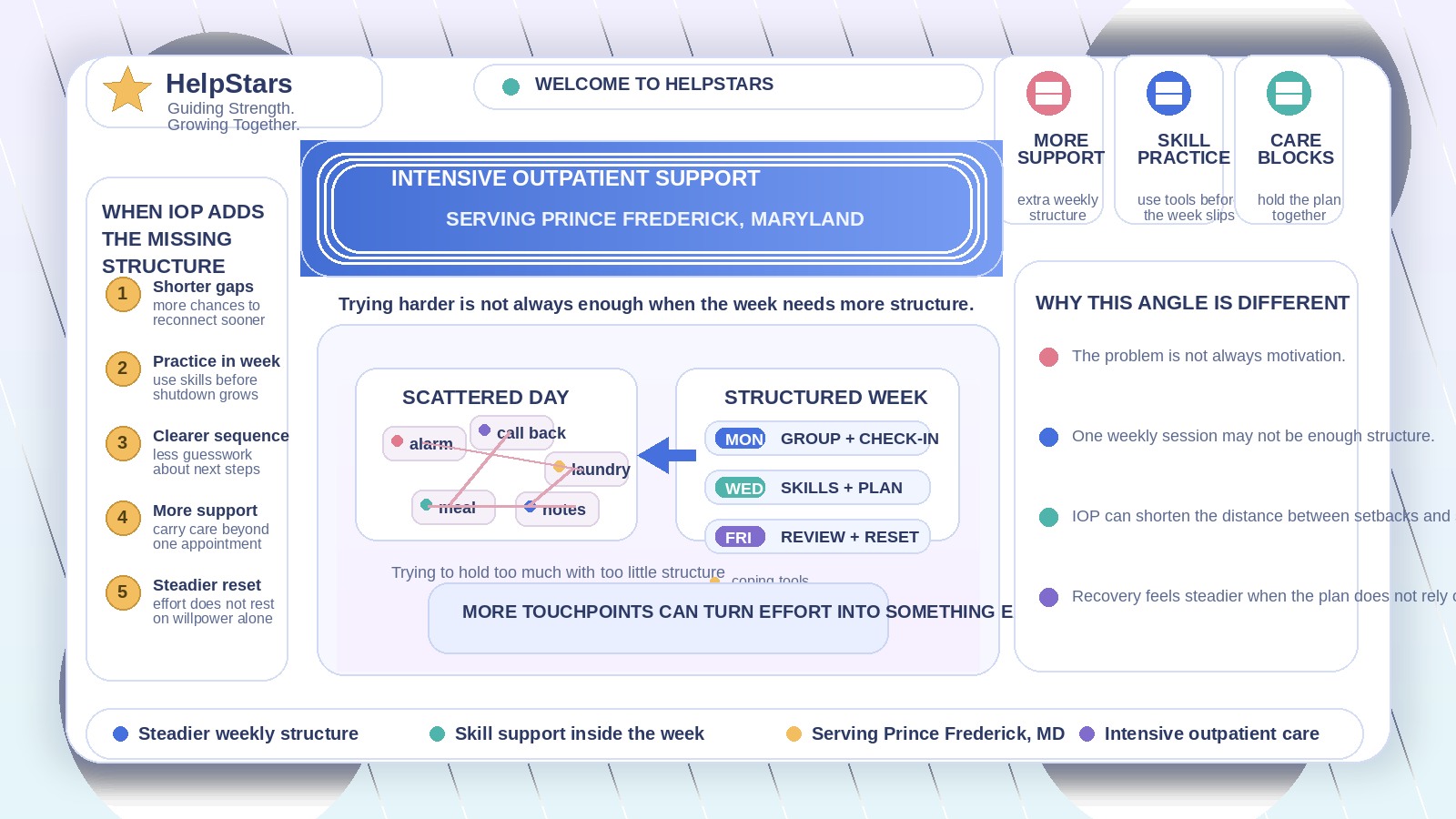
Trying Harder Is Not the Same as Having Enough Structure: How an Intensive Outpatient Program Can Help Adults Serving Prince Frederick, Maryland
Some adults are not running out of effort. They are running out of structure. They wake up with a reset plan, a list in their notes app, three alarms, and a real intention to do the day differently. By early afternoon, the plan has already thinned out. One hard phone call, one wave of anxiety, one emotionally heavy appointment, or one lost hour can turn the rest of the day into another private promise to start over tomorrow.
For adults looking for an intensive outpatient program serving Prince Frederick, Maryland, that pattern can be an important clue. The problem may not be that the person does not care, does not want help, or is refusing to try. The problem may be that weekly support is not enough to hold the week together once stress starts moving through it.
HelpStars LLC supports adults and families across Southern Maryland with compassionate behavioral health services. When life keeps asking more of a person than their current structure can carry, a higher level of organized outpatient support may help create a steadier path forward.
The Week Can Keep Collapsing Even When Motivation Is Real
People are often told to be more disciplined when routines keep slipping. But many adults are already pushing themselves hard. They may be making calendars, rewriting to-do lists, setting phone reminders, trying breathing exercises, and promising themselves that this time they will stay on top of everything. The issue is not always willingness. Sometimes it is the amount of unsupported recovery work happening between appointments.
That can sound like:
- “I keep making plans that look reasonable at 8:00 AM and impossible by 2:00 PM,”
- “I am trying, but my week keeps breaking in the same places,”
- “One rough morning throws off everything after it,”
- “I do better for a day or two and then lose the thread again,” or
- “I do not think I need a hospital, but I know this is not working well enough.”
That middle zone matters. Some adults do not need crisis-level care, yet they also do not have enough support with only occasional touchpoints. When that gap stays unaddressed, people can begin blaming themselves for a structure problem they did not create by laziness.
Why Self-Made Recovery Systems Often Break Under Too Much Weight
Personal routines can help, but they have limits. A handwritten checklist cannot always compete with depression, panic, irritability, shutdown, attention drift, sleep disruption, or the emotional aftereffects of difficult conversations. A person may know exactly what they meant to do and still watch the day get pulled off course by symptoms, overload, or sudden avoidance.
That is one reason adults sometimes feel confused by their own inconsistency. The knowledge is there. The intention is there. The plan may even be thoughtful. But the plan depends on the same depleted energy and self-direction that the person is already struggling to protect.
When that happens repeatedly, the week can start to feel like a string of resets rather than actual recovery. Monday becomes the day to regroup. Tuesday feels a little better. Wednesday gets interrupted. Thursday turns into catch-up plus guilt. By Friday, the person is exhausted by how much of their energy has gone toward reassembling the plan instead of living inside it.
What an Intensive Outpatient Program Can Add
Intensive outpatient support can help when the main need is more structure, more contact, and more chances to reconnect before the whole week slips further away. Rather than depending on one appointment to carry the next several days, adults may benefit from a more organized level of care that helps treatment stay active inside the week.
Depending on the person’s needs and program structure, that support may help with:
- creating more frequent therapeutic touchpoints across the week,
- building practical coping routines that are reinforced instead of only discussed once,
- catching withdrawal, overwhelm, or shutdown patterns earlier,
- making recovery steps feel more sequential and less improvised,
- connecting skill-building to the actual moments when the week starts unraveling, and
- reducing the gap between “I know what would help” and “I can actually follow through today.”
The goal is not to prove that someone has failed at ordinary outpatient care. The goal is to match the support level more honestly to the amount of structure the person needs right now.
A Prince Frederick Example: The Person Keeps Rebuilding the Same Week
Imagine an adult serving Prince Frederick, Lusby, Huntingtown, Dunkirk, Chesapeake Beach, North Beach, Solomons, or another Calvert County community who keeps trying to hold life together with determination alone. They may still be showing up for some responsibilities. They may still answer a few texts, attend some appointments, or get a couple of solid days in each week. From the outside, it can look like they are almost back on track.
But inside the week, the pattern feels different. Mornings require too much recovery energy. Emotional setbacks spread faster than expected. A hard conversation or one missed task can make the rest of the day feel unusable. The person is not ignoring their mental health. They are actively trying to manage it, but the effort keeps happening in isolation and under pressure.
By the time the next appointment arrives, they may not even know how to explain what happened. They only know the same story keeps repeating: “I meant to stay on top of things, and then it got away from me again.” That is the kind of pattern where an adult mental health IOP serving Prince Frederick, Maryland may be worth exploring. More structure can help the person stop rebuilding from scratch so often.
Five Signs the Main Problem May Be Structure, Not Caring
- The person keeps restarting with sincerity. They are not shrugging the problem off. They are making real attempts over and over, but the follow-through will not hold for long.
- One disruption changes too much. A difficult morning, conflict, bad night of sleep, or missed task seems to alter the rest of the day or several days after it.
- The gap between appointments feels too long. Insight may be building in session, but the person is struggling to carry it through ordinary daily stress.
- Shame is beginning to replace clarity. Instead of noticing what support is missing, the person starts concluding they are simply failing at adulthood or recovery.
- The person seems to need more than emergency help but more than weekly help too. They may not be describing an immediate crisis, yet the current support level is clearly not enough to stabilize the week.
These signs do not automatically mean the same solution fits everyone. They do suggest that a higher-structure outpatient option may be a better question than “Why can’t I just do this on my own?”
More Structure Can Protect Progress Before Things Escalate Further
Adults sometimes wait too long because they think added support should only be considered when life becomes unmanageable in a dramatic way. In reality, the better moment to ask about structure may be earlier, while the person is still reachable, still trying, and still able to describe the places where follow-through keeps slipping.
That matters because recovery often erodes in ordinary ways before it collapses in obvious ones. Meals get skipped. Messages sit unanswered. Sleep shifts. Appointments become harder to prepare for. Home tasks build up. People start avoiding situations that feel too demanding to handle on a low reserve. The week may still look functional in pieces while becoming less sustainable overall.
A structured outpatient mental health support option serving Calvert County can matter at exactly that stage. The value is not only symptom discussion. It is helping the person carry treatment, coping skills, and accountability through the part of the week where things usually start to slide.
Why Local Routine Still Matters in Calvert County
Adults serving Prince Frederick and surrounding Calvert County communities are often balancing commuting, household responsibilities, childcare, medical appointments, family tension, and the long mental load of staying organized while already under stress. A care plan that sounds manageable in theory may still be too thin for the actual week a person is living.
That local reality matters. Support works better when it reflects real timing, energy, transportation, and routine demands instead of assuming every adult can recover on a blank schedule. More structured care can be especially helpful when the problem is not understanding what matters, but keeping enough traction to keep doing it consistently.
Questions Adults Often Ask About Needing More Structure
Does needing an intensive outpatient program mean I failed at weekly therapy?
No. It may simply mean the current level of support is not enough for what the week is asking of you right now. Different stages of recovery can need different levels of structure.
What if I am functioning in some areas and struggling badly in others?
That mixed picture is common. Many adults can still handle parts of daily life while quietly losing ground in consistency, follow-through, emotional regulation, or routine stability.
Do I have to wait until things get much worse before asking about more support?
Not necessarily. Earlier structure can be helpful precisely because it may support the person before the week becomes harder to recover.
Can more support help if I already know what coping skills I am supposed to use?
Often, yes. Sometimes the biggest barrier is not knowing the skills. It is having enough support and repetition to use them when the hard part of the week actually arrives.
Relief Can Start When the Plan Stops Resting on Willpower Alone
Some adults do not need another lecture about discipline. They need a care structure that matches how much effort recovery is already taking. More support is not a personal defeat. Sometimes it is the first honest adjustment that makes the week feel more livable.
HelpStars LLC serves adults and families across Southern Maryland with compassionate behavioral health services. For adults looking for an IOP program serving Prince Frederick, Maryland, more structured outpatient support may help turn repeated resets into something steadier, more supported, and easier to hold onto.