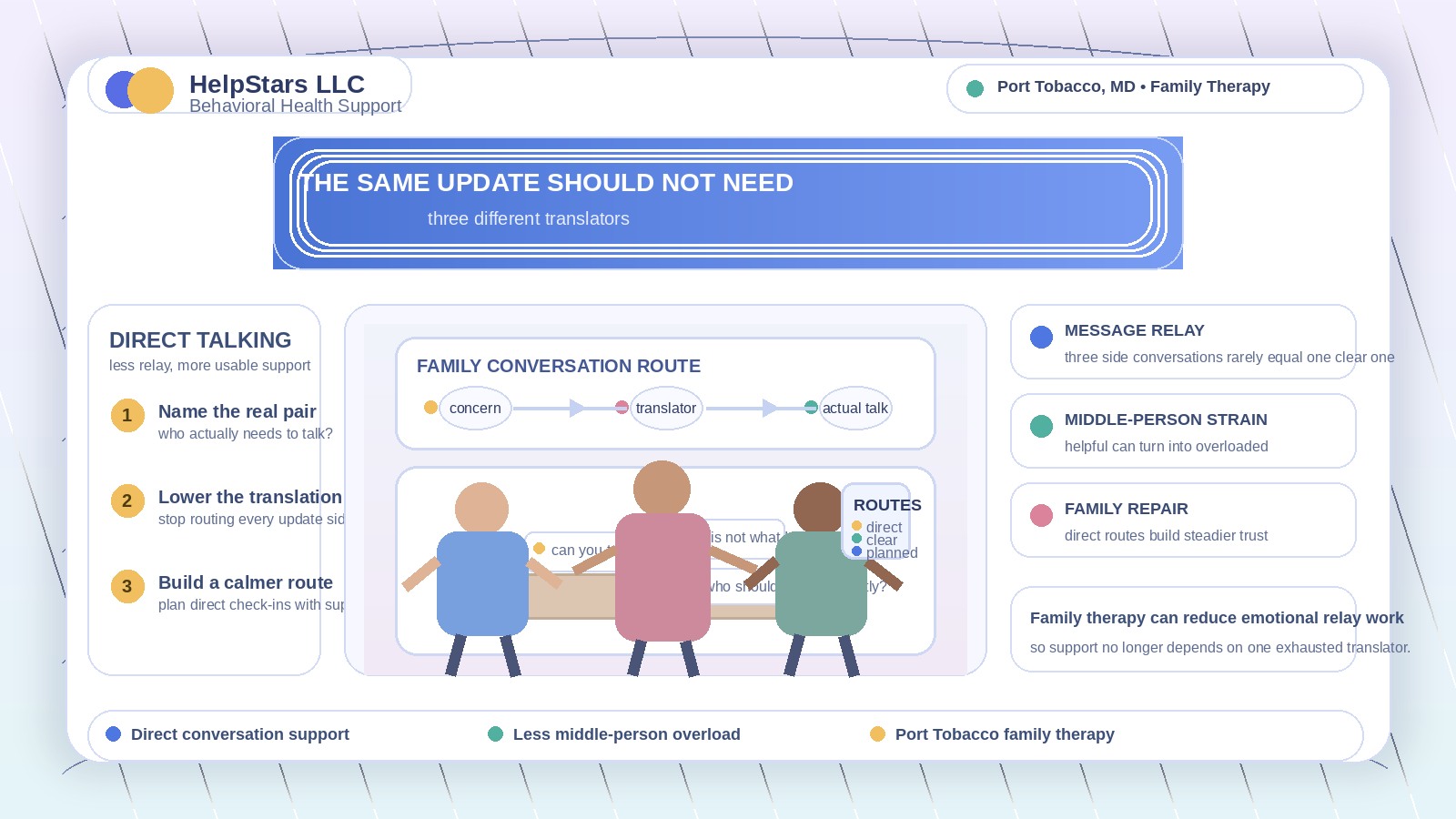
The Same Update Should Not Need Three Different Translators: Family Therapy for Adults Serving Port Tobacco, Maryland
Sometimes a family problem is not a lack of caring. It is that the same message keeps moving through the house in pieces. One person tells Mom what the brother really meant. Later that same person explains to the brother why Mom sounded sharper than she intended. By evening, they are updating a partner, smoothing over a misunderstanding, and trying to remember who actually asked for what in the first place. The conversation never stays between the people who need to have it. It keeps passing through a third person who slowly becomes the family’s translator, shock absorber, and cleanup crew.
For adults seeking family therapy serving Port Tobacco, Maryland, that pattern can wear everyone down. The issue is not only miscommunication. It is that one relative may start carrying too much of the emotional traffic for the whole family. A family therapy process can help families step back from that go-between role, understand why it formed, and build more direct ways to talk about stress, treatment, expectations, and concern without forcing one person to keep managing the meaning for everyone else.
HelpStars LLC supports adults and families across Southern Maryland with compassionate behavioral health services. When support conversations keep needing a translator before they can even begin, structured family therapy may help the household create a steadier and more direct way of communicating.
How a Go-Between Role Quietly Forms
Most families do not sit down and choose one person to become the interpreter. The role usually develops because it seems useful at first. Maybe one relative is calmer under pressure. Maybe they are easier to talk to than the person who is struggling most. Maybe they have better availability, respond to texts faster, or know enough of the treatment background that other family members keep going to them first.
At the beginning, this can look helpful. The go-between relays an update, softens a tense message, reminds someone about an appointment, or explains what a loved one “really meant.” For a while, the arrangement may even lower conflict.
But the role often grows. Soon the same person is:
- repeating one family member’s concerns to another instead of those two people speaking directly,
- editing messages so no one gets upset too quickly,
- holding private frustrations from multiple sides at once,
- being expected to remember who was told what and when, and
- feeling responsible for whether the conversation goes well before it has even started.
That is where the pattern stops being simple support and starts becoming a burden. The household may look calmer on the surface while one person quietly absorbs more and more strain underneath it.
Why This Role Usually Creates More Confusion Than Clarity
A go-between can pass along information, but they cannot perfectly carry tone, timing, fear, history, or emotional meaning. Every handoff changes something. One person hears a softened version of the concern. Another hears only the defensive part of the reply. Someone starts feeling talked about instead of talked with. Another person thinks they were being careful, while the person on the receiving end feels managed or excluded.
Families often get stuck in problems like these:
- the original concern gets diluted or reshaped by the time it reaches the right person,
- people argue about whether something was said accurately,
- the go-between becomes the target when the message lands badly,
- direct relationships weaken because family members rely on side channels instead of direct repair, or
- one relative becomes emotionally overloaded while everyone else keeps assuming they are the “strong one” who can handle it.
In families already dealing with mental health stress, treatment decisions, missed responsibilities, or old hurts, that extra layer can make everything feel heavier. The issue is no longer just the original problem. The issue becomes the whole route the message had to travel to get there.
A Port Tobacco Example: The Household Starts Routing Everything Through One Adult
Imagine an adult serving Port Tobacco, Maryland whose family has been under strain for months. One relative is trying to stabilize appointments and daily routines. Another wants more follow-through at home. A third is worried but does not know how to raise concerns without sounding critical. Rather than speak directly, everyone begins leaning on the sibling who seems best at smoothing things over.
At first, that sibling feels helpful. They explain why an appointment was missed. They tell one person not to take a sharp tone personally. They reassure another that concern was not meant as control. But after a while, they are carrying updates before breakfast, clarifying texts during work, and replaying family conversations late at night so the next interaction will not explode.
The family then starts depending on the arrangement. Instead of learning how to speak more directly, each person becomes more likely to ask the middle-person what to say, what was meant, and whether now is a good time to bring something up. The sibling looks central to the family’s stability, but privately they are getting more frustrated, more tired, and less sure where their role ends.
That is the kind of pattern where family therapy serving Port Tobacco, Maryland can help. The goal is not to blame the go-between for helping. The goal is to stop requiring one person to carry conversations that belong in the actual relationships themselves.
What Family Therapy Can Help Untangle
Family therapy can help when households keep communicating through triangles instead of direct connection. In practical terms, support may help families:
- notice which conversations are repeatedly getting rerouted through a third person,
- understand what each family member is trying to avoid by using a go-between,
- separate legitimate support from over-functioning that is no longer sustainable,
- build more direct language for concern, boundaries, disappointment, and requests,
- reduce the pressure on one relative to monitor everyone else’s emotional reactions, and
- practice clearer agreements about who needs to talk to whom when an issue comes up.
The benefit is often bigger than better wording alone. When families stop routing everything through one person, they begin rebuilding trust in the relationships that had slowly become indirect.
Signs the Family Is Leaning Too Hard on a Translator Role
Families do not need perfect communication to notice this pattern. A few signs often stand out:
- One person knows too much about everyone else’s private frustration. They are hearing the full emotional version from every side.
- The same relative is always asked to explain what someone “really meant.” Direct communication keeps getting replaced by interpretation.
- Conflict looks delayed, not resolved. The household feels temporarily calmer, but the same issue keeps returning because the real conversation never happened directly.
- The go-between is starting to feel resentful, exhausted, or trapped. They may look capable while privately feeling like they cannot step away.
- Important treatment or home-routine discussions depend on side conversations first. Nobody trusts the main conversation to hold on its own.
These signs do not mean the family is failing. They usually mean the current method of holding things together is costing too much to keep using.
What Can Change Before the Next Message Starts Traveling in Circles
Families often need more than a reminder to “just communicate directly.” The shift works better when it becomes specific. That may mean:
- naming which topics should go directly to the person involved instead of through a relative,
- asking for permission before using someone else as the messenger,
- reducing the habit of sending emotionally loaded updates through text chains,
- agreeing on one calmer time for harder conversations instead of multiple side conversations all day, and
- letting the go-between step out of problems that are not actually theirs to carry.
Those changes can feel uncomfortable at first because the old pattern was functioning like a brace. But braces are not meant to become the body. If one person has been holding the conversation structure together alone, the family may need help learning how to tolerate a more direct style without immediately snapping back into old roles.
Why This Matters for Adults and Families in Charles County
Adults and families serving Port Tobacco, Maryland, Waldorf, White Plains, La Plata, Indian Head, Bryans Road, and nearby Charles County communities are often trying to manage treatment, transportation, home responsibilities, work stress, and concern about a loved one’s stability all at the same time. Under that pressure, indirect communication can start to feel efficient even when it is quietly making the family more strained.
That is part of why family therapy serving Port Tobacco, Maryland can be valuable. A stronger communication process can help families move away from emotional relay systems and toward more direct, usable, and sustainable conversations.
Questions Families Often Ask
Is it always bad for one family member to help explain things?
No. Temporary support can be helpful. The problem is when one person becomes the default route for nearly every important conversation and starts carrying emotional responsibility that belongs to the whole family.
What if direct conversations usually go badly?
That can be an important reason to seek family therapy. The answer is usually not to rely forever on a middle-person. It is to build a safer structure for direct communication.
What if the go-between is the only person everyone will currently talk to?
That may show how important the role has become, but it can also show why the pattern is no longer sustainable. Therapy can help the family use that awareness to build better communication rather than staying dependent on one person.
Can this pattern affect the person who is trying to get support too?
Yes. When messages keep passing through others, the person at the center of concern may feel managed, misunderstood, or left out of conversations that are supposedly about helping them.
A Family Usually Needs a Better Route, Not a Stronger Messenger
When the same update keeps needing three different translators, the family may not need one relative to work harder. It may need a more honest and more direct route for care, concern, and problem-solving.
HelpStars LLC supports adults and families across Southern Maryland with compassionate behavioral health services. For adults seeking family therapy serving Port Tobacco, Maryland, structured support may help the household stop leaning on one exhausted translator and start building conversations the family can carry together.