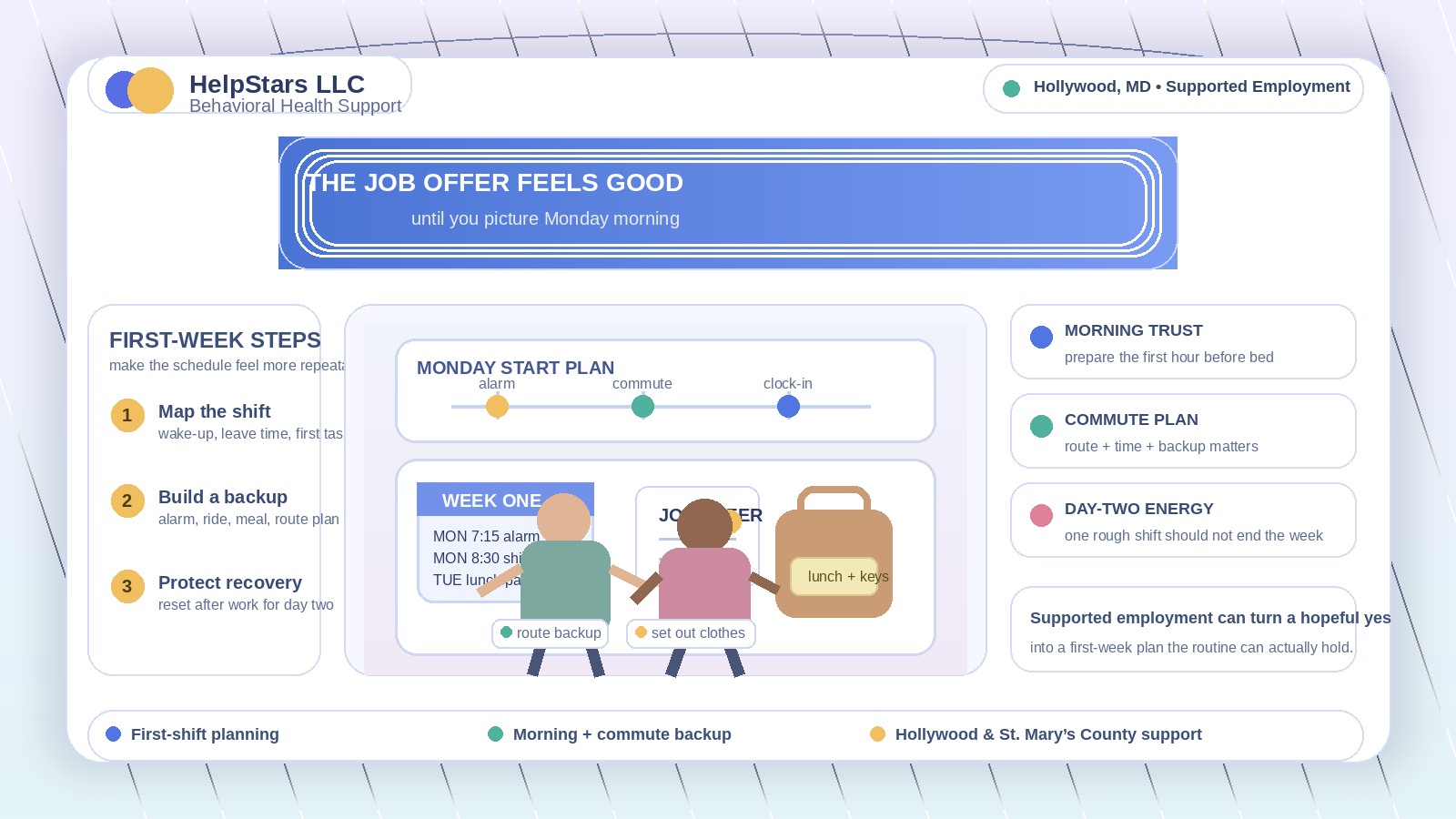
The Job Offer Feels Good Until You Picture Monday Morning: Supported Employment for Adults Serving Hollywood, Maryland
Sometimes the hardest part is not getting a job offer. It is what happens a few hours later, when the excitement fades just enough for the real questions to arrive. What time do I need to wake up every day? How long will the commute actually feel? What happens if my sleep goes off on Tuesday? What if the first shift drains me so much that the second one already feels out of reach? A person can genuinely want the job and still feel afraid of the routine that comes attached to it.
For adults seeking supported employment serving Hollywood, Maryland, that fear can be important to name. The problem is not always motivation. Sometimes the offer itself feels possible, but the Monday-through-Friday structure around it feels much harder to trust. Supported employment can help break that first-week pressure into smaller, more practical steps so the return to work feels more manageable and less like one giant test of readiness.
HelpStars LLC supports adults and families across Southern Maryland with compassionate behavioral health services, including supported employment. When the offer is welcome but the first real schedule feels shaky, structured job support may help turn that nervous yes into a steadier plan.
Why a Job Offer and a Work Routine Can Feel Like Two Different Challenges
A job offer gives people something clear to react to. There is a position, a start date, a schedule, and often a sense of relief that progress is finally happening. But once that first relief settles, a second layer of pressure often shows up. Now the person has to picture getting there on time, repeating the routine, handling the social energy, recovering after shifts, and staying steady enough for the week to keep working.
That is a different challenge from interviewing or applying. Someone may have the skills, the interest, and the desire to work while still feeling uncertain about whether their current sleep, concentration, transportation habits, emotional bandwidth, or home routine can carry a new schedule. The fear is not necessarily, “I do not want this job.” The fear may be, “I do not know if my week can hold this yet.”
What This Can Sound Like in Real Life
- “I was excited until they gave me the exact start time.”
- “I think I can do the work, but I am worried about repeating the routine every day.”
- “It is not the interview that scares me now. It is the first full week.”
- “I do not want to say yes and then fall apart by Wednesday.”
- “The job looks good. I just do not trust my mornings yet.”
These reactions do not mean a person is lazy or ungrateful. They often mean the emotional and practical weight of the schedule has finally become real.
A Hollywood Example: The Offer Is Good, but the Week Already Feels Heavy
Imagine an adult serving Hollywood, Maryland who has been working hard to get back into employment. They update the resume, make the calls, get through the interview, and finally hear good news. A job offer comes through. On paper, this is exactly what they wanted.
Then the details start landing. The shift begins earlier than their current routine. The drive needs more consistency than they have been practicing. Lunch, clothes, alarms, transportation timing, and evening recovery all suddenly matter in a more immediate way. The person starts thinking less about the opportunity and more about the chain of small tasks required to survive the first week without unraveling.
That is where supported employment serving Hollywood, Maryland can help. Instead of treating the situation like a simple yes-or-no decision, support can focus on making the first week more workable. The question becomes less about whether the person deserves the job and more about what conditions will help them show up consistently once it starts.
How Supported Employment Can Help After the Offer Arrives
Supported employment is not only for finding openings. It can also help adults prepare for the transition from job offer to job routine. Depending on the person’s needs, support may help with:
- breaking the first workweek into practical steps instead of one overwhelming idea,
- planning wake-up, transportation, meals, clothes, and recovery routines around the actual shift,
- identifying where mornings, transitions, or energy dips are most likely to derail follow-through,
- creating realistic backup plans for alarms, rides, timing, and first-week stress,
- talking through whether the schedule fits the person’s current mental health and daily functioning, and
- building confidence through preparation rather than pressure alone.
The goal is not to pretend the first week will feel easy. The goal is to make it feel more thought-through, more repeatable, and less likely to collapse under avoidable stress.
Four First-Week Pressure Points That Often Matter More Than People Expect
- The morning sequence. Getting to work usually depends on several small steps happening in order. Sleep, alarms, getting dressed, finding what you need, and leaving on time can matter as much as the job itself.
- The commute reality. A route may look fine on paper and still feel much harder when it becomes part of every day. Timing, traffic, gas, rides, and stress tolerance all matter.
- The after-work recovery window. Some adults can manage the shift itself but have trouble resetting afterward, which makes the next day harder before it starts.
- The emotional meaning of one rough day. Early setbacks can feel bigger than they are. A hard Tuesday can quickly turn into “Maybe I was never ready,” unless the person has support for recalibrating instead of shutting down.
These pressure points are practical, but they also affect confidence. The first week often feels less threatening once the routine around it becomes more concrete.
Why “Just Push Through It” Usually Is Not Enough
Well-meaning people sometimes respond to work anxiety by telling someone to just commit and figure it out on the fly. That approach can work for some adults, but for others it creates a fragile start. If the routine was already barely held together, one missed alarm, one chaotic commute, or one exhausting shift can start a spiral of shame, panic, and withdrawal.
Supported employment can be useful because it treats preparation as part of success, not as proof of weakness. A stronger start may depend on practical structure: packing the night before, rehearsing timing, planning food and transportation, choosing a realistic bedtime, and thinking through how to recover after the shift without losing the next morning too.
Questions Worth Asking Before the First Day
- What part of this schedule feels least trustworthy right now?
- What normally makes mornings harder for me?
- What backup would help if the first plan slips?
- How much energy does the commute itself require?
- What would help me keep one hard day from turning into quitting the whole plan?
These are not negative questions. They are the kinds of practical questions that can make a work transition more sustainable.
Why This Matters for Adults in St. Mary’s County
Adults serving Hollywood, Leonardtown, California, Lexington Park, Great Mills, Mechanicsville, and nearby St. Mary’s County communities are often balancing employment goals with treatment, family responsibilities, transportation logistics, and the effort of staying emotionally steady through the rest of life too. Because of that, the first week of a new job can carry much more than a simple start date.
That is part of why supported employment serving Hollywood, Maryland can be valuable. The right support can help adults move from “I hope I can hold this together” toward “I have a plan for how this week will actually work.”
Questions Adults Often Ask
Is it normal to feel more nervous after getting the offer than during the interview?
Yes. The offer makes the routine real. Many adults feel more pressure once they start imagining the repeated daily schedule instead of the one-time interview.
Can supported employment help after I already got the job?
Yes. Support is not only about searching. It can also help with planning, transition, first-week readiness, and sustaining follow-through once work begins.
What if I want the job but do not trust my mornings?
That is often the kind of practical problem job support can help address. The goal is to make the routine more workable, not to shame the struggle.
Does needing this kind of preparation mean I am not ready?
Not necessarily. For many adults, preparation is exactly what makes readiness possible. A supported plan can be a strength, not a sign of failure.
A Steadier Start Usually Comes From a More Concrete Plan
A new job can represent progress, relief, and hope — but also real pressure. If the offer feels good until you picture Monday morning, that does not erase the progress. It simply means the routine deserves as much attention as the opportunity itself.
HelpStars LLC supports adults and families across Southern Maryland with compassionate behavioral health services, including supported employment. For adults seeking supported employment serving Hollywood, Maryland, practical job support may help turn a stressful first-week leap into a more realistic and repeatable work plan.