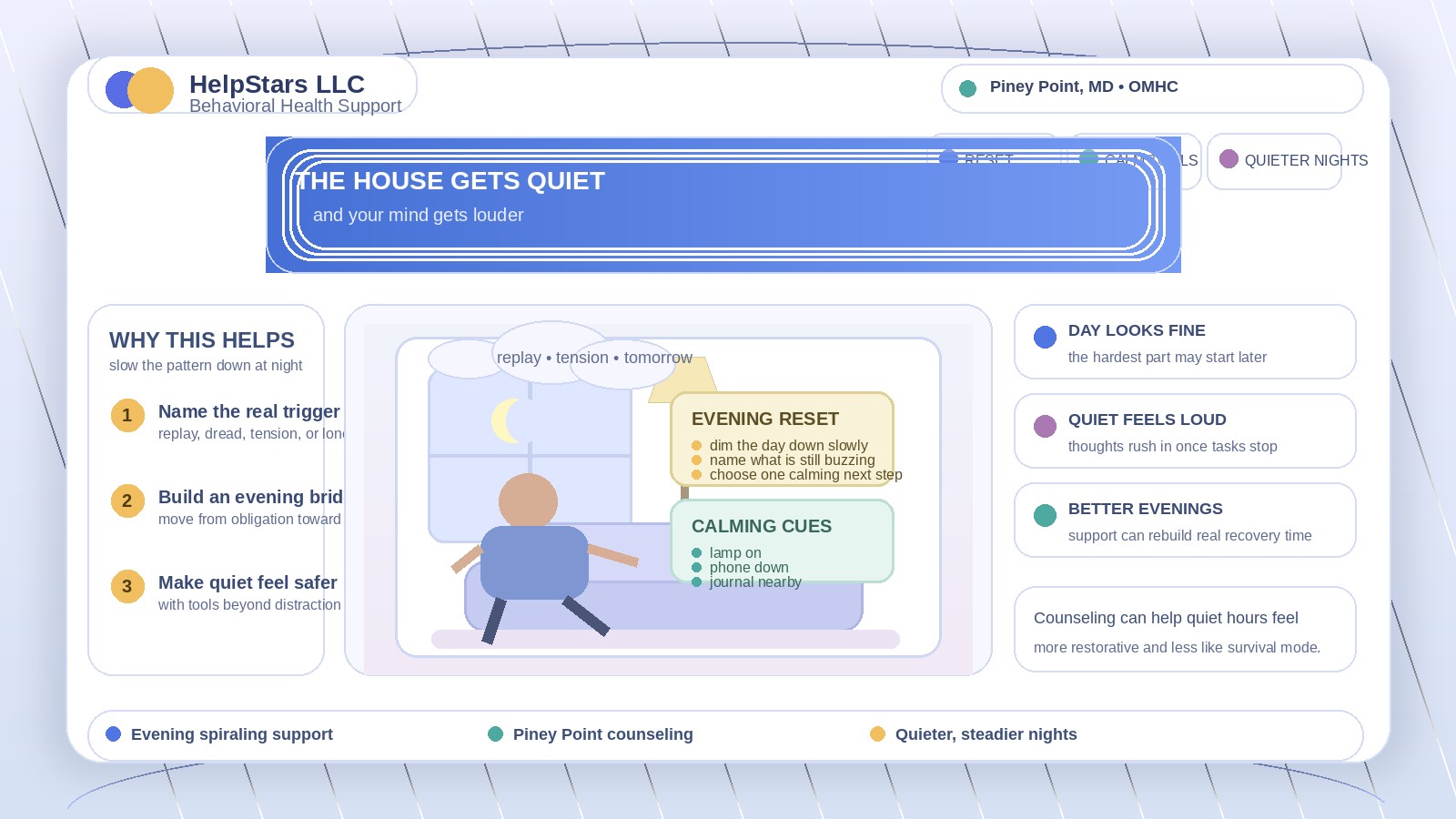
The House Finally Gets Quiet and Your Mind Gets Louder: Outpatient Mental Health Counseling for Adults Serving Piney Point, Maryland
Some adults do not feel most overwhelmed in the busiest part of the day. They feel it later, when the errands are over, the messages slow down, the room gets quieter, and there is finally space to notice what their mind has been carrying. That quiet should feel like relief. Instead, it can feel like replay, tension, dread, or a restless pressure to stay mentally on guard even when nothing urgent is happening.
For adults seeking outpatient mental health counseling serving Piney Point, Maryland, that pattern can matter. A person may keep functioning through work, family responsibilities, driving, appointments, or routine tasks and still discover that the hardest part of the day starts only once there is enough silence to feel everything that got pushed aside. Outpatient mental health counseling can help adults understand why quiet time feels so uncomfortable and how to make evenings and downtime more usable again.
HelpStars LLC serves adults and families across Southern Maryland with compassionate behavioral health support. For adults in St. Mary’s County who can hold it together until the day slows down and then feel emotionally flooded, counseling may offer a steadier place to sort out what is actually happening under the surface.
Why Quiet Can Feel Harder Than Activity
During the day, structure can do a lot of protective work. There are places to be, tasks to answer, people to respond to, and visible responsibilities that keep attention moving outward. Once that structure falls away, the internal backlog often becomes much easier to hear. Thoughts start replaying. Worries that were briefly muted return. The body may stay tense even though the schedule is finally lighter.
That can sound like:
- “I am fine while I am busy, but the minute it gets quiet I start spiraling,”
- “Nothing happened tonight, but I still cannot settle,”
- “My brain saves everything for later and then hits me with it all at once,”
- “I look forward to downtime and then feel worse inside it,” or
- “By the end of the day I am exhausted, but not actually calm.”
That experience does not always mean one single diagnosis. It can show up with anxiety, depression, trauma-related stress, burnout, prolonged overload, grief, or months of functioning in a way that leaves very little room to process what the day was costing.
The Problem Is Not Always the Silence Itself
Sometimes people assume that if quiet feels bad, the answer must be to stay distracted. But the issue is often not the silence alone. It may be what surfaces in silence: unfinished stress responses, second-guessing, loneliness, pressure to review every interaction, or a nervous system that has not really believed the day was safe enough to end.
For some adults, the evening turns into a strange mix of fatigue and alertness. They feel too tired to do anything meaningful and too activated to rest. A person may pace, scroll, re-read old messages, overthink the next day, start small tasks they cannot finish, or sit still while feeling no real relief in the stillness.
That is one reason behavioral health services in St. Mary’s County can matter even when someone appears highly functional from the outside. The visible part of the day may not show how hard the nervous system is working once nobody else is watching.
A Piney Point Example: The Hardest Hour Starts After Everything Is Done
Imagine an adult serving Piney Point, Maryland and nearby St. Mary’s County communities who gets through most days by staying task-focused. They make the drive, answer what needs to be answered, handle the practical parts of life, and do not look obviously in crisis to anyone around them. But once the house gets quieter, the emotional tone changes.
Maybe they replay conversations and wonder whether they said too much or too little. Maybe they notice a heavy drop in mood that was hidden by activity earlier. Maybe the mind starts jumping ahead to tomorrow before tonight has even been lived. Maybe the person sits on the couch intending to relax and instead feels an unsettled mix of dread, irritability, sadness, or emotional static they cannot explain clearly.
Nothing dramatic may have happened that evening. The difficulty is that the absence of noise does not create peace. It creates contact with everything the person kept carrying to get through the day.
What Counseling Can Help Untangle
Outpatient mental health counseling can help by slowing the pattern down and making it more specific. Depending on the person’s needs, support may include:
- identifying whether the hardest part is emotional replay, physical tension, loneliness, dread, shame, or overstimulation aftereffects,
- noticing what parts of the day quietly build toward the nighttime flood,
- understanding how anxiety, depression, trauma stress, or burnout may be shaping the evening pattern,
- building transition routines that help the body register that the day is actually changing,
- reducing the self-criticism that often arrives once productivity stops, and
- creating more realistic ways to recover that do not rely only on distraction.
The goal is not to force a person to love quiet instantly. The goal is to help quiet stop feeling like the moment everything unresolved finally rushes in at once.
Four Signs the Day May Be Costing More Than It Looks
- You seem steady until there is nothing left to react to. The drop happens not in the busy part of the day, but after it ends.
- Downtime feels exposed instead of restorative. Free time does not bring relief so much as emotional noise.
- Your body stays activated after the schedule is over. Even while sitting still, your jaw, thoughts, chest, or pacing suggest the day never really let go.
- You keep treating the evening like a personal failure instead of a pattern. Many adults blame themselves for “not relaxing right” when the issue is bigger and more persistent than that.
Those signs can help shift the conversation from “Why can’t I just calm down?” to “What keeps building through the day that finally becomes audible at night?”
Why the Transition Into Evening Often Matters
The hours between obligation and rest can be especially revealing. Some adults go from constant motion to total stillness too abruptly. Others never really transition at all; they carry the same internal speed into the evening and expect their body to stop on command. Small patterns can matter here: whether meals are skipped, whether screens become the only coping tool, whether the person gets any decompression before new family demands begin, or whether the mind treats night as review time for every unresolved feeling.
For adults in Piney Point and across St. Mary’s County, daily life often includes commuting, caregiving, financial strain, medical follow-up, relationship stress, and the quiet pressure of trying to stay functional while emotionally overloaded. Counseling can help make that invisible carry cost more visible and more workable.
Questions Adults Often Ask
Does feeling worse at night automatically mean anxiety?
Not necessarily. Anxiety can be part of it, but so can depression, trauma-related stress, burnout, grief, loneliness, or prolonged emotional suppression during the day.
What if I get through work and responsibilities just fine?
That still matters. Many adults stay functional in public settings and struggle most once the structure falls away.
Is scrolling or staying distracted a real fix?
Distraction may bring short-term relief, but if the same emotional flood keeps returning, it may help to understand the underlying pattern more directly.
Can counseling help even if I do not know how to describe what I feel at night?
Yes. Many adults start with vague language like “keyed up,” “heavy,” “off,” or “unable to settle,” and the pattern becomes clearer through the process.
Quiet Time Should Not Keep Turning Into Survival Mode
If the house gets quieter and your inner world gets harder to live in, that does not mean you are doing downtime wrong. It may mean your stress, mood, or nervous system has been carrying more all day than anyone else can see. Understanding that pattern is often the first step toward changing it.
HelpStars LLC serves adults and families across Southern Maryland with compassionate behavioral health support. For adults seeking outpatient mental health counseling serving Piney Point, Maryland, support may help turn nighttime spiraling, emotional replay, and hard-to-settle evenings into something clearer, steadier, and easier to recover from.