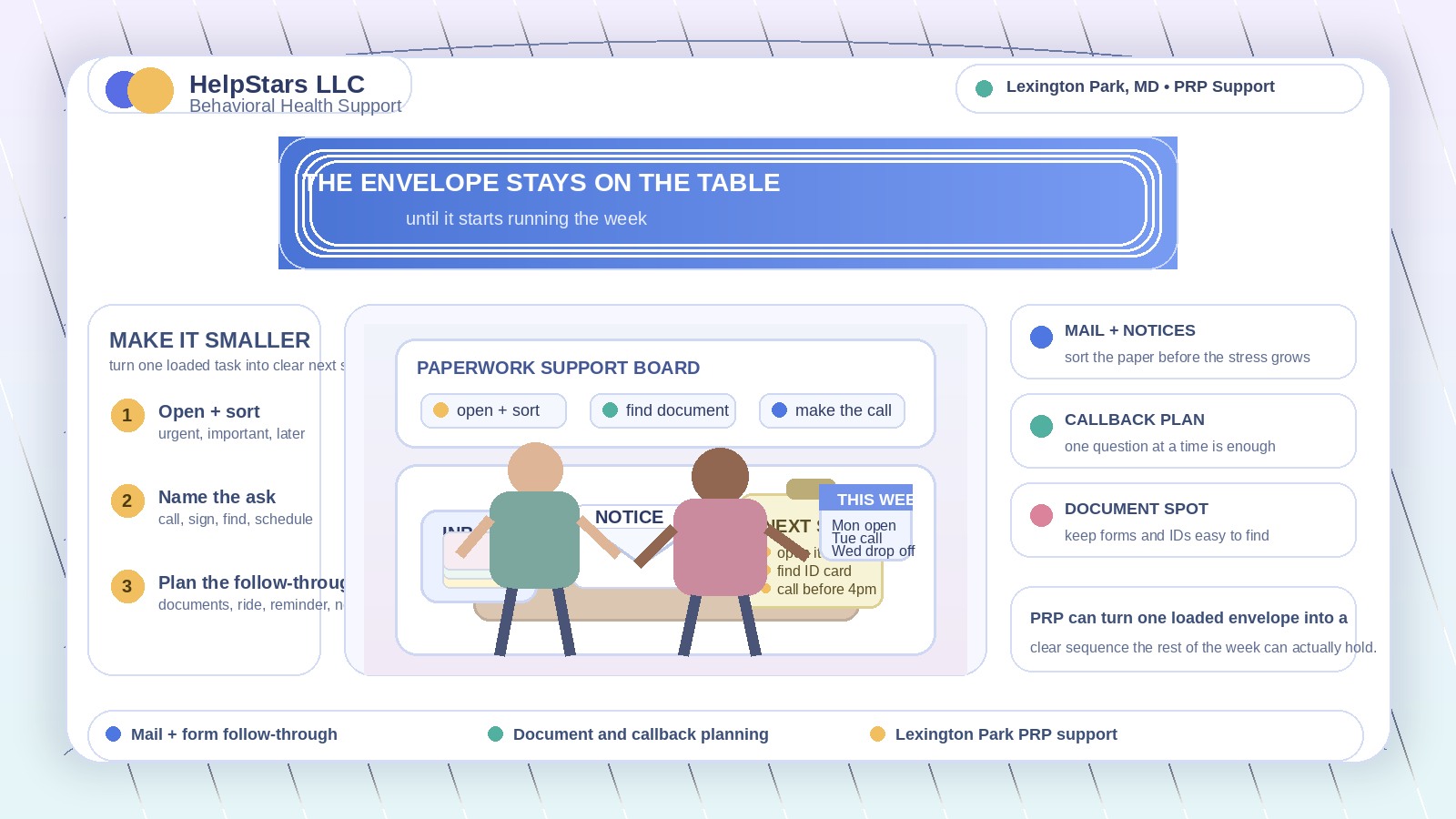
The Envelope Stays on the Table Until It Starts Running the Week: PRP Support for Adults Serving Lexington Park, Maryland
An envelope can sit on the table for three days without looking like a crisis. It may be a clinic notice, a pharmacy message, a benefits form, a bill, or a reminder that something needs to be signed, called back, or brought somewhere by a certain date. Nothing dramatic happens the first day it sits there. The problem is what begins gathering around it. Another paper lands on top. A voicemail is left. An appointment gets closer. A person starts thinking about the task more often while feeling less ready to touch it.
For adults seeking PRP support serving Lexington Park, Maryland, that pattern can be more important than it looks from the outside. The issue is not laziness or a lack of care. Sometimes one unopened envelope starts carrying decision-making, anxiety, memory load, transportation questions, and fear of finding out there is already something overdue. A psychiatric rehabilitation program can help adults break that pileup into practical steps before one small administrative task starts running the whole week.
HelpStars LLC supports adults and families across Southern Maryland with compassionate behavioral health services, including practical community-based support. When mail, forms, reminders, and follow-through keep becoming heavier than they seem like they should be, structured PRP support may help the day feel more manageable again.
How One Unopened Item Quietly Becomes Five Different Tasks
People rarely get stuck because a single piece of paper is physically hard to open. They get stuck because opening it may create more steps than they feel ready to hold. The letter may reveal a phone call that needs to be made, a document that has to be found, a date that now feels too close, a pharmacy issue that needs clarification, or a question the person does not know how to answer on the spot.
That is why a small task can keep expanding emotionally. The mind is not reacting only to the envelope. It is reacting to the chain that might come after it. Many adults start telling themselves they will deal with it once they have more energy, a clearer head, a better morning, or a fully open afternoon. But the week rarely clears itself that neatly. Meanwhile, the task keeps taking up mental space anyway.
This may sound familiar:
- mail gets moved from one surface to another without really being handled,
- a form is opened but not finished because one missing detail stops the whole process,
- a notice leads to a phone call that feels easier to postpone than begin,
- one delayed task makes the next reminder feel more embarrassing, or
- the person spends more energy worrying about the paperwork than the paperwork would actually take with support.
That pattern can affect daily stability because unfinished practical tasks rarely stay contained to one corner of the house. They follow people into sleep, meals, errands, relationships, and the tone of the rest of the day.
PRP Is Often About Daily Function, Not Just Encouragement
Some adults hear psychiatric rehabilitation program and imagine vague support or repeated reminders to stay organized. A more useful PRP approach is much more practical than that. It can help adults build step-by-step systems for daily living tasks that keep stalling out under stress, depression, anxiety, executive overload, or inconsistent routine.
Depending on the person’s needs, PRP support serving Lexington Park, Maryland may help with:
- sorting mail into urgent, important, and later categories instead of treating every envelope like the same level of threat,
- breaking forms into smaller sections so one blank does not stop all progress,
- planning when calls, pickups, and signatures fit best into the actual week,
- figuring out what documents need to be kept in one predictable place,
- creating routines for checking notices before they become last-minute emergencies, and
- reducing the shame spiral that often grows around delayed paperwork.
The goal is not to make life feel perfectly neat. The goal is to make ordinary follow-through less emotionally expensive and more repeatable.
A Lexington Park Example: The Paper Was Small, but the Fallout Was Not
Imagine an adult serving Lexington Park, Maryland who is already balancing treatment appointments, a shared household, transportation planning, and uneven energy through the week. A letter arrives that looks routine enough. It may relate to scheduling, benefits paperwork, medication coverage, or a request for information. The person sees it, means to handle it, and leaves it for later because they are on the way out the door.
Later never feels ideal. By the next day, the envelope has picked up emotional weight. Now the person wonders whether they waited too long already. They avoid opening it before breakfast because they do not want to start the day stressed. They avoid it in the afternoon because they do not have time to deal with whatever it leads to. By evening, they feel guilty for not touching it and too mentally tired to begin.
A few days later, the issue is no longer just the envelope. It is the pressure around the envelope. The person is thinking about deadlines, dreading a phone tree, trying not to lose another form, and feeling more disorganized than the situation really required. In that kind of moment, PRP support can help transform the task from a vague stress cloud into a sequence: open it, identify the actual ask, gather what is needed, decide what can be done now, and make a plan for the part that cannot.
What Makes Paperwork and Notices Feel So Disproportionately Heavy
Administrative tasks often carry hidden pressure. They usually arrive without much emotional room around them. A person may already be tired, discouraged, overstimulated, or trying to recover from something else. The notice then asks for attention, accuracy, memory, and follow-through all at once.
For some adults, the hardest parts are:
- Unclear starting points. They do not know whether to read, call, sign, search, ask, or wait first.
- Fear of bad news. Even neutral paperwork can feel threatening when a person expects a problem behind it.
- Task chaining. One small step creates two or three more, which makes the first step easier to avoid.
- Shame after delay. Once a task sits too long, embarrassment becomes part of the barrier.
None of those barriers are unusual. They are part of why practical rehabilitation support can matter. The person may not need a lecture about responsibility. They may need help making the task smaller, clearer, and easier to restart.
Supports That Can Make the Week Feel Less Vulnerable to One Piece of Mail
PRP often becomes most useful when it creates visible structure around ordinary tasks. That might include:
- a simple tray or folder system for urgent paperwork,
- a repeatable weekly check-in time for notices and appointment reminders,
- a written list of common phone numbers, account details, or questions to ask,
- a document spot for IDs, insurance papers, and signed forms,
- short task pairing such as “open and sort now, call tomorrow morning,” and
- support around transportation or scheduling when the task leads to an in-person follow-up.
These supports matter because they lower the all-or-nothing feeling. The person no longer has to solve everything at once just to make progress.
This Can Affect More Than Paperwork
When small administrative tasks keep stalling, the impact often spreads beyond the task itself. Adults may lose confidence in their ability to stay on top of everyday life. They may begin avoiding the table where the mail sits, ignoring unknown numbers, or feeling tense whenever a new notice arrives. A partner or family member may step in with frustration, which can make the person feel even less capable. Over time, the practical problem and the emotional problem start feeding each other.
That is one reason PRP near Lexington Park, MD can be meaningful. Community-based support is not only about helping people “do more.” It can also help them rebuild a steadier relationship with the tasks that have started feeling loaded, avoidable, or bigger than they are.
Questions Adults and Families Often Ask
Is PRP only for major life-skills problems?
No. PRP can also help with smaller daily-living tasks that keep repeating enough to disrupt stability, confidence, and follow-through.
What if the paperwork itself is simple, but I still keep avoiding it?
That still matters. The barrier is not always complexity. Sometimes it is stress load, task chaining, low energy, or fear of what comes next.
Can PRP help with routines around appointments, mail, and phone calls?
Yes. Practical rehabilitation support may help adults create better systems for reminders, documents, scheduling, and next-step follow-through.
Does needing this kind of support mean I am failing at adulthood?
No. Many adults need more structure at certain points in life, especially when mental health symptoms are already making ordinary tasks more expensive to carry.
A Smaller Barrier Can Change the Whole Feel of the Week
Some weeks do not unravel because of one dramatic event. They unravel because one ordinary task keeps staying unfinished long enough to affect everything around it. If an envelope has started feeling heavier than paper should feel, that does not mean the problem is trivial. It often means the week needs more practical support than the task appears to deserve on the surface.
HelpStars LLC supports adults and families across Southern Maryland with compassionate behavioral health services, including psychiatric rehabilitation. For adults seeking PRP support serving Lexington Park, Maryland, structured daily-living support may help turn delayed notices, stacked reminders, and hard-to-start follow-through into a plan that feels possible again.