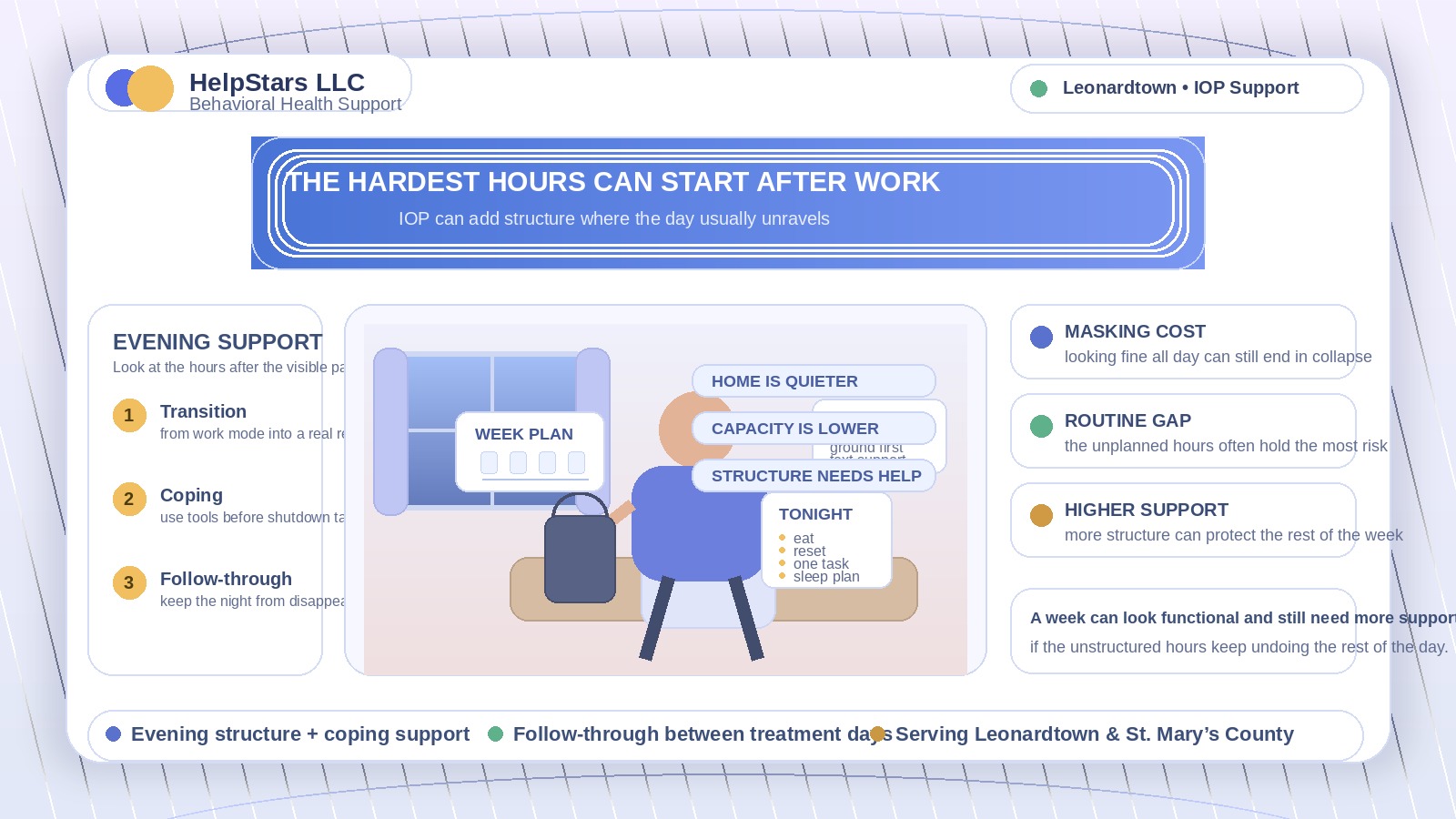
The Day Looks Fine Until the Unscheduled Hours Begin: Intensive Outpatient Support for Adults Serving Leonardtown, Maryland
Some adults can hold themselves together through the most structured part of the day and still feel like everything slips once that structure falls away. They get through work, classes, errands, or appointments well enough that other people assume they are managing. Then the evening opens up, the plan gets thinner, and the emotional strain that stayed contained all day starts spreading into the hours with the least support around them.
For adults seeking intensive outpatient support serving Leonardtown, Maryland, that pattern matters. The hardest part of the week is not always the busiest hour. Sometimes it is the stretch after the required tasks are done, when the person is left alone with exhaustion, overthinking, isolation, irritability, or the urge to shut down completely. An intensive outpatient program can help create more structure, coping support, and follow-through during exactly the part of the week that tends to go off course.
HelpStars LLC supports adults across Southern Maryland with practical behavioral health care. When the day looks manageable from the outside but the unstructured hours keep taking over, a higher level of outpatient support may help make the rest of the week more livable.
A Stable Schedule Can Hide an Unstable Evenings Pattern
Many adults delay asking about IOP because they assume they do not look unwell enough. They are still showing up somewhere. They still answer some messages. They still meet the minimum expectations that make other people think things are basically under control.
But daily function is not only about whether someone made it through the visible part of the day. A person may spend the rest of the evening emotionally flooded, mentally blank, unable to start basic tasks, or too depleted to hold onto any progress after dinner. If that pattern repeats most days, the week may be less stable than it appears.
That is one reason an intensive outpatient program can matter. It offers more consistent support than occasional check-ins alone when the difficult part of recovery keeps showing up in the hours that are easiest for others to miss.
What the Unscheduled Hours Often Feel Like
For some adults, the shift starts the moment they get home. For others, it starts as soon as the last required interaction ends. The person may notice that they:
- lose momentum once nobody else is expecting anything from them,
- sit down for a minute and then cannot restart the rest of the evening,
- replay the day so intensely that it becomes hard to eat, rest, or think clearly,
- feel emotionally raw after holding in too much all day,
- avoid texts, family conversations, or small responsibilities because their capacity is already gone, or
- end the night feeling like the whole day collapsed even if the visible part went reasonably well.
This can be especially confusing because the outside evidence looks mixed. The person is functioning enough to be overlooked, but not steadily enough to feel safe inside their own routine.
A Leonardtown Example: Work Gets Done, the Rest of Life Does Not
Imagine an adult serving Leonardtown, Maryland who keeps making it through the official part of the day. They clock in. They finish what absolutely has to be done. They may even seem calm in short conversations. But by late afternoon, most of their energy is gone.
Once they get home, the structure disappears. Dinner becomes an afterthought. Laundry, paperwork, and follow-up tasks pile up because starting one more thing feels impossible. A single difficult interaction from earlier in the day can replay for hours. Sleep gets delayed because the person cannot come down from the internal strain of holding everything together. By morning, they are already behind on recovery before the next day begins.
That is not just a busy-person problem. It can be a sign that more structured mental health support is needed than the current level of care is providing.
How Intensive Outpatient Support Can Help
Intensive outpatient support is often helpful when someone needs more structure, repetition, and skill reinforcement across the week, but does not need inpatient care. The goal is not simply to talk about stress after it happens. The goal is to build more reliable support around the patterns that keep undoing progress.
Depending on the program design and the person’s needs, IOP may help with:
- creating more support around the hours that usually unravel,
- building coping tools that can be used before the evening crash takes over,
- improving follow-through between therapy moments instead of relying on one good conversation a week,
- reducing the cycle of masking through the day and collapsing afterward,
- supporting emotional regulation, routine, and recovery structure across multiple days, and
- helping the person recognize earlier signs that their capacity is already running out.
The point is not to fill every hour with activity. It is to make the vulnerable hours less unsupported.
Three Signs the Current Level of Support May Be Too Thin
- The person can perform but not recover. They keep getting through what is required, but the rest of the day consistently falls apart.
- Evenings are where symptoms become most costly. Shutdown, agitation, overthinking, isolation, or emotional exhaustion keep collecting after the visible obligations end.
- One appointment at a time is not holding the week together. Insight may be growing, but daily structure and emotional steadiness are not improving enough between sessions.
These signs do not automatically mean IOP is the answer for everyone. They do suggest that a more structured outpatient option may be worth discussing.
Why the Evening Pattern Deserves Serious Attention
Adults sometimes minimize what happens after hours because they feel embarrassed that they “should” be able to manage once the major tasks are done. But the evening often reveals the real cost of the whole day. If the person is spending most nights depleted, dysregulated, disconnected, or unable to manage basic home-life demands, that is clinically meaningful.
It can affect sleep, medication consistency, nutrition, relationships, hygiene, household follow-through, and the ability to show up again the next morning with any reserve left. What looks like simple tiredness can actually be a repeated pattern of emotional overload.
Why This Matters in St. Mary’s County
Adults serving Leonardtown, California, Lexington Park, Hollywood, Great Mills, Mechanicsville, and nearby St. Mary’s County communities often balance work demands, commuting, family responsibilities, treatment follow-through, and financial pressure within the same week. In that real-life setting, the most dangerous hours are not always dramatic. They may simply be the hours with the least structure and the highest carryover from the rest of the day.
That is part of why an intensive outpatient program serving Leonardtown, Maryland can be meaningful. More support may help adults move from merely getting through the required part of the day toward building evenings and weekends that feel less fragile and more workable.
Questions Adults Often Ask
Do I need IOP only if I am in obvious crisis during the day?
No. Some adults need more structured support because the week keeps unraveling outside the visible daytime obligations, not because they are in one constant public crisis.
What if I still look functional to other people?
Looking functional does not always mean feeling stable. If the cost of holding it together is nightly shutdown, overthinking, or loss of follow-through, that still matters.
Can IOP help if my hardest time is after work or in the evening?
Yes. That kind of repeated pattern can be one reason more structured outpatient support is worth exploring, especially if current treatment is not improving the rest of the week enough.
What if I keep telling myself I should be able to handle this because I made it through the day?
Making it through the day is not the whole picture. If the price of doing that is that the rest of life keeps collapsing afterward, more support may be appropriate than you have been receiving.
The Hardest Part of the Week Still Counts
Adults do not have to wait until the visible part of life falls apart before asking whether they need more help. Sometimes the clearest sign is that the day only looks fine until the unstructured hours begin.
HelpStars LLC supports adults across Southern Maryland with practical behavioral health care. For adults seeking intensive outpatient support serving Leonardtown, Maryland, more structured care may help turn the hardest hours of the week into something less isolating, less fragile, and more manageable.