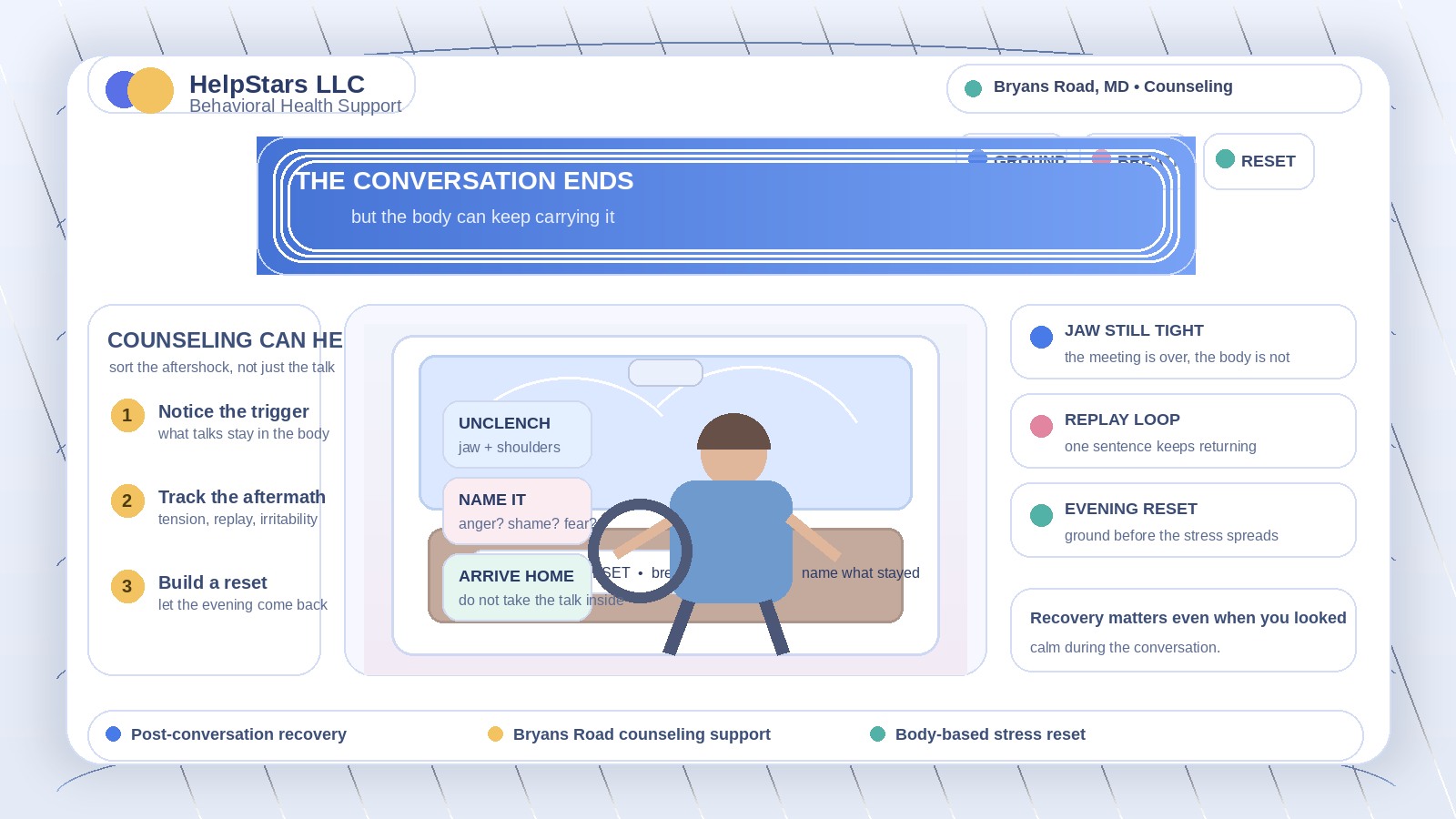
The Conversation Is Over, but Your Body Is Still Having It: Outpatient Mental Health Counseling for Adults Serving Bryans Road, Maryland
Some conversations end on time but do not end in the body. A person leaves the meeting, the family talk, the appointment, or the conflict and technically the hard part is over. Then the drive home starts. The jaw is still tight. The chest is still braced. The mind keeps replaying one sentence, then another, then a version of the exchange that did not even happen. From the outside, it can look like the moment passed. Inside, it can feel like the body is still stuck in it.
For adults seeking outpatient mental health counseling serving Bryans Road, Maryland, that delayed wave can matter as much as the conversation itself. The problem is not always what was said in the room. Sometimes it is what happens afterward, when the nervous system keeps acting like the pressure is still happening and the rest of the evening gets shaped by tension, replay, irritability, or shutdown. Outpatient mental health counseling can help adults understand why certain interactions linger so physically and emotionally — and how to recover with more clarity instead of carrying the whole exchange into the night.
HelpStars LLC supports adults and families across Southern Maryland with compassionate behavioral health services. For adults in Charles County who keep looking functional during hard conversations and then feeling flooded afterward, counseling may offer a steadier place to sort out the pattern.
Why the Aftermath Can Feel Harder Than the Moment Itself
Many adults stay composed while something difficult is actively happening. They answer the question, get through the appointment, keep the tone steady, or avoid making the situation worse. The emotional cost often arrives later, once the task of getting through it is over.
That can sound like:
- “I was calm in the room, so why do I feel wrecked now?”
- “It keeps replaying after I leave, even when I do not want to think about it,”
- “I do not fall apart during the conversation. I fall apart afterward,”
- “My body acts like I am still in it,” or
- “By the time I get home, I am short with everyone because I am still carrying the whole thing.”
This pattern can be easy to minimize because the person did, in fact, get through the interaction. But getting through something and recovering from it are not the same skill.
A Bryans Road Example: The Drive Home Becomes the Second Half of the Stress
Imagine an adult serving Bryans Road, Maryland and nearby Charles County communities who holds it together well in stressful settings. Maybe they manage a work meeting, a difficult family check-in, or an appointment where they had to explain more than they wanted to. In the moment, they sound reasonable. They stay polite. They do not say everything they are feeling.
Then the interaction ends, and the real wave begins. In the car, their shoulders are still lifted. They replay the wording they used, wonder whether they sounded weak or defensive, imagine what they should have said instead, and feel the rest of the night narrowing before they even pull into the driveway. The visible part of the conversation is over, but the internal part has barely started.
In that situation, behavioral health services Charles County may help by focusing not only on communication but on recovery after activation. The person may not need to become tougher. They may need help recognizing what gets stored in the body, what makes replay intensify, and what helps the stress response actually come down.
What Counseling Can Help Untangle After Hard Interactions
Outpatient mental health counseling can help adults notice what happens in the minutes and hours after difficult conversations rather than treating the aftermath like a personal weakness. Depending on the situation, therapy may help with:
- identifying which kinds of interactions leave the strongest physical residue,
- understanding whether the replay is driven more by anxiety, shame, anger, self-protection, or old relational patterns,
- tracking what happens in the body after the person leaves the stressful setting,
- building transition routines so the nervous system has a clearer way to come down,
- reducing the urge to keep mentally reopening the conversation all evening, and
- finding language for what felt overwhelming before it turns into irritability or withdrawal at home.
The goal is not to never feel activated. The goal is to keep one hard exchange from quietly taking over the rest of the day.
Four Signs the Conversation May Still Be Running the Evening
- Your body stays keyed up long after the talk ends. Breathing, muscle tension, pacing, or restlessness suggest the interaction is still active inside you.
- You keep replaying tone, wording, or facial expressions. The mind starts editing the conversation instead of leaving it in the past.
- The rest of the night gets emotionally narrowed. Small household needs, messages, or ordinary noise become much harder to tolerate.
- You look composed to others but pay for it later. The reaction is delayed, not absent.
These patterns do not mean the reaction is exaggerated. They often mean the stress response is lasting longer than the visible event.
Why “I’m Fine Now” Can Be a Misread of What Happened
Adults often dismiss the pattern because the conversation did not explode. Nobody yelled. The appointment ended. The meeting moved on. But the nervous system does not always judge stress by whether a moment looked dramatic from the outside. It often responds to felt pressure, held-back emotion, old sensitivity, or the effort it took to stay controlled.
That is one reason counseling can be useful even when a person appears high-functioning. The important question is not only whether the conversation was survivable. It is whether the person keeps losing the rest of the evening to the physical and emotional aftershock of surviving it.
Questions Adults Often Ask
Does this mean I handled the conversation badly?
Not necessarily. Many adults handle difficult interactions skillfully in the moment and still feel a delayed stress reaction afterward.
Is this only anxiety?
Not always. Anxiety can be part of it, but so can unresolved anger, shame, trauma-related stress, burnout, or learned self-protection in certain relationships.
What if the replay feels more physical than emotional?
That still counts. Some people notice the pattern first in their chest, shoulders, stomach, sleep, or pacing before they have clear words for the emotion underneath it.
Can counseling help if I do not know why certain talks stay with me so strongly?
Yes. Therapy can help make the pattern more specific so recovery stops depending on guessing or simply waiting it out.
Relief Sometimes Starts After the Room Is Empty
Some adults think the only part that matters is how they performed during the conversation. But the aftermath matters too. If the body keeps holding the interaction long after everyone else has moved on, support may help the evening feel less hijacked and the next hard conversation feel less expensive to carry.
HelpStars LLC supports adults and families across Southern Maryland with compassionate behavioral health services. For adults seeking outpatient mental health counseling serving Bryans Road, Maryland, therapy may help turn post-conversation replay, delayed tension, and hard-to-shake activation into something more understandable, more workable, and less likely to run the rest of the night.