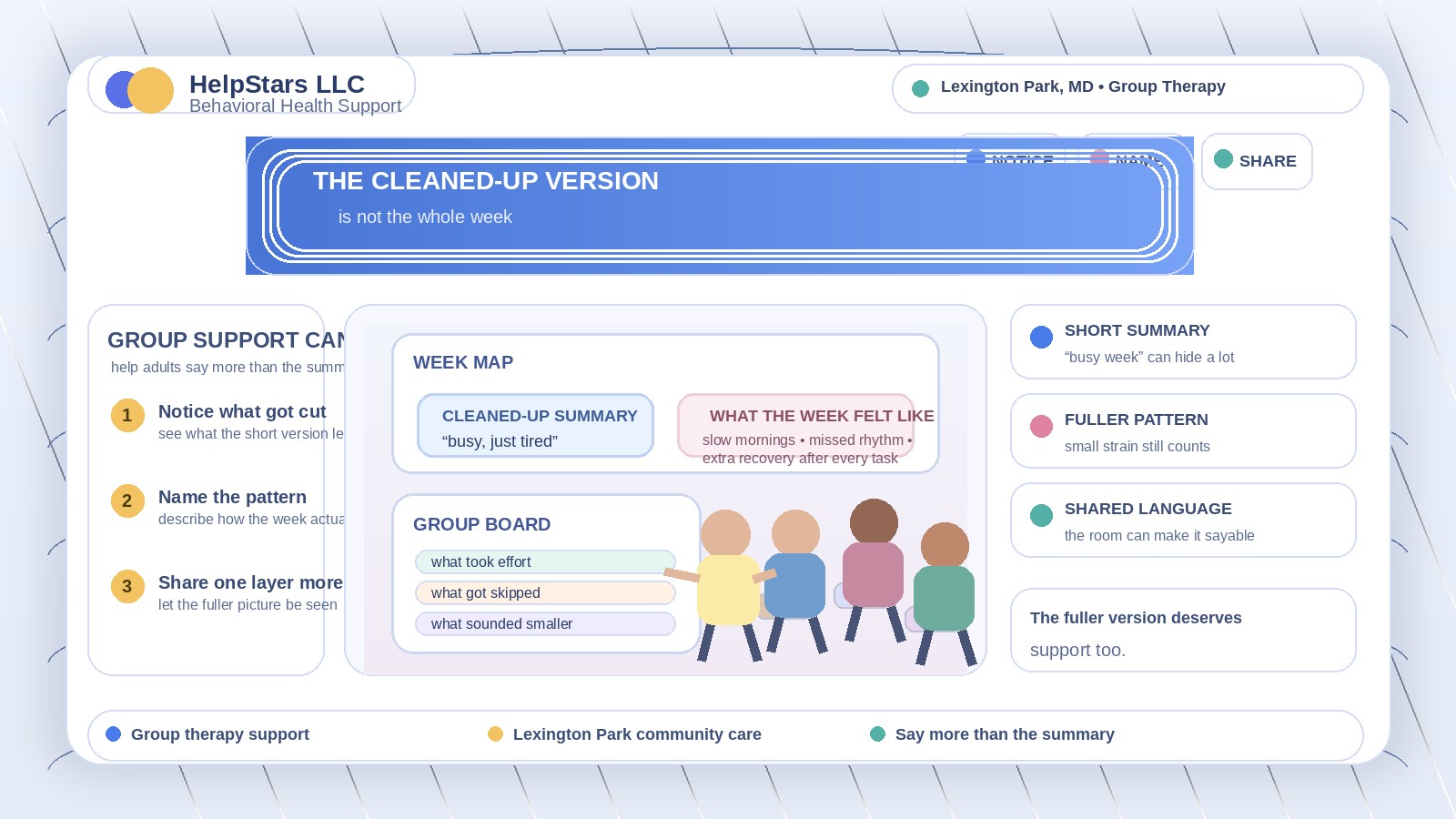
The Cleaned-Up Version Is Not the Whole Week: Group Therapy for Adults Serving Lexington Park, Maryland
Some adults are honest, but not complete. They describe the part of the week that sounds manageable enough to say out loud. They mention being stressed, tired, behind, or frustrated, but leave out how disorganized the day actually felt, how many small things were dropped, or how much effort it took to look mostly okay in front of other people. The summary is not false. It is just cleaner than the real experience.
For adults seeking group therapy serving Lexington Park, Maryland, that habit of self-editing can quietly get in the way of useful support. A person may keep offering the acceptable version of the week while the more important details stay hidden in the background. Group therapy can help adults say more of the middle, notice where they minimize their own strain, and hear how other people describe patterns that also sound familiar but harder to admit alone.
HelpStars LLC supports adults and families across Southern Maryland with compassionate behavioral health services. For adults in St. Mary’s County who keep explaining the week in a way that sounds more organized than it felt, group-based support may offer a steadier place to be more specific, less performative, and more accurately understood.
The Polished Summary Can Hide the Real Problem
Many adults do not mean to misrepresent what is happening. They are trying to be brief. They do not want to sound dramatic. They want to focus on what matters most. But in trying to sound reasonable, they may keep trimming away the exact details that would show how hard the week actually became.
That can sound like:
- “It was a busy week,” when the truth is that almost every task took twice as much effort as usual,
- “I missed a couple things,” when the reality is that the day kept falling apart every time the plan changed,
- “I was a little off,” when sleep, focus, appetite, patience, and motivation all shifted at the same time,
- “I handled it,” when the person spent the rest of the evening trying to recover, or
- “Nothing major happened,” even though several smaller struggles added up to a week that felt hard to carry.
Over time, the person may start believing their own shortened version. The week becomes something they survive and then compress, rather than something they fully name.
Why Adults Start Editing the Story Down
Self-editing often comes from understandable instincts. Some adults grew used to downplaying their needs because other people seemed to have bigger problems. Some worry that the fuller version will sound messy or hard to follow. Others feel embarrassed by how much energy ordinary tasks now require, so they offer a cleaner summary that makes them feel more put together.
There can also be a timing problem. By the time a person sits down to talk, they may only remember the outline. The emotional detail is harder to access. What remains is a short report instead of the lived shape of the week.
That matters because support is usually better when it responds to the real pattern, not the trimmed version of it. If the fuller story stays hidden, treatment may keep circling the edge of the problem without touching the part that is actually exhausting the person.
How Group Therapy Helps the Middle Become More Sayable
Group therapy is not only a place to share feelings in general. It can help adults notice how they talk about their lives and what gets left out. Hearing other people describe similar patterns in more concrete language can make a person realize how much of their own experience has been edited down for clarity, comfort, or self-protection.
Depending on the group and the person’s needs, support may help adults:
- move beyond one-line summaries and name what made the week hard in practical terms,
- notice where they routinely minimize strain, confusion, or emotional fallout,
- hear how other adults describe ordinary-looking weeks that were still difficult to manage,
- practice offering one more layer of honesty instead of stopping at the polished version, and
- feel less alone in the gap between “I got through it” and “it actually took a lot out of me.”
The goal is not to make people dramatic. The goal is to make the conversation accurate enough to be useful.
A Lexington Park Example: “Nothing Big Happened,” but the Week Kept Slipping
Imagine an adult serving Lexington Park, Maryland and nearby St. Mary’s County communities who keeps telling people the week was “fine, just busy.” On the surface, that seems believable. They went to work. They answered a few messages. They made one appointment and rescheduled another. No single event was a disaster.
But the fuller version looks different. Mornings took much longer to start. Meals were scattered. Small changes to the day kept knocking everything else out of sequence. The person forgot details they normally would have remembered. After each conversation, they needed extra time alone to settle back down. By Friday, they were not in crisis, but they were functioning with far less margin than usual.
When they tell the story quickly, most of that disappears. What remains is “It was a busy week.” In group therapy, another adult may describe a similar pattern with more specificity: getting through the obligations while quietly losing rhythm, patience, and recovery capacity. That moment of recognition can change the whole discussion. The first person may realize they do not need a dramatic event to justify talking honestly about cumulative strain.
Three Shifts That Group Settings Can Make Possible
- From summary to pattern. Instead of reporting whether the week was good or bad, adults can start describing what kept happening and how it affected daily functioning.
- From private self-doubt to shared recognition. People often discover that what they assumed was a personal failure is a recognizable experience that others can name too.
- From sounding okay to being understood accurately. The room may make it easier to tell the less polished truth because imperfection is already present and does not need to be hidden.
Those shifts can reduce the pressure to sound coherent before support becomes available. Sometimes support gets better the moment a person stops trying to sound less affected than they are.
Signs the Cleaned-Up Version May Be Blocking Useful Support
Adults may want to consider extra support when they notice patterns like:
- describing hard weeks with the same few vague words over and over,
- leaving out the effort cost of ordinary tasks because it feels hard to justify,
- feeling misunderstood even though they technically told the truth,
- hearing someone else explain a similar struggle and realizing their own version is much more edited, or
- walking away from support conversations thinking, “That was not really the whole picture.”
These signs do not mean someone is being dishonest. They often mean the person has gotten used to compressing their experience so tightly that other people cannot fully see what care should respond to.
Why Hearing In-Progress Stories Matters
One value of group therapy is that adults do not only hear finished insights. They hear people describing things that are still unfolding. That can be powerful for someone who keeps assuming their own week must be translated into a clean lesson before it is worth bringing up.
In a group setting, a person may hear another adult say they looked productive but felt scattered all day, or that nothing terrible happened yet everything felt harder than it should have. Those kinds of in-progress descriptions can make room for a different standard of honesty. The person no longer has to arrive with a polished conclusion. They can bring the rougher middle.
That can matter for adults serving Lexington Park, California, Great Mills, Leonardtown, Hollywood, and nearby St. Mary’s County communities whose lives already involve work strain, commuting, parenting, appointments, and routine pressure. Many difficult weeks do not look dramatic from the outside. Group therapy can help make those quieter forms of strain easier to name before they grow heavier.
Common Questions About Group Therapy
What if I am used to saying “I’m fine” or “it was just a long week”?
That is common. Group therapy may help adults practice noticing what those phrases are covering and how to add a little more specificity without feeling exposed all at once.
Do I need a major crisis for group therapy to make sense?
No. Many adults benefit because the problem is cumulative strain, repeated self-editing, or difficulty describing what daily life has started to feel like.
What if I mostly listen at first?
Listening can still be meaningful. Hearing how others describe their weeks may help you recognize your own patterns with more accuracy and less shame.
Can group therapy fit alongside other outpatient behavioral health support?
Yes. Depending on the individual situation, group therapy may be one part of a broader outpatient plan that also includes counseling, psychiatric evaluation, medication management, or other behavioral health services.
The Fuller Version Deserves Support Too
Some adults do not need help inventing a better story. They need help telling a less edited one. If the week keeps sounding manageable when you describe it but draining when you live it, that gap may be worth paying attention to.
HelpStars LLC supports adults and families across Southern Maryland with compassionate behavioral health services. For adults seeking group therapy serving Lexington Park, Maryland, group-based support may help turn compressed summaries, minimized effort, and hard-to-explain strain into a conversation that reflects the week more honestly and supports it more effectively.