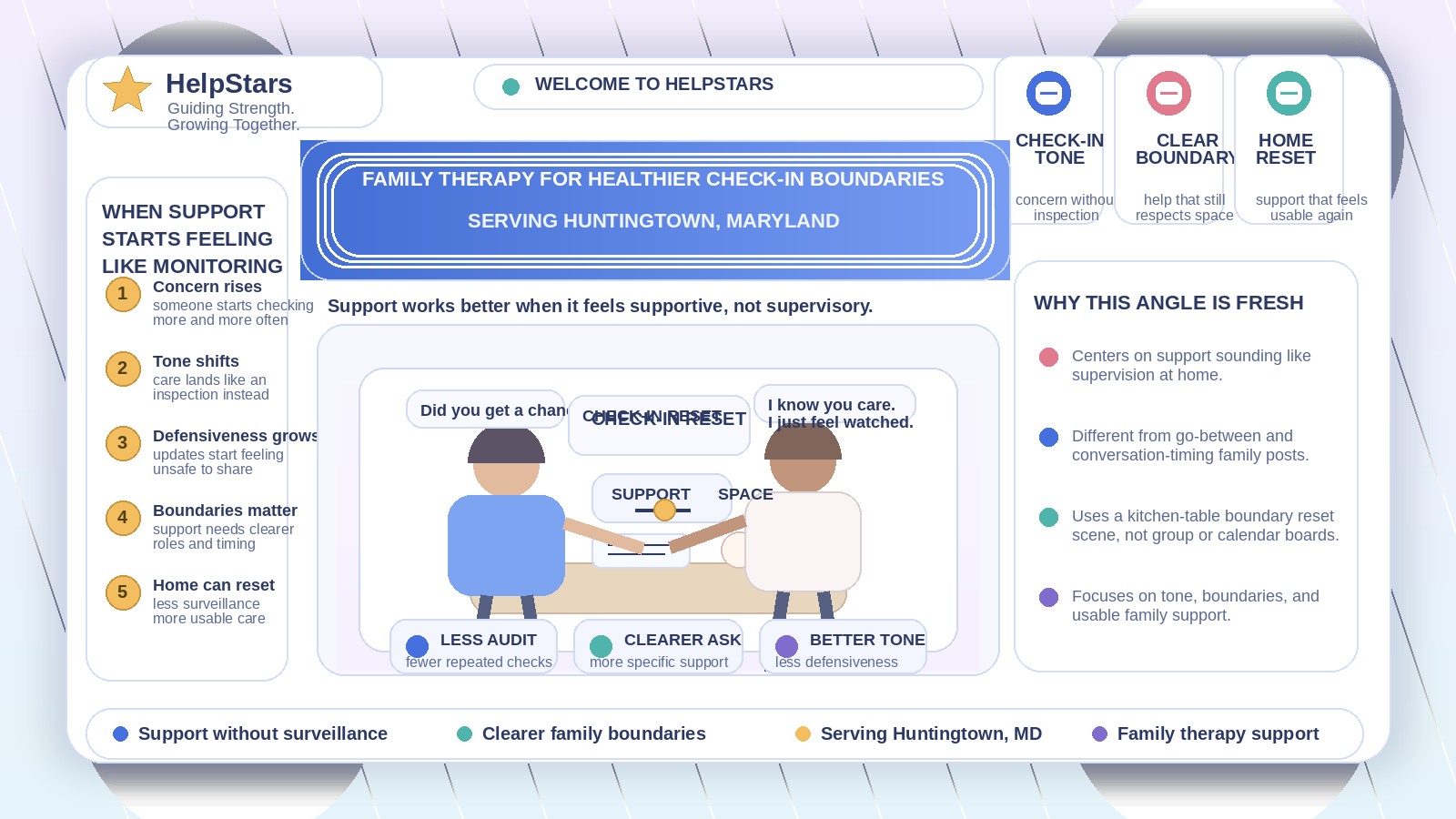
Support Can Start Sounding Like Supervision When Everyone Is Tired: Family Therapy for Adults Serving Huntingtown, Maryland
Family support can wear two very different faces. In one version, a loved one helps an adult stay steady through a hard season. In the other, every reminder starts to sound like monitoring, every missed task becomes a review session, and every conversation carries a little more tension than either person intended. The difference is not always about love. Often it is about exhaustion, fear, and a family system that has stopped knowing how to sound supportive without also sounding watchful.
For adults serving Huntingtown, Maryland, family therapy may help when care at home has become heavy, repetitive, or defensive. HelpStars LLC works with adults and families who may need a calmer structure for conversations about stress, routines, responsibilities, mood changes, and follow-through. The goal is not to decide who cares more. It is to help support feel more usable again.
How a Helpful Check-In Can Slowly Turn Into Pressure
Many families do not notice the shift right away. A loved one asks how someone is doing, whether they slept, whether they made the call, whether the medication was taken, whether they are still planning to leave the house, or whether the bills are handled. None of those questions is automatically harmful. The strain builds when the same topics keep returning without relief and both people begin reacting to the pattern instead of the moment.
One person may feel responsible for preventing another setback. The other may feel that every conversation begins with an audit. What started as care can begin sounding like supervision, and once that happens, even neutral check-ins can trigger defensiveness or shutdown.
What This Pattern Can Look Like at Home
The issue is not always loud conflict. Sometimes it shows up in subtler ways that still wear a family down:
- one relative repeating reminders because they do not trust that silence means things are okay,
- an adult family member avoiding calls or texts because every update feels like a status report,
- simple questions turning into debates about responsibility or motivation,
- supportive intentions being heard as criticism, and
- both people leaving conversations feeling unappreciated, misunderstood, or more alone.
These patterns can build even when no one is trying to be controlling. They often develop because a family has been carrying stress for too long without a better structure.
Why Family Therapy Can Help Shift the Tone
Family therapy can offer a place to slow the whole interaction down. Instead of arguing about who is right in the latest conversation, the work may focus on the pattern underneath it: what the worried person is trying to prevent, what the overwhelmed person is hearing instead, and how both people have started protecting themselves in ways that keep the cycle going.
That can make room for changes such as:
- more specific and less constant check-ins,
- clearer boundaries around what help is welcome and when,
- better language for concern that does not sound like inspection,
- shared expectations about responsibilities and follow-through, and
- less reactive communication when stress is already high.
For some families, the biggest relief is not a dramatic breakthrough. It is finally having a conversation that does not turn into the same argument again.
A More Useful Question Than “Who Started It?”
When tension has been building for a while, families often get stuck in a blame framework. One person says the reminders would stop if the follow-through improved. The other says the follow-through would improve if they felt less watched and more respected. Both people may be describing something real, but the argument does not create a better system.
Family therapy can redirect the conversation toward more workable questions. What kind of support actually helps? Which reminders make things worse? What tasks need clear accountability, and which ones need more breathing room? When is reassurance useful, and when does it become repeated pressure? Those questions can move a family closer to a structure they can live with.
Who May Benefit From This Kind of Support
This kind of family-therapy conversation may be useful when:
- an adult feels micromanaged by people who are trying to help,
- a parent, partner, or relative feels trapped in constant monitoring,
- mental health stress is affecting routines, trust, or household roles,
- the same conversations keep happening without real change, or
- good intentions keep landing badly on both sides.
It can be especially helpful for adults who still want family support but need that support to feel less intrusive and more respectful of autonomy.
Questions Families Often Ask About This Dynamic
Is needing family therapy a sign that home life is “really bad”?
No. Many families seek therapy before things become extreme because they can feel the strain building and want a better way to talk before resentment hardens.
What if the reminders come from real concern?
Real concern matters. Family therapy is not about dismissing that concern. It can help shape concern into communication that is more likely to be heard and less likely to trigger defensiveness.
Can this help if both people already feel misunderstood?
Yes. That is often the point at which structured support becomes most useful. When both people feel unheard, outside guidance can help slow the pattern down and make each person’s experience clearer.
Does someone have to stop offering help entirely?
Usually not. The goal is not less caring. It is better-defined caring, with clearer roles, better timing, and less pressure built into every exchange.
Why Local Support Matters for Huntingtown Families
Families serving Huntingtown and nearby Calvert County communities may already be balancing work, commuting, caregiving, school logistics, and the everyday effort of keeping a household moving. When emotional strain sits on top of those practical demands, small conversation problems can expand quickly. A local outpatient option can make it easier to keep support consistent enough for communication changes to actually take hold.
Consistency matters because family patterns rarely shift after one good talk. They improve when families have a place to revisit the structure, notice what is changing, and keep building on what works.
Support Works Better When It Feels Like Support
Families do not usually set out to create a house full of check-ins, defensiveness, and mutual frustration. Most are trying to protect one another with the tools they have. Family therapy can help replace that cycle with something more sustainable: clearer boundaries, more respectful communication, and support that does not feel like surveillance.
For adults serving Huntingtown, Maryland, that shift can make home feel less like a performance review and more like a place where real support is possible again.