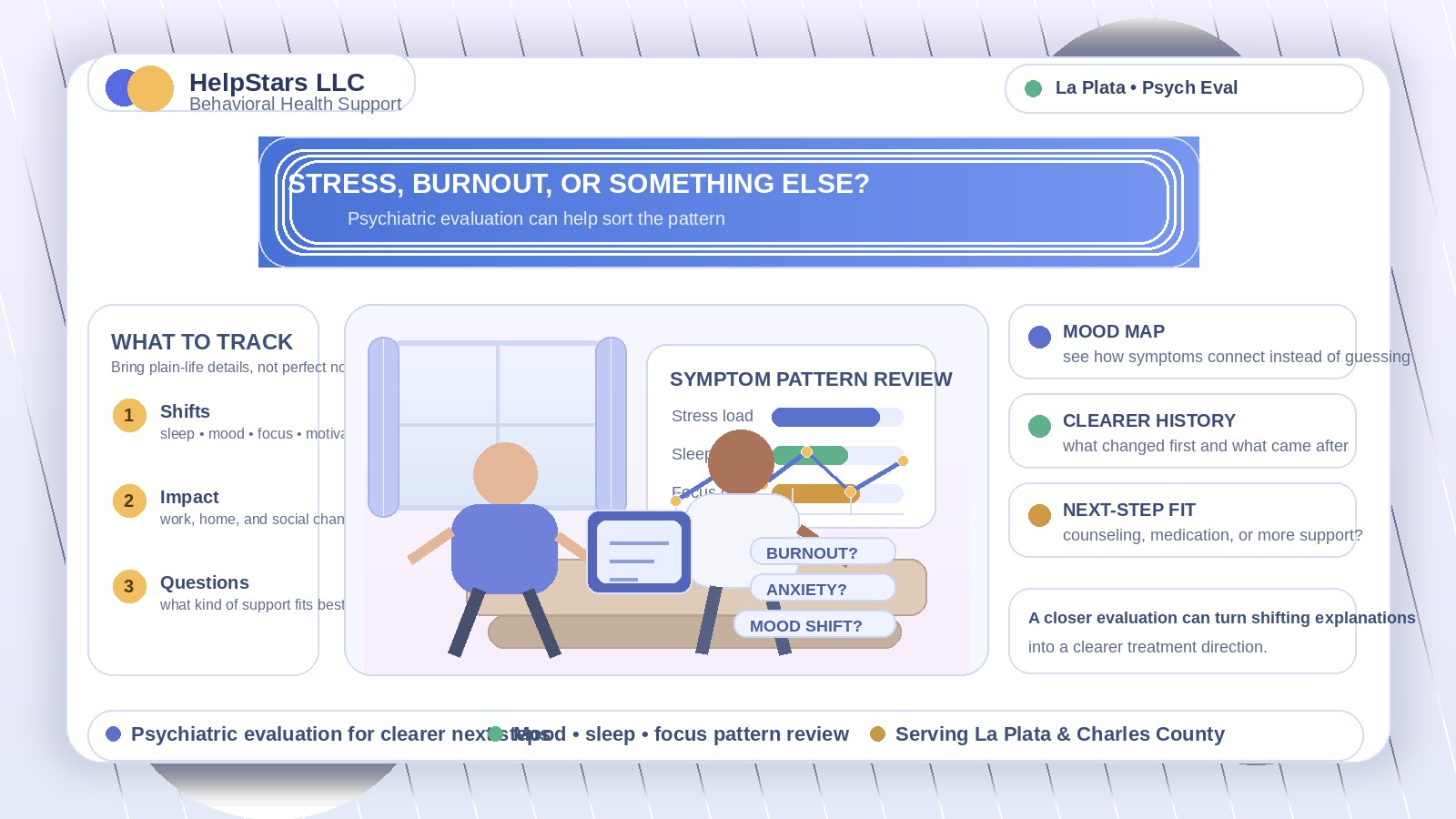
Stress, Burnout, or Something Else? How a Psychiatric Evaluation Can Help Adults Serving La Plata, Maryland
A lot of adults are surprisingly good at minimizing what is happening to them. They call it a rough stretch, a busy month, burnout, poor sleep, or just being under pressure. That explanation may feel reasonable at first. But after a while, the label stops covering the full picture. Sleep changes, patience gets thinner, concentration drops, motivation becomes unreliable, and the person starts feeling unlike themselves in more than one part of life at once.
For adults serving La Plata, Maryland and nearby Charles County communities, a psychiatric evaluation can help when the story keeps changing but the struggle keeps staying. The goal is not to overstate normal stress. It is to look more carefully at patterns in mood, anxiety, focus, energy, daily functioning, and recent life changes so the next step in care is based on something clearer than guesswork.
HelpStars LLC serves adults and families across Southern Maryland with compassionate behavioral health support. When stress explanations no longer fully match what daily life feels like, an outpatient psychiatric evaluation may be a useful place to start.
Why “It’s Probably Just Stress” Sometimes Stops Being a Useful Answer
Stress is real, and many people are dealing with a lot. But the word can become too broad to help. It may hide the fact that a person is no longer bouncing back the way they usually do. What began as a temporary explanation can turn into a vague umbrella covering five different problems at the same time.
That can look like:
- feeling keyed up and shut down in the same week,
- sleeping longer but still waking up exhausted,
- finishing work tasks more slowly even when effort is high,
- pulling away from people without fully understanding why,
- getting unusually irritable over small changes, or
- cycling between “I’m fine” and “something is definitely wrong.”
At that point, the main question is not whether life has been stressful. It usually has. The question is whether stress is the whole story, or whether another mental health pattern needs a closer look.
What a Psychiatric Evaluation Can Help Sort Out
Some adults avoid this step because they imagine a psychiatric evaluation as a quick label or a forced decision. A thoughtful evaluation should be more practical than that. It can help organize symptoms, timing, daily-life impact, prior treatment history, and possible next-step options.
Depending on the person’s situation, an evaluation may help clarify:
- whether the current pattern sounds more connected to anxiety, depression, trauma-related stress, burnout, mood instability, or another concern,
- how changes in sleep, concentration, appetite, motivation, and emotional regulation fit together,
- whether outpatient counseling, medication support, or another layer of care may be worth discussing,
- which symptoms appear most disruptive to work, relationships, home responsibilities, or daily routines, and
- what information is still missing before treatment decisions become more precise.
For many adults, the first real benefit is not instant certainty. It is finally having a more accurate frame for what has been happening.
Five Signs a Closer Look May Be Worth It
- You keep changing the explanation. One week it feels like anxiety. The next week it feels like exhaustion. Then it seems like sadness, irritability, brain fog, or emotional numbness. When the description keeps shifting, more assessment can help.
- Functioning is slipping in small but important ways. The biggest changes are not always dramatic. A person may start missing details, taking longer to recover from social demands, delaying calls, or struggling to stay consistent with routines that once felt ordinary.
- People close to you are noticing something different. Loved ones may mention impatience, withdrawal, mood swings, or low energy before the person fully trusts their own observations.
- Rest is not resetting the pattern. A few lighter days may not bring relief the way they used to. The person may remain foggy, emotionally flat, reactive, or overwhelmed even after stepping back.
- You know you need help, but not what kind. Many adults reach a point where the real problem is not willingness. It is uncertainty about whether they need counseling, medication support, structured outpatient care, or a clearer diagnostic picture first.
These signs do not prove one diagnosis. They do suggest that more clarity could be helpful.
A La Plata Example: When the Label Changes but the Pattern Keeps Growing
Imagine an adult serving La Plata who starts by blaming a hard month at work. That seems fair at first. Then sleep gets more uneven. Small decisions begin taking too long. Ordinary family conversations feel heavier than they should. On some days the person feels mentally sped up and tense. On other days they feel flat, slow, and hard to reach. They keep telling themselves it will settle once the schedule eases up.
But the relief never arrives in a stable way. One weekend helps a little, then Monday feels impossible again. A short break improves energy, yet concentration is still off. A friend says, “You don’t seem like yourself lately,” and the person realizes they have been managing confusion as if it were only overwork.
In that situation, a psychiatric evaluation can help move beyond rotating explanations. Instead of asking, “Why can’t I just handle stress better?” the conversation becomes more specific: What changed first? What is happening across sleep, mood, focus, and motivation? How much is daily life being affected? What kind of support may match the pattern best now?
What Makes a First Evaluation More Useful
Adults do not need polished medical language to prepare for an evaluation. In fact, plain details are often more helpful than a perfect summary. A few honest observations can make the visit much more productive.
Helpful things to bring or think through may include:
- when you first noticed the change, even if the timeline is approximate,
- what has become harder in work, home life, relationships, or routine,
- whether symptoms cluster at certain times of day or after certain stressors,
- what coping strategies, counseling, medications, or self-management steps have already been tried,
- what family or close friends have noticed, if that feels relevant, and
- what outcome would make the next month feel more manageable.
That information can help an evaluation move past “I don’t know, I just feel off” and toward something more clinically useful and personally accurate.
Why This Step Is About Direction, Not Judgment
Some adults delay evaluation because they worry it means something has gotten “serious enough” to count. Others worry it will lock them into one answer too quickly. A better way to think about it is that evaluation helps reduce unnecessary guessing.
It can be useful when:
- someone has already spent weeks or months trying to self-interpret symptoms,
- daily functioning is becoming less predictable,
- family members are asking questions the person cannot answer yet,
- previous coping strategies are no longer keeping things steady, or
- the person wants a clearer starting point before choosing treatment.
The goal is not to dramatize distress. It is to understand it well enough that the next recommendation makes sense in real life.
Why Local Routine Matters in Charles County
Mental health symptoms show up inside actual schedules. Adults serving La Plata, White Plains, Waldorf, Bryans Road, Indian Head, and nearby Charles County communities are often trying to judge their own symptoms while still managing commuting, caregiving, work pressure, household logistics, appointments, and ordinary Southern Maryland obligations.
That context matters. Difficulty concentrating is not abstract when forms keep getting delayed. Sleep disruption matters differently when a person still has to drive, parent, or stay sharp at work the next day. Irritability affects more than mood when it starts changing how someone responds at home. A useful psychiatric evaluation should take those everyday demands seriously because treatment planning works better when it reflects the real week a person is living.
Questions Adults Often Ask About Psychiatric Evaluations
Do I need a psychiatric evaluation if I am still functioning?
Not always, but many adults seek an evaluation while they are still getting through the day because they can tell the pattern is changing and do not want to wait for a bigger disruption before asking questions.
Does an evaluation automatically mean I will be told to take medication?
No. An evaluation is meant to clarify symptoms and options. Medication may or may not be part of the conversation depending on the person’s needs and the clinical picture.
What if I cannot describe what I am feeling very clearly?
That is common. Many people seek evaluation precisely because the pattern feels hard to explain. Specific examples from daily life are often enough to begin the conversation well.
Can this happen alongside counseling or other support?
Often, yes. Depending on the situation, a psychiatric evaluation may complement outpatient counseling or help clarify whether another service should be added, changed, or prioritized.
A Better Next Step Can Start With a Better Read on the Pattern
Sometimes the most exhausting part is not the symptom itself. It is the constant mental debate about what the symptom means. When stress, burnout, mood changes, and concentration problems no longer fit neatly into one explanation, more clarity can be a relief in its own right.
HelpStars LLC serves adults and families across Southern Maryland with compassionate behavioral health support. For adults serving La Plata, Maryland who feel stuck between “maybe it’s just stress” and “something feels bigger than that,” a psychiatric evaluation may help turn uncertainty into a more useful plan.