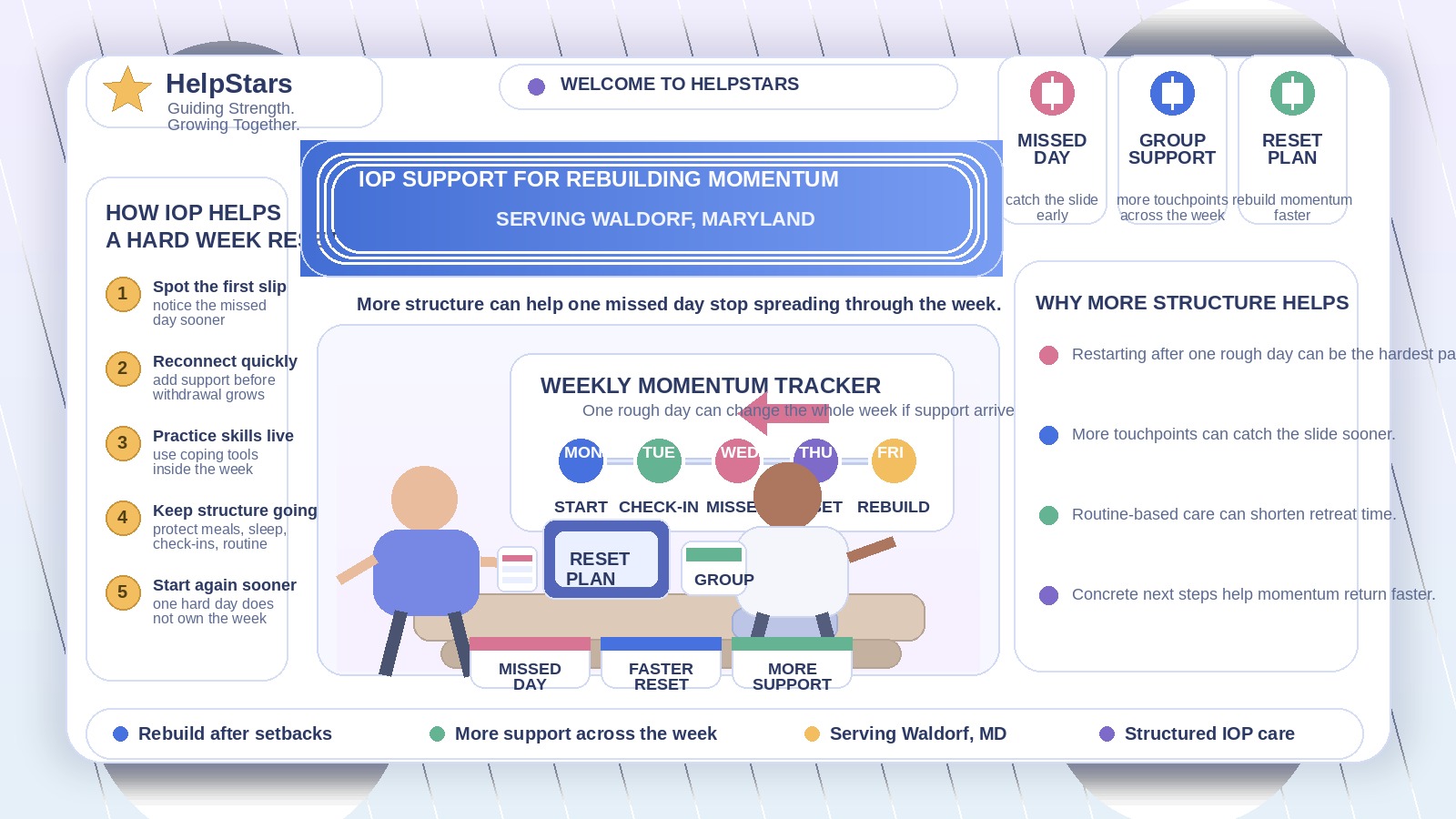
One Missed Day Can Turn Into a Lost Week: How an Intensive Outpatient Program Can Help Adults Serving Waldorf, Maryland Rebuild Momentum
For some adults, the problem is not only having a hard day. The problem is how quickly one hard day starts changing the rest of the week. A missed morning routine becomes a cancelled appointment. A cancelled appointment becomes two quieter days at home. Messages go unanswered. Meals get simpler. Sleep slips later. By the time the person looks up, the week feels smaller, flatter, and harder to restart than it did at the beginning.
For adults serving Waldorf, Maryland and nearby Charles County communities, an intensive outpatient program can help when recovery keeps losing momentum after one disruption. The goal is not to treat every rough day like a crisis. The goal is to create enough structure, support, and repetition across the week that one difficult day does not automatically turn into several more.
HelpStars LLC provides compassionate behavioral health support for adults and families across Southern Maryland. When someone keeps trying to recover their footing but one setback keeps pulling the whole week off course, a more structured outpatient level of care may be worth considering.
The Real Problem May Be the Restart, Not the Bad Day Itself
Many adults can name the day things went off track. Maybe sleep was poor. Maybe anxiety was higher than expected. Maybe energy dropped out suddenly. Maybe there was conflict at home, a medication issue, transportation trouble, or simple emotional overload. But the harder pattern is often what happens next. Restarting can feel disproportionately hard.
That may sound like:
- “I thought I just needed one day to reset, and then I never really got back into the week,”
- “Once I missed one thing, everything else started feeling pointless,”
- “I kept telling myself I would try again tomorrow, but tomorrow kept moving,”
- “Nothing dramatic happened after that, but I still sort of disappeared,” or
- “I do not only need help on the worst day. I need help getting traction again after it.”
That pattern matters because treatment needs are not always defined by severity alone. Sometimes they are defined by how easily progress collapses and how hard it is to rebuild once it does.
Why Weekly Support Can Feel Too Far Apart for This Pattern
A weekly counseling appointment may still be meaningful. Medication follow-up may still matter. Family support may still be present. But for adults whose week can unravel quickly after one rough day, those supports may leave too much unsupported time between touchpoints. Insight from Tuesday may not be enough to carry Thursday if Wednesday went sideways first.
When the gap is too wide, adults may find themselves:
- understanding what would help but not using it in time,
- feeling embarrassed to admit how much one disrupted day changed the week,
- withdrawing before anyone sees the slide clearly,
- reaching out only after several days have already been lost, or
- repeating the same recovery attempt without enough structure to make it stick.
That does not automatically mean the person has failed outpatient care. It may mean they need more support points across the exact stretch where momentum keeps disappearing.
What an Intensive Outpatient Program Can Add
An adult mental health IOP offers a more structured outpatient rhythm than standard weekly care alone. While each treatment plan is individualized, IOP may help when a person needs more than a single encouraging conversation and less than inpatient or residential treatment.
Depending on the person’s needs, an IOP program serving Waldorf, Maryland may help by:
- adding more treatment contact across the week instead of asking one appointment to do all the work,
- making it easier to recover sooner after a rough day instead of waiting until the next week begins,
- giving adults repeated chances to practice coping, communication, and regulation while stress is still active,
- helping people notice the earliest signs that the week is shrinking around symptoms,
- building more accountability without relying only on family pressure, and
- turning “start over tomorrow” into a more concrete plan with support behind it.
The benefit is often not perfection. It is shorter slide time, faster recovery, and a better chance of keeping the week from disappearing altogether.
A Waldorf Example: One Missed Morning, Then Four Quieter Days
Imagine an adult serving Waldorf who has been trying to stabilize anxiety, depression, or emotional overwhelm while still managing work history, family demands, and daily responsibilities. They wake up one morning after poor sleep and feel immediately behind. They skip an obligation because they cannot get organized fast enough. By afternoon, shame joins the exhaustion. A couple of messages stay unopened because they do not know what to say.
The next morning is not catastrophic, but it is softer in the wrong ways. There is less urgency, less structure, and less confidence. The person stays home longer, eats less regularly, and tells themselves they will restart once they feel more ready. By Friday, the original problem is no longer only the missed morning. The problem is that the whole week has narrowed. They feel more isolated, less effective, and farther from the version of themselves they were trying to rebuild on Monday.
In a more structured outpatient setting, that pattern can be interrupted earlier. The work is not only about analyzing why the first morning was hard. It is also about reducing how much control that one morning gets over the next several days.
Four Signs a More Structured Week Might Help
- One disruption changes too much. A poor night of sleep, difficult call, missed ride, or emotional trigger keeps affecting far more of the week than it should.
- The return feels harder than the setback. Adults often describe the restart as more difficult than the original stressor that knocked them off course.
- Several days are being lost quietly. There may be no single dramatic crisis, but functioning keeps shrinking after the first bad day.
- Support works, but not long enough. The person does feel better with help, but the current treatment rhythm is not holding through ordinary stress.
These signs do not by themselves prove IOP is the right level of care. They do suggest that treatment intensity and treatment timing may deserve a closer look.
What Families and Supporters Often Notice First
Sometimes the adult living the pattern experiences it as laziness, inconsistency, or failure. Supporters may see something more specific. They may notice that the person can still recover from stress sometimes, but only when the week does not get interrupted too sharply. They may realize that one missed commitment often predicts several quieter days. They may also notice that encouragement alone is not enough to restore traction once the person slips into retreat.
That outside view can help because it shifts the conversation away from blame. Instead of asking, “Why can’t you just push through one hard day?” the better question may be, “What kind of support helps you restart before the week disappears?”
Why Local Routine in Charles County Still Matters
Adults serving Waldorf, White Plains, La Plata, Bryans Road, and nearby Charles County communities are not trying to stabilize symptoms in empty space. They are dealing with commuting, caregiving, job pressure, home responsibilities, relationship strain, transportation needs, and the ordinary unpredictability of daily life. A treatment plan has to survive those real routines.
That is one reason structured outpatient care can matter. If one disrupted morning keeps turning into four compromised days, the answer may not be more self-criticism. It may be more support placed closer to the part of the week where recovery keeps breaking down.
Questions Adults Often Ask About IOP
Do I need an intensive outpatient program only if I am in immediate crisis?
No. Some adults explore IOP because they are repeatedly losing momentum, not because they are in a constant emergency. The issue may be that weekly support alone is not enough to hold the week together.
What if I can still function some of the time?
That can still matter. Many adults seek more structured support while they are still partly functioning because they can see the pattern worsening or repeating.
Does needing more structure mean I failed regular outpatient care?
Not at all. It may simply mean your symptoms, stress load, and week-to-week pattern need a denser level of support for a period of time.
Can IOP fit alongside other behavioral health services?
Often, yes. Depending on the person’s needs, IOP may exist as part of a broader outpatient plan that also includes counseling, psychiatric evaluation, medication management, family support, or step-down services later on.
A More Stable Week Can Begin With Faster Re-Entry
Some adults do not need to be convinced that their mental health matters. They need help shortening the distance between one bad day and the next usable step. When the week keeps getting away from you after one disruption, more structured outpatient support may offer a steadier way back.
HelpStars LLC supports adults and families across Southern Maryland with compassionate behavioral health care. For adults serving Waldorf, Maryland who feel like one missed day keeps turning into a lost week, an intensive outpatient program may help restore momentum, reduce retreat, and make recovery easier to restart.