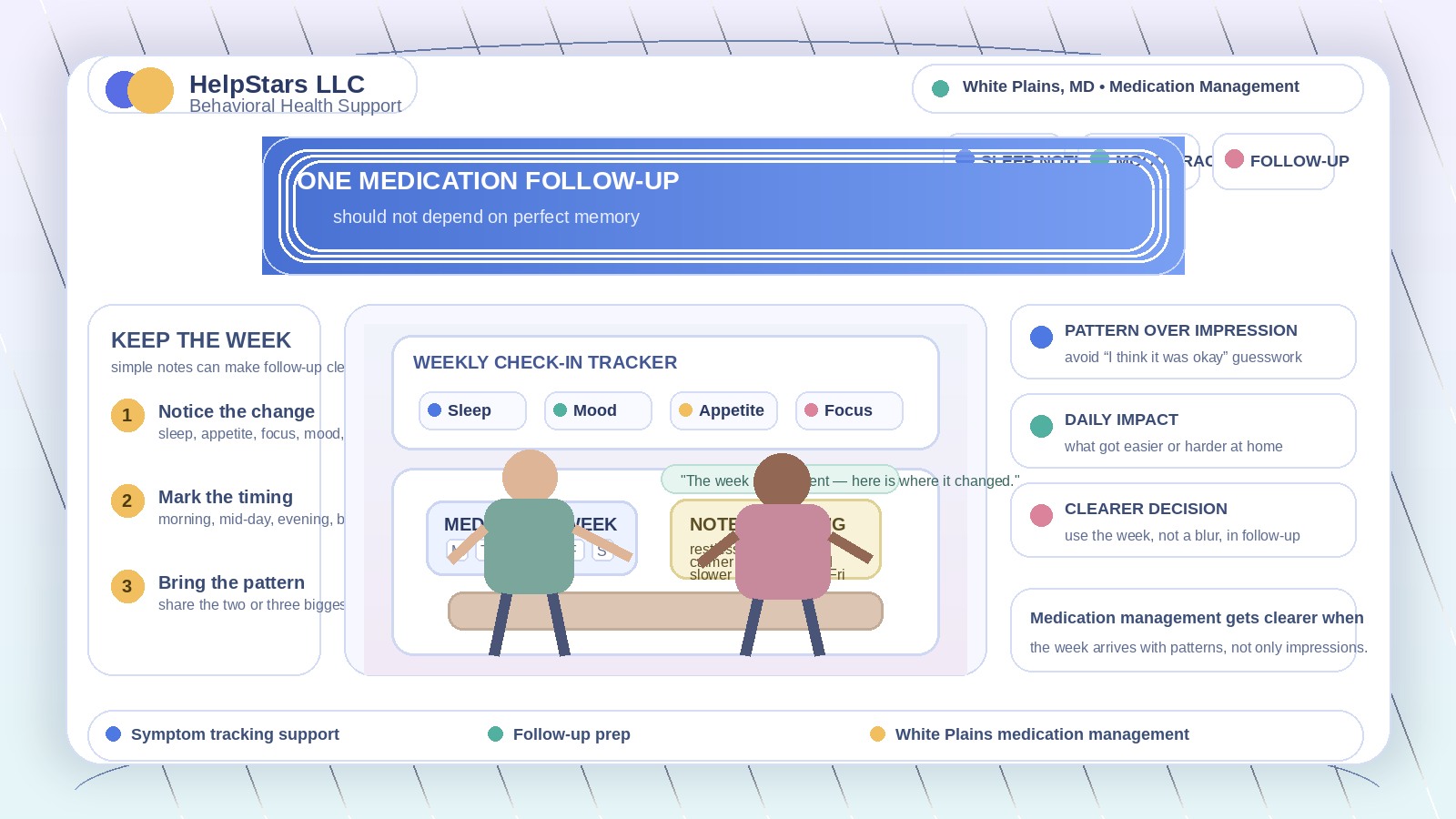
One Medication Follow-Up Should Not Depend on Perfect Memory: Medication Management for Adults Serving White Plains, Maryland
Some medication changes do not create one dramatic problem or one obvious success. They create a week full of smaller shifts. Sleep may be a little lighter. Mornings may take longer. Appetite may dip for two days and then partly return. Focus may improve at work but feel more scattered at home. By the time the follow-up appointment arrives, the person knows the week felt different, but the exact pattern is already slipping out of reach.
For adults seeking medication management serving White Plains, Maryland, that can be more than frustrating. It can make treatment decisions harder than they need to be. If the conversation depends on perfect recall, important details get flattened into phrases like "I think it helped" or "It was kind of up and down." Medication management can be more useful when the week is reviewed with enough specific detail to show what actually changed and what daily life is really carrying.
HelpStars LLC serves adults and families across Southern Maryland with behavioral health support. For adults in Charles County who want medication follow-ups to feel clearer and less guess-based, practical symptom tracking can make the next decision much more grounded.
The Week Can Be Clear While It Is Happening and Fuzzy by the Appointment
Many adults do notice changes in real time. They think about mentioning the dry mouth, the strange midday crash, the calmer evening, or the restless sleep. Then life keeps moving. Work happens. Family needs something. Another day passes. By appointment time, the person still remembers that something mattered, but not always when it happened, how often it happened, or whether it felt mild, growing, or inconsistent.
That can sound like:
- "I know I noticed a few things, but now I cannot line them up,"
- "It was not bad enough to feel dramatic, but it was different,"
- "I wish I had written it down when it was happening,"
- "I do not want to overstate it, but I also do not want to leave things out," or
- "I can tell the week changed. I just cannot describe it cleanly anymore."
That does not mean the person is unobservant. It usually means the brain was busy living the week, not archiving it for a later medical conversation.
Medication Management Works Better With Patterns, Not Just Impressions
Medication management is often more helpful when a follow-up visit has real patterns to work from. The goal is not to produce a perfect journal or turn daily life into homework. The goal is to bring enough usable information into the conversation that a medication decision reflects more than a vague overall impression.
Depending on the situation, useful details might include:
- whether the biggest change showed up in sleep, mood, appetite, energy, focus, or irritability,
- what time of day the change was most noticeable,
- whether the effect happened once, several times, or almost every day,
- what parts of work, parenting, home life, or routine became easier or harder,
- whether the person felt more steady overall even if one side effect remained, and
- which change was annoying versus which change was truly disruptive.
Those specifics can make it easier to sort out whether a medication needs more time, closer monitoring, a change in timing, a different strategy, or a more direct adjustment.
A White Plains Example: The Appointment Arrived After the Details Slipped
Imagine an adult serving White Plains, Maryland who recently started a medication adjustment. During the week, they noticed several real changes. Tuesday morning felt unusually slow. Wednesday afternoon seemed calmer than usual. Thursday night sleep was restless. By Friday, concentration improved for a few hours, but appetite still felt off.
None of those shifts was big enough to stop the week. But together, they mattered. The problem is that the follow-up appointment did not happen while each detail was fresh. By the time the person sits down to talk, all of those experiences have blurred together. Now the update comes out as "maybe a little better, maybe a little weird."
In that situation, behavioral health services Charles County may include medication follow-up support that helps make the conversation more concrete. Instead of deciding from a hazy recap, the appointment can focus on what showed up, what seemed to help, what still interfered, and which pattern deserves more attention before the next step is chosen.
What Can Help Adults Bring a More Useful Update
Some adults benefit from keeping the tracking process as simple as possible. A full diary may feel unrealistic, but a few steady prompts can still be useful. That may include:
- Write down only the changes. If something feels noticeably different, note the shift instead of trying to summarize the entire day.
- Link the change to a time or routine. Morning, after lunch, during work, in the evening, or before sleep can be enough.
- Name the daily impact. Did the change make the day easier, stranger, heavier, calmer, or harder to manage?
- Bring the most important two or three patterns. A follow-up does not need every detail. It needs the details that most affect the next decision.
This approach can reduce the pressure people feel to remember the week perfectly while still making the appointment far more informative.
Why Small Changes Still Matter
Adults sometimes avoid mentioning things because the change seems too minor to bring up. But medication decisions are often shaped by smaller patterns, especially when those patterns repeat. A side effect that shows up three evenings in a row, a sleep shift that keeps delaying the morning, or an appetite change that quietly alters the whole day can matter even if it never looks dramatic on paper.
That is one reason medication follow-up White Plains MD searches often come from people who are not in crisis but still want more clarity. Treatment is easier to adjust thoughtfully when the everyday details have not disappeared by the time the conversation starts.
Questions Adults Often Ask About Follow-Up Visits
Do I need to track every single symptom every day?
No. Many adults do better with a lighter approach that only captures the changes that felt most noticeable or disruptive.
What if I already forgot most of the week by the appointment?
That is common. Even a partial pattern can still help, and future follow-ups may feel clearer with a simpler tracking routine between visits.
Should I only mention side effects?
No. It also helps to name what improved, what stayed the same, and what parts of daily life felt more manageable.
Can medication management fit alongside other behavioral health support?
Yes. Depending on the person’s needs, medication management may be part of a broader outpatient support plan that also includes counseling, psychiatric evaluation, PRP, or other services.
A Better Follow-Up Can Start Before the Appointment Begins
Adults do not need perfect memory to have a useful medication conversation. They often need a simpler way to hold onto the few details that matter most before the week moves on. If follow-up visits keep turning into guesswork, the next helpful step may be support that makes the pattern easier to see and easier to say out loud.
HelpStars LLC serves adults and families across Southern Maryland with behavioral health support. For adults seeking medication management serving White Plains, Maryland, clearer week-to-week tracking can help turn a vague update into a more confident treatment decision.