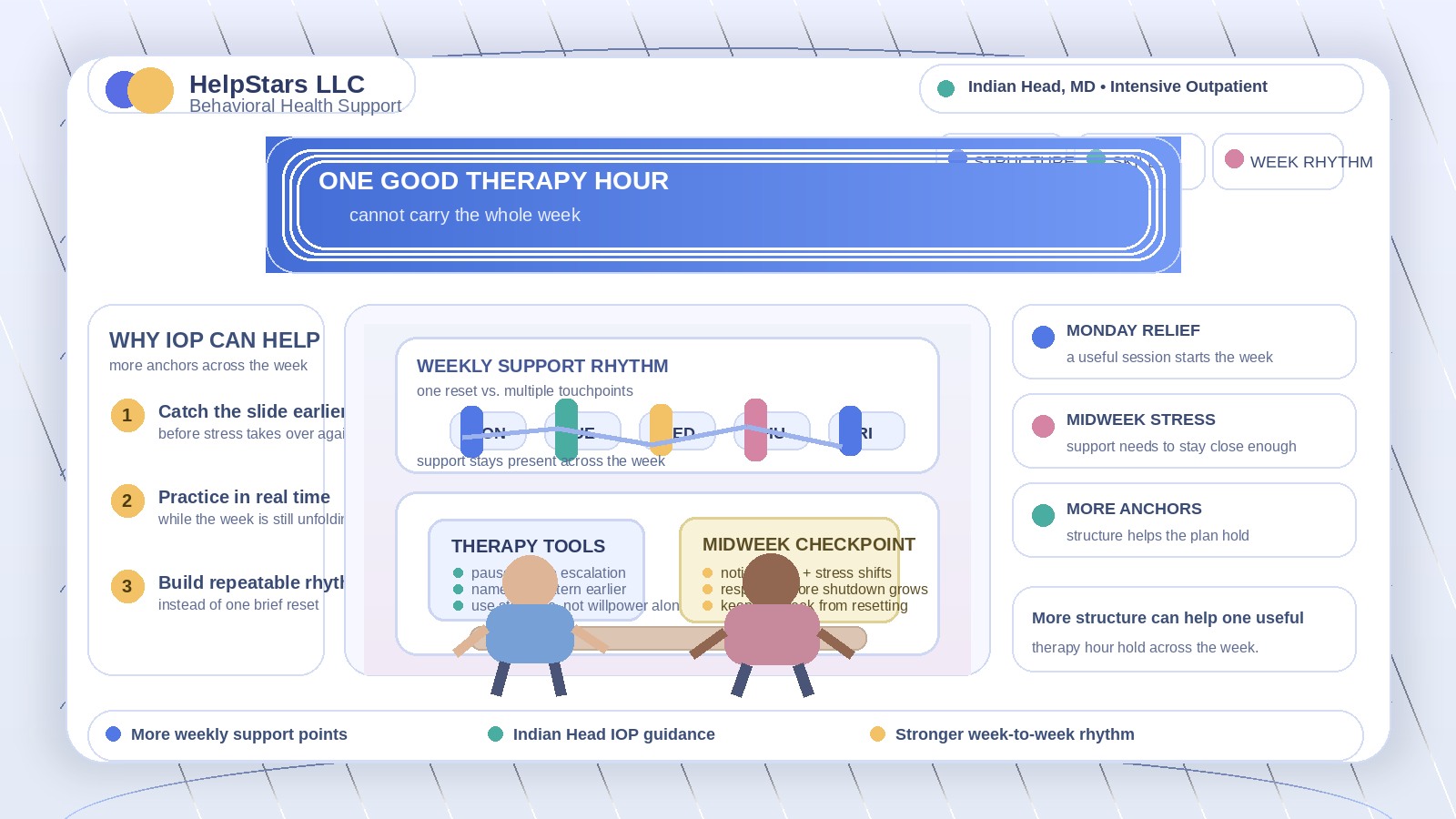
One Good Therapy Hour Cannot Carry the Whole Week: Intensive Outpatient Support for Adults Serving Indian Head, Maryland
A helpful therapy appointment can change the tone of a day. A person may leave feeling clearer, steadier, or more hopeful than they did going in. But by the middle of the week, the same arguments, shutdowns, urges, stress reactions, or emotional crashes can start piling back up. The problem is not that the appointment failed. Sometimes the week simply needs more structure than one hour can reasonably carry.
For adults seeking intensive outpatient support serving Indian Head, Maryland, that pattern can matter. Someone may be trying hard, using insight well, and still finding that too much falls apart between check-ins. Intensive outpatient program support can offer a more structured level of care when a person needs more than occasional relief and more than a single reset point each week.
HelpStars LLC serves adults and families across Southern Maryland with behavioral health support. For adults in Charles County who feel like progress keeps slipping in the long spaces between appointments, a more consistent outpatient rhythm may help make the week feel more stable and more usable.
When Progress Keeps Breaking Apart Between Appointments
Some adults do not need to be convinced that support helps. They already know it does. What they are noticing instead is that the support rhythm may no longer match the pressure of the week they are living in. A Monday session may help. By Tuesday evening, stress is rising again. By Thursday, the same conflict, isolation, panic, irritability, or follow-through problem is back in charge.
That can sound like:
- “I can use the appointment, but I lose the thread too quickly,”
- “I keep starting the week with a plan and ending it in the same hole,”
- “One good conversation is not the same as a stable week,”
- “I know what I am supposed to do, but the harder moments come too fast,” or
- “I do not think I need the highest level of care, but I do need more support than this.”
That is an important distinction. Many adults are not looking for “more care” because they want something dramatic. They are looking for a format that better matches how often the week starts slipping.
What Intensive Outpatient Support Adds
Intensive outpatient support can be useful when once-a-week treatment is not enough structure, but the person may still benefit from a community-based outpatient setting. The added value is often not only the number of contacts. It is the rhythm, repetition, and chance to work with problems while they are still active instead of only reviewing them after the fact.
Depending on the program and the person’s needs, that may help with:
- having multiple support points across the week instead of one reset that has to do all the work,
- practicing coping tools while real stress patterns are still unfolding,
- noticing what triggers setbacks sooner rather than after the week has already gone off track,
- building more consistency around emotional regulation, communication, and daily structure,
- creating a treatment routine strong enough to hold harder stretches, and
- reducing the cycle of brief relief followed by rapid unraveling.
The goal is not to make life feel clinical every day. It is to give the person a steadier support frame while they are trying to regain traction.
An Indian Head Example: Better on Monday, Overloaded by Thursday
Imagine an adult serving Indian Head, Maryland and nearby Charles County communities who genuinely benefits from treatment. They often leave appointments with insight, motivation, and a plan. They know what conversations they want to have differently. They know what boundaries would help. They know the signs that stress is climbing.
But the week does not unfold in a calm, controlled order. By Tuesday there is family pressure, an upsetting text thread, work stress, sleep disruption, or a pileup of practical demands. By Wednesday the person is already using more energy to stay level. By Thursday they are back in the old pattern: shutting down, snapping at someone, isolating, crying unexpectedly, or losing follow-through on the basics that help them stay grounded.
Then the next appointment becomes a recap of everything that broke down again.
In a situation like that, the main issue may not be willingness. It may be that the treatment spacing is asking one useful hour to carry too much of the emotional load alone. A more structured outpatient level can help when a person needs support that meets the week more often and with more continuity.
Four Signs the Week May Need More Structure Right Now
- You keep understanding the pattern, but still cannot interrupt it fast enough. Insight is present, but the week moves faster than the support rhythm.
- The same hard stretch keeps returning before the next appointment. Relief may be real, yet it does not hold long enough to change the bigger cycle.
- Skills make sense in theory but get lost in live stress. Some adults need more repetition and more real-time practice before the tools become usable under pressure.
- One session keeps turning into cleanup instead of momentum. If treatment time is mostly spent repairing the last few days, more structure may help create forward movement instead of repeated recovery.
None of those signs automatically mean one service is right for every person. They do suggest that support intensity is a worthwhile conversation when the same weekly slide keeps repeating.
Why Repetition Can Matter More Than Motivation
Adults often blame themselves when progress will not hold. They tell themselves they should have tried harder, remembered more, or calmed down faster. But some patterns do not improve because of effort alone. They improve when support shows up often enough to compete with the pace of stress, habit, conflict, isolation, or mood instability.
That is one reason intensive outpatient program Charles County searches may come from people who are already participating in care and want something more workable, not something more extreme. Repetition can help turn insight into habit. Multiple weekly touchpoints can make it easier to catch a slide earlier, rehearse a different response, and keep the week from resetting all the way back to the same painful starting point.
What Adults May Want To Watch Between Sessions
When someone is wondering whether the current support rhythm is enough, it may help to look beyond how they feel during the appointment itself. Useful questions can include:
- How quickly does the week start slipping after the last support contact?
- Which days or times feel most vulnerable to a drop in regulation or follow-through?
- Does conflict, loneliness, task pressure, or sleep disruption keep outrunning the coping plan?
- Are the same problems being discussed over and over without enough time to stabilize them in daily life?
- Would more structured support across the week make it easier to practice skills before the situation escalates?
These questions do not diagnose anything by themselves. They simply help clarify whether the issue is only the problem itself or also the spacing of the current support.
Why This Can Matter for Adults Serving Charles County
For adults serving Indian Head, Waldorf, White Plains, Bryans Road, La Plata, and nearby Charles County communities, emotional strain does not happen in a vacuum. It shows up inside commutes, parenting, appointments, bills, relationship stress, work expectations, and recovery responsibilities. If the support structure is too light for the pace of that week, people can end up feeling like they are always restarting.
A more structured outpatient approach may help because it gives the week more anchors. Instead of relying on one good day to carry several harder ones, the person may have a better chance of building steadier momentum across the days where stress usually regains ground.
Questions Adults Often Ask About Intensive Outpatient Care
Does needing more support mean I failed at regular therapy?
No. It may simply mean the current treatment rhythm is not strong enough for what the week is asking of you right now.
Is intensive outpatient support only for people in immediate crisis?
Not necessarily. Some adults consider it because they want more consistent structure before the pattern worsens further.
What if I am functioning in some areas but still falling apart between appointments?
That still matters. A person can keep meeting some responsibilities while also needing more support to stay emotionally steady across the whole week.
Can more frequent support help if I already know my triggers?
Yes. Knowing the pattern and being able to interrupt it reliably are not always the same thing. More repetition and structure may help bridge that gap.
A Stronger Week Sometimes Starts With a Better Support Rhythm
Some adults do not need proof that support works. They need a form of support that can stay closer to the pace of the week they are trying to live through. If insight keeps arriving on time but stability keeps leaving early, a more structured outpatient level may be worth exploring.
HelpStars LLC serves adults and families across Southern Maryland with behavioral health support. For adults seeking intensive outpatient support serving Indian Head, Maryland, more frequent therapeutic structure may help turn one useful hour into a steadier week instead of another brief reset.