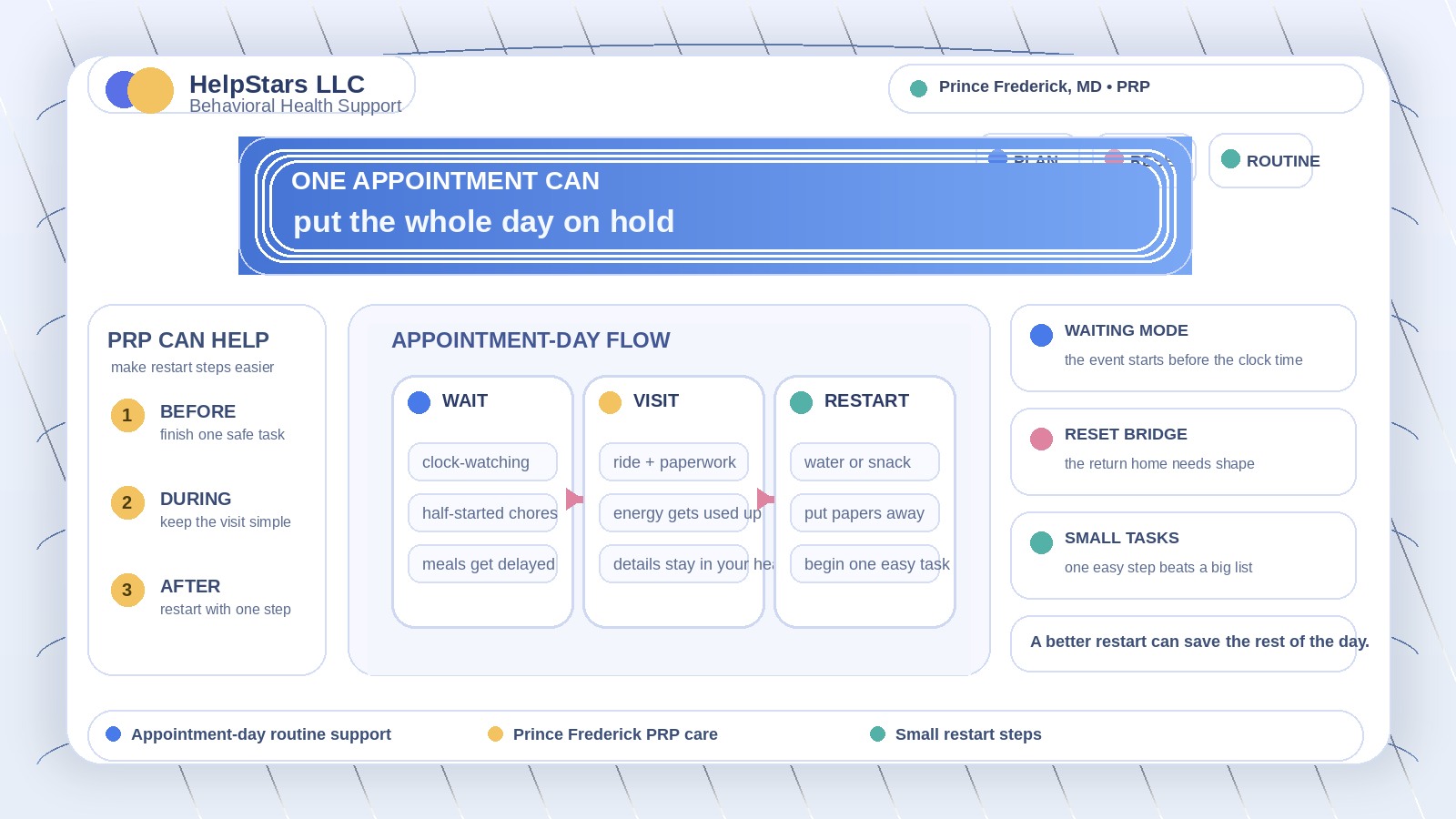
One Appointment Can Put the Whole Day on Hold: PRP Support for Adults Serving Prince Frederick, Maryland
Some days do not fall apart because the schedule was packed. They fall apart because one appointment takes over everything around it. A morning check-in, a school meeting, a benefits call, or a medical visit may only last part of an hour, but the lead-up starts earlier than expected and the reset afterward takes longer than anyone planned. By the time the appointment is finished, meals are off, small tasks have been postponed, and the rest of the day feels strangely hard to restart.
For adults seeking PRP support serving Prince Frederick, Maryland, that pattern can become a real barrier to daily stability. The issue is not always the appointment itself. Often the issue is that the whole day slips into waiting mode before it starts and never fully comes back online afterward. Psychiatric rehabilitation program support can help adults build steadier routines around those disruption points so one scheduled obligation does not keep swallowing the rest of the day.
HelpStars LLC supports adults and families across Southern Maryland with compassionate behavioral health services. When a single appointment keeps turning the rest of the day into a blur of delay, fatigue, and unfinished follow-through, practical support may help make the routine feel more usable again.
The Hard Part Is Often the Time Around the Appointment
People often assume an appointment only affects the minutes on the calendar. Real life is rarely that neat. A person may spend hours getting mentally ready, watching the clock, delaying errands because they do not want to run late, or avoiding any task that feels too hard to stop and restart. After the appointment, there may be emotional letdown, transportation fatigue, paperwork, uncertainty, or the simple feeling that the useful part of the day is already gone.
That can sound like:
- “I keep waiting for the appointment instead of doing the rest of my day,”
- “Once I get back home, I cannot seem to restart anything,”
- “The appointment only took forty minutes, but it took my whole day with it,”
- “If something is scheduled in the middle, everything before and after gets blurry,” or
- “I am not doing nothing on purpose. I just never get back into motion.”
That experience is common for adults who are already juggling anxiety, depression, executive-function strain, low energy, transportation stress, or a fragile home routine. The problem is not laziness. The problem is that one fixed event keeps breaking the rhythm the rest of the day depends on.
Waiting Mode Can Quietly Drain More Than Time
When an appointment splits the day in half, many adults lose more than a few open hours. They lose momentum. A person may avoid starting laundry, making phone calls, eating lunch, cleaning up, answering messages, or handling forms because each task feels too close to the scheduled interruption. Then, once the appointment is over, the brain may treat the day like it is already spent.
Over time, this can create a discouraging cycle. Necessary appointments still happen, but each one leaves behind an outsized trail of unfinished tasks and self-criticism. Someone may start believing they are bad at managing time, even when the real problem is that their routine does not have a reliable way to absorb interruptions and restart.
What PRP Support Can Help Rebuild
PRP support is often most useful when daily life needs more structure, not more blame. For adults whose schedule keeps collapsing around one obligation, support may focus on the handoff between the appointment and the rest of the day.
Depending on the person’s needs, psychiatric rehabilitation support may help with:
- building a realistic pre-appointment routine that reduces passive waiting,
- choosing one or two tasks that are safe to finish before leaving,
- setting up paperwork, transportation details, and return-home essentials in advance,
- creating a short post-appointment reset so the day does not end emotionally at the front door,
- breaking afternoon tasks into a smaller re-entry plan instead of one overwhelming list, and
- figuring out which kinds of appointments drain the most energy and why.
The goal is not to make every appointment easy. The goal is to stop one scheduled event from taking over the whole day by default.
A Prince Frederick Example: The Calendar Only Shows One Task, but the Day Feels Gone
Imagine an adult serving Prince Frederick, Maryland and nearby Calvert County communities who has a 1:00 PM appointment. On paper, the day still looks open. There should be time for breakfast, a quick errand, a follow-up phone call, and maybe some housework before leaving. There should also be time afterward to come home, reset, and finish two or three practical tasks.
Instead, the whole day starts bending around the appointment by midmorning. The person keeps checking the time. They hesitate to begin anything that might run long. Lunch gets delayed because leaving the kitchen half-clean feels stressful. The ride plan stays in the back of the mind. After the appointment, they come home mentally tired and sit down “for a minute,” only to realize the afternoon has thinned out into nothing usable.
In that situation, PRP support serving Prince Frederick, Maryland may help by treating restart skills as a real part of daily functioning. The appointment is not the only issue. The missing bridge before and after it is the issue too.
Three Places the Day Usually Gets Lost
- Before the appointment starts. Adults may slide into clock-watching, delayed meals, or half-started chores because they do not trust themselves to stop and transition smoothly.
- During the return home. Transportation, emotional fatigue, or follow-up instructions can create a feeling that the active part of the day is already over.
- At the re-entry moment. Once home again, the person may need a clearer first step than “be productive now.” Without that step, the rest of the afternoon can disappear into scrolling, sitting, or trying to think of where to begin.
Understanding which of these zones causes the most trouble can make practical support much more targeted.
Small Supports Can Make the Afternoon More Reachable
Many adults do not need a dramatic life overhaul. They need a better handoff. Sometimes that means deciding in advance what the one pre-appointment task will be. Sometimes it means packing paperwork, water, keys, and a snack before the day gets tense. Sometimes it means choosing one low-friction post-appointment task, such as putting forms in the right place, reheating food, or taking a ten-minute home reset before attempting anything harder.
These kinds of steps matter because restarting is often easier when it has shape. The brain usually handles “put the folder in the tray, drink water, and start the dishwasher” better than “get the whole day back on track.” PRP support can help adults find routines small enough to repeat and practical enough to survive tired days.
Why This Pattern Matters in Everyday Calvert County Life
For adults serving Prince Frederick, Huntingtown, Dunkirk, Chesapeake Beach, North Beach, and nearby Calvert County communities, appointments often sit inside a full real-life context: family responsibilities, transportation coordination, errands, work obligations, and the energy it takes to move between towns. A single appointment can create more friction than the calendar suggests.
That is one reason practical behavioral health support can be valuable. The problem may not be insight. The problem may be that the daily structure around appointments is too fragile. Support becomes useful when it helps the person build a day that can bend without fully breaking.
Questions Adults Often Ask About PRP Support
Is this really something PRP can help with?
Yes. PRP often focuses on daily-living structure, routines, follow-through, and the practical systems that make appointments, errands, and home responsibilities easier to manage.
What if I can get to the appointment but cannot get moving again afterward?
That still counts as a meaningful barrier. For many adults, the harder problem is not attendance. It is rebuilding the day once the appointment is over.
Do I need to fix my whole schedule at once?
No. It is often more useful to start with one repeated problem pattern, such as pre-appointment waiting mode or post-appointment shutdown, and make that part more workable first.
Can PRP fit alongside therapy, medication management, or other behavioral health care?
Yes. Depending on the person’s needs, psychiatric rehabilitation support may be one part of a broader outpatient behavioral health plan.
A Better Day May Start With a Better Restart
Some adults are not losing whole days because they do not care about their routines. They are losing them because one scheduled interruption keeps taking more mental space than it seems like it should. When that happens again and again, practical support can help turn the day back into something usable.
HelpStars LLC supports adults and families across Southern Maryland with compassionate behavioral health services. For adults seeking PRP support serving Prince Frederick, Maryland, psychiatric rehabilitation support may help make appointment days easier to prepare for, easier to recover from, and easier to keep moving after they end.