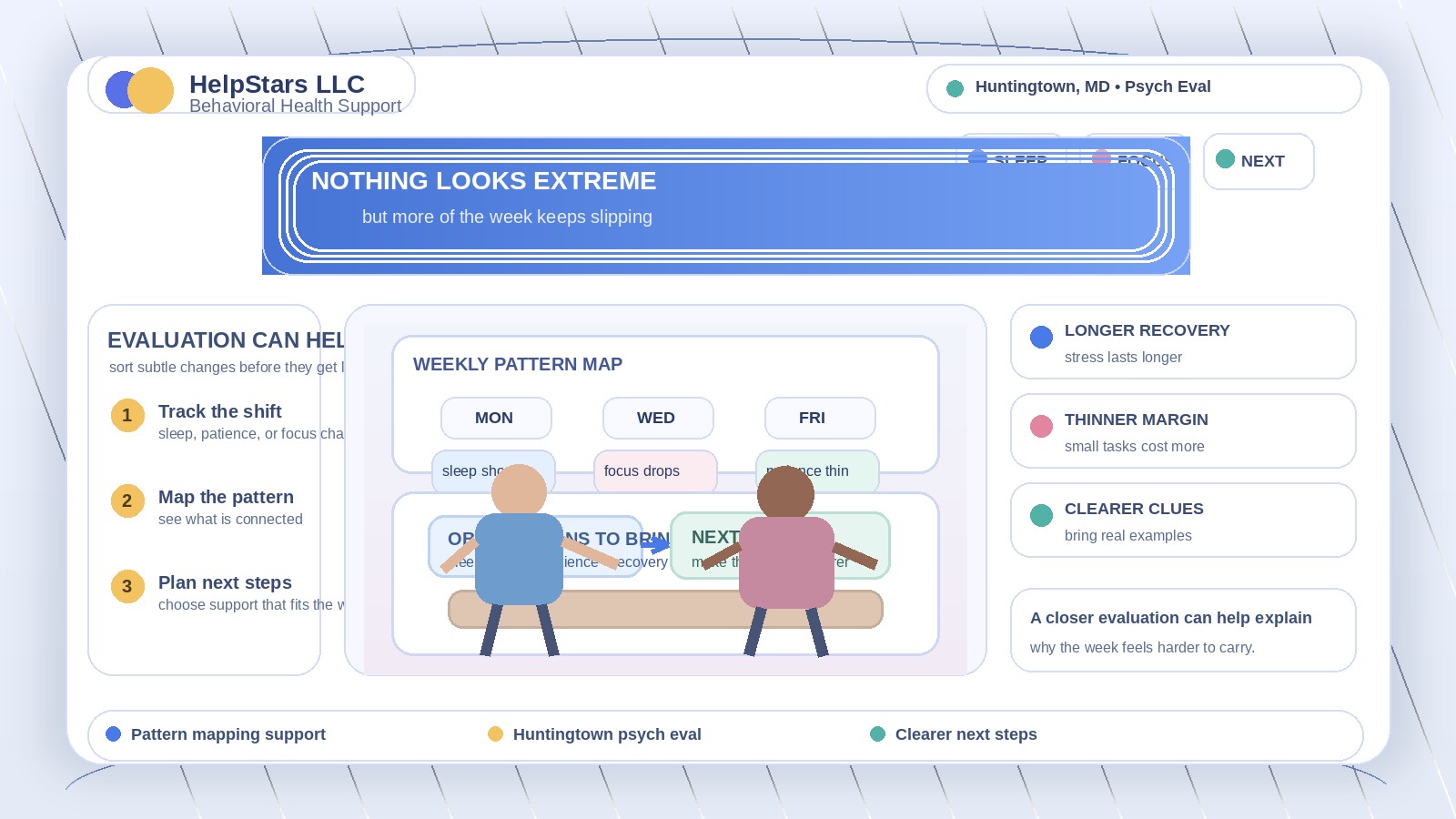
Nothing Looks Extreme, but More of the Week Keeps Slipping: Psychiatric Evaluation for Adults Serving Huntingtown, Maryland
Some adults delay getting help because nothing about the week looks dramatic enough to justify a bigger conversation. They are still going to work. They are still answering some texts. They are still getting through the visible parts of life well enough that other people may not notice the shift right away. But inside that “well enough,” more and more of the week can start slipping. Sleep is less reliable. Patience is thinner. Concentration is harder to hold. Simple tasks take more setup, more recovery, or more self-talk than they used to.
For adults seeking a psychiatric evaluation serving Huntingtown, Maryland, that quieter kind of change can still matter. The issue is not always one overwhelming symptom. Sometimes it is the growing sense that ordinary life is taking more out of you, your explanations keep changing, and the usual resets are no longer resetting much. A thoughtful evaluation can help sort what is happening before the pattern grows heavier or harder to explain.
HelpStars LLC serves adults and families across Southern Maryland with compassionate behavioral health support. For adults in Calvert County who do not feel “in crisis” but do feel less steady, less clear, or less like themselves across the week, a closer clinical look may be a useful next step.
Why “Mostly Functioning” Can Still Hide a Real Mental Health Shift
Many adults assume that if they are still handling the basics, they should wait longer. But functioning is not all-or-nothing. A person can still be showing up while paying a much higher internal cost than before. The day may look normal from a distance while feeling increasingly narrow from the inside.
That can show up as:
- needing more time to get started in the morning,
- finding small problems much harder to absorb calmly,
- losing track of tasks that used to feel automatic,
- finishing work but having little emotional bandwidth left afterward,
- having trouble telling whether the main problem is stress, sleep, mood, attention, or all of them at once, or
- quietly withdrawing because everything feels more effortful than it used to.
Those signs do not automatically point to one diagnosis. They do suggest that guessing may no longer be the most useful strategy.
A Psychiatric Evaluation Can Help Organize What No Longer Fits One Simple Explanation
Adults often wait because they think they need a neat summary first. In reality, a psychiatric evaluation can be helpful precisely when the summary is hard to make. A person may keep rotating through explanations such as burnout, poor sleep, work strain, irritability, anxiety, or low motivation without feeling like any one label fully matches the whole picture.
A fuller evaluation can help organize questions like:
- What changes started first?
- Which symptoms seem connected, and which ones may be consequences of the others?
- Is the pattern getting broader, heavier, or more frequent?
- What part of daily functioning is being affected the most?
- Would outpatient counseling, medication support, or another behavioral health service make sense to discuss next?
The goal is not to force a label too quickly. The goal is to replace vague concern with a clearer read on what the week is actually showing.
A Huntingtown Example: Nothing Has Fallen Apart, but the Margin Is Gone
Imagine an adult serving Huntingtown, Maryland and nearby Calvert County communities who still looks dependable to most people around them. They are still making it to the responsibilities that cannot be skipped. But the margin that used to make daily life workable is disappearing.
They used to recover from a hard day by the next morning. Now the stress lingers. They used to keep track of errands, messages, and home tasks without much friction. Now each extra demand feels like one too many. They are not describing panic, a major breakdown, or one obvious trigger. Instead, they keep saying some version of, “I’m getting through it, but it keeps feeling harder than it should.”
That kind of pattern can be easy to minimize because there is no single dramatic event to point to. But it can still be a strong reason to consider a psychiatric evaluation in Calvert County. When the cost of “holding it together” keeps rising, the next useful step may be getting more specific about what changed and why.
What Clinicians Often Look For Before Symptoms Get Louder
Many adults assume an evaluation is only for severe or unmistakable symptoms. It can also help earlier, when the pattern is quieter but widening. Some of the most useful clues are not flashy. They are repeated changes in how the week is functioning.
- Your recovery time keeps getting longer. Stress that once passed in hours now lingers into the next day or longer.
- Ordinary responsibilities require more effortful planning. What used to be automatic now takes reminders, workarounds, or extra mental energy.
- Your explanation keeps shifting, but the strain keeps staying. The story changes from “I’m just tired” to “maybe it’s stress” to “maybe I’m just off lately,” but the week never truly returns to normal.
- Other people notice a change in patience, presence, or responsiveness. Even if they cannot name it well, they can often tell something is different.
These clues do not mean someone should jump to conclusions. They do mean it may be time for more than self-monitoring alone.
Four Observations Worth Bringing to an Evaluation
Adults do not need polished language to make an evaluation useful. Real examples are often more valuable than perfect insight. If you are trying to explain a quieter decline in steadiness, it may help to notice:
- what part of the day now feels most different than it did a month or two ago,
- whether patience, sleep, motivation, focus, or emotional recovery have changed together,
- which responsibilities now feel disproportionately hard relative to how simple they seem on paper, and
- what you keep doing to compensate that did not used to be necessary.
That information can help the conversation move beyond “I don’t know, I’m just off” and toward something more specific and actionable.
Questions Adults Sometimes Ask Before Scheduling
Do I need an evaluation if I’m still meeting most of my responsibilities?
Not always, but many adults seek an evaluation during that stage because they can tell the effort, inconsistency, or internal strain has changed in a meaningful way.
What if I am not sure whether this is stress, anxiety, depression, or something else?
That uncertainty is one of the reasons an evaluation may help. You do not need to solve the pattern alone before asking for a closer assessment.
Could this still matter if nothing “big” has happened?
Yes. Mental health patterns do not always begin with one dramatic event. Sometimes they show up as a gradual loss of steadiness, flexibility, or emotional margin across ordinary life.
Clearer Answers Can Matter Before the Week Gets Smaller
Adults do not have to wait for life to look unmistakably unmanageable before taking a quieter pattern seriously. If more of the week keeps slipping — even while you still appear mostly functional from the outside — a closer evaluation may help you understand what is changing and what kind of support makes sense next.
HelpStars LLC serves adults and families across Southern Maryland with compassionate behavioral health support. For adults seeking a psychiatric evaluation serving Huntingtown, Maryland, a clearer clinical picture may be the step that helps the week feel more understandable, more workable, and less expensive to carry.