Nothing Is Missing, but Everything Is Hard To Find: PRP Support for Adults Serving Charlotte Hall, Maryland
Some adults are not falling behind because they do not care. They are falling behind because too many small essentials keep floating with no reliable place to land. The keys were in the other bag. The form was under yesterday’s mail. The charger moved to another room. The appointment card made sense when it arrived, but now it is mixed into a stack of unrelated papers. Nothing seems major on its own, yet the day starts with a search before it starts with a plan.
For adults seeking PRP support serving Charlotte Hall, Maryland, that kind of daily friction can quietly drain energy, confidence, and follow-through. The problem is not always motivation. Sometimes the problem is that home setup, routine, and recovery tasks do not give important items anywhere dependable to live. PRP services can help adults create workable landing spots, rebuild everyday structure, and reduce the chain reaction that starts when one needed item disappears into the wrong pile at the wrong time.
HelpStars LLC supports adults and families across Southern Maryland with compassionate behavioral health services. For adults in St. Mary’s County whose mornings keep getting hijacked by lost paperwork, moving items, and broken setup, practical psychiatric rehabilitation support may help make the day easier to begin and easier to hold together.
Daily Stress Often Builds Around Ordinary Objects
It is easy to dismiss this issue because the objects themselves sound small. A key ring. A folder. A refill note. A bus card. A charger. A calendar page. But these items often sit at the intersection of several bigger responsibilities. When they do not have a stable place, the cost shows up in missed timing, scrambled thinking, irritability, and the feeling that every task takes longer than it should.
That can sound like:
- “I know it is here somewhere, but I do not know where I put it this time,”
- “I keep spending the first part of the day looking for what I need to start the day,”
- “Once I lose one thing, everything else starts sliding too,”
- “I end up leaving late because I cannot find the paper, charger, or card I need,” or
- “By the time I locate everything, I already feel behind.”
That pattern can become especially frustrating for adults managing mental health symptoms at the same time. A cluttered or unstable setup does not just waste minutes. It can raise stress before the person even gets to the part of the day that requires focus.
Why the Problem Is Bigger Than Being “Disorganized”
Adults often blame themselves and say they just need to be more organized. But many people are not dealing with a simple lack of effort. They are dealing with routines that never became reliable, living spaces that do not support follow-through, mental overload that makes item-tracking harder, or recovery periods where ordinary setup tasks quietly unravel.
Sometimes the issue is that there is no single place for important things to go. Sometimes there are too many temporary piles, each created with good intentions and then forgotten. Sometimes the person can clean or reset the space one day but cannot keep the system usable once the week gets crowded. The result is a home environment that keeps forcing fresh decisions about where things belong.
That repeated decision-making can be exhausting. The day starts not with forward motion but with preventable searching, second-guessing, and trying to reconstruct yesterday’s path.
How PRP Services Can Help Create More Usable Daily Systems
Psychiatric rehabilitation program support is not only about encouragement. It can help adults build practical daily-living systems that make ordinary responsibilities easier to repeat. For someone whose week keeps getting disrupted by item drift and setup breakdown, support may focus on function more than perfection.
Depending on the person’s needs, PRP support may help with:
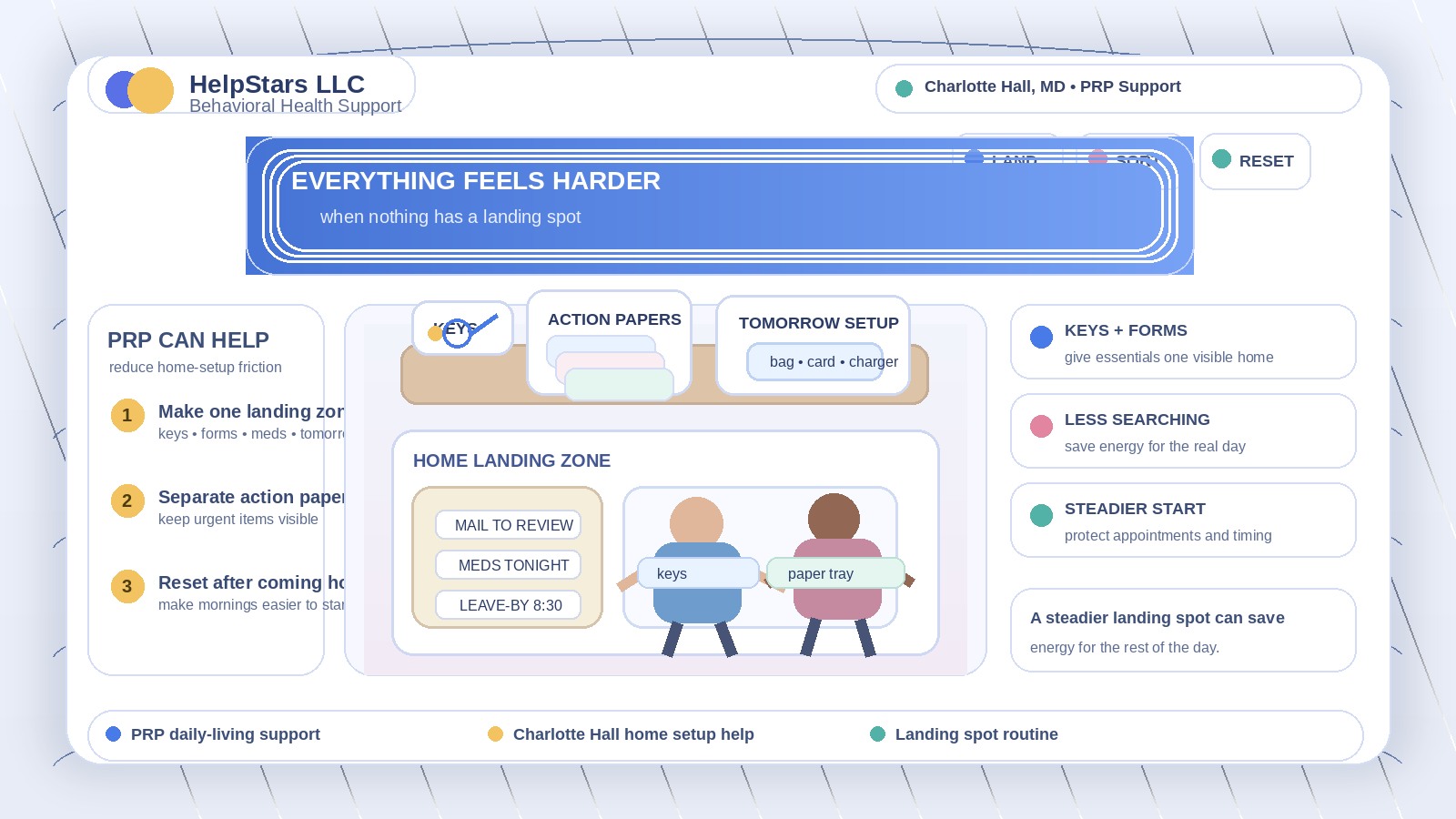
- creating one dependable landing area for keys, paperwork, medications, and schedule items,
- reducing the number of random holding spots that make important things harder to track,
- setting up a simple routine for what gets put where when the person walks in the door,
- separating urgent documents from general paper clutter,
- linking home setup to real daily tasks like appointments, refills, transportation, and forms, and
- rebuilding the system after a hard week so one disruption does not turn into a month of searching.
The goal is not a picture-perfect house. The goal is a daily environment that stops making ordinary follow-through harder than it already is.
A Charlotte Hall Example: The Morning Keeps Starting With a Search
Imagine an adult serving Charlotte Hall, Maryland and nearby St. Mary’s County communities who feels like they are always almost ready. The clothes are mostly together. The appointment is on the calendar somewhere. The medication is in the house. The right paper arrived earlier in the week. But each morning, one missing piece throws the whole sequence off.
The keys are not where they were yesterday. The folder got moved when the kitchen table had to be cleared. The charger is in another room. The appointment card is mixed into a stack of unopened mail and grocery receipts. None of this means the person does not want to show up or handle responsibilities. It means the setup around those responsibilities keeps forcing a scavenger hunt before the day has any chance to feel steady.
In that situation, PRP support serving Charlotte Hall, Maryland may help by starting smaller than “get more organized.” The real work may be identifying which items repeatedly derail the day, giving those items one visible home, and building a return routine that makes tomorrow easier than today instead of equally chaotic all over again.
Three Small Setup Changes That Can Reduce Daily Friction
- Create one true landing spot. A key bowl, document tray, medication area, or go-bag zone only helps if it is consistent enough to become the first place the person checks every time.
- Separate action items from everything else. Papers that require a phone call, signature, appointment, or refill step usually need a more visible place than general mail or mixed household clutter.
- Build a return-home routine, not just a clean-up idea. Systems last longer when they are tied to a repeatable moment, such as walking in the door, finishing dinner, or setting up for the next morning.
These changes may sound basic, but they can reduce the daily emotional cost of being repeatedly thrown off by the same preventable search pattern.
Signs the Setup May Be the Real Barrier
Adults may want to consider practical support when they notice patterns like:
- spending too much of the morning trying to find what is needed to leave the house,
- important papers repeatedly getting buried under unrelated items,
- knowing tasks matter but still losing track of the objects connected to them,
- feeling late, irritated, or defeated before the main part of the day even begins, or
- cleaning the space occasionally without creating a system that stays usable across the week.
These signs do not mean someone is lazy or careless. They often mean the current environment is asking the person to compensate for too much friction with memory and willpower alone.
Why Practical Support Can Matter Between Appointments
Many adults understand what they need to do in theory. The challenge is making the home environment support that understanding in real life. A good plan for treatment, medication, work, or appointments can still fall apart if the basic handoff between one day and the next is unreliable.
That is part of why PRP services in St. Mary’s County can matter. Daily functioning is shaped by ordinary systems: where forms go, where medications live, where tomorrow’s items wait, and how the person resets after a tiring day. When those systems stay unstable, the rest of the week can start feeling more fragile than it should.
For adults serving Charlotte Hall, Mechanicsville, Leonardtown, California, Lexington Park, and nearby communities, practical behavioral health support may help make the home side of daily life easier to use, not just easier to describe.
Common Questions About PRP Support
Is this really something PRP can help with?
Yes. PRP often supports practical daily-living patterns, routines, and community functioning, including the kinds of systems that affect appointments, paperwork, medication follow-through, and leaving the house more smoothly.
What if I know what system I want but cannot keep it going?
That is a common reason support may help. The challenge is not always knowing the idea. It is building something simple enough to repeat when the week is stressful.
Do I need my whole home perfectly organized first?
No. Many adults benefit from starting with one high-impact area or one repeated problem rather than trying to fix everything at once.
Can PRP fit alongside other outpatient behavioral health services?
Yes. Depending on the individual situation, PRP may be one part of a broader outpatient plan that also includes counseling, psychiatric evaluation, medication management, supported employment, or other behavioral health support.
The Right Landing Spot Can Change More Than It Sounds Like
Sometimes the next useful step is not more pressure. It is less daily searching. If the week keeps losing energy to missing keys, moving paperwork, and unstable home setup, the problem may be more practical and more fixable than it first appears.
HelpStars LLC supports adults and families across Southern Maryland with compassionate behavioral health services. For adults seeking PRP support serving Charlotte Hall, Maryland, psychiatric rehabilitation support may help turn scattered entry points, lost essentials, and fragile routines into a setup that feels easier to trust from one day to the next.