Not Knowing Which Change Matters Most: How a Psychiatric Evaluation Can Help Adults Serving Chesapeake Beach, Maryland
Some adults do not have one dramatic symptom they can point to. What they have is a pile of smaller changes that keep crossing into each other. Sleep feels lighter. Patience runs shorter. Focus slips in the middle of the day. Motivation seems inconsistent. A person may still be working, parenting, commuting, showing up for errands, and answering the most urgent messages, yet the week no longer feels like it is moving on the same rails it used to.
For adults seeking a psychiatric evaluation serving Chesapeake Beach, Maryland, that kind of blurry pattern matters. The problem is not always that nothing makes sense. Sometimes it is that too many explanations seem possible at once. Stress could be part of it. So could depression, anxiety, poor sleep, burnout, attention problems, medication changes, grief, or a mental health pattern that has been gradually building for longer than the person realized.
HelpStars LLC supports adults and families across Southern Maryland with compassionate behavioral health services. When mood, sleep, concentration, and daily functioning all start shifting together, a thoughtful outpatient evaluation can help sort out what deserves closer attention and what kind of support may fit best.
The Hard Part Is Often the Pileup, Not Just One Symptom
Many people delay getting help because each individual change sounds too ordinary on its own. Trouble sleeping happens. Everyone loses focus sometimes. Irritability can sound like stress. Pulling back socially can sound like needing space. But when several of those shifts begin showing up in the same season of life, the overall pattern can become much heavier than any one symptom sounds by itself.
That can sound like:
- “I can still get through most of the day, but everything feels more effortful than it should,”
- “I keep changing my mind about what the real problem is,”
- “Some days it feels like anxiety, other days it feels like exhaustion,”
- “I do not know what to write down because too many little things feel off,” or
- “Nothing sounds severe enough alone, but together it is changing how I function.”
That pileup can be draining because the person is not only dealing with symptoms. They are also spending energy trying to interpret those symptoms, minimize them, explain them away, and decide whether they are “serious enough” to count.
Why Conflicting Self-Explanations Can Keep People Stuck
Adults often try hard to make sense of what they are feeling before they ask for help. That effort is understandable, but it can turn into a loop. One week the explanation is work stress. The next week it is poor sleep. Then the person wonders whether they are depressed, burned out, emotionally overloaded, or simply not managing life well enough. If a few better days show up in the middle, they may decide the problem is already passing — right up until it starts interfering again.
This is one reason people can stay stuck longer than they need to. Not because they are careless, but because uncertainty creates permission to wait. If the pattern were clearer, the next step might feel obvious. When the pattern stays mixed, many adults keep telling themselves to watch it a little longer.
Meanwhile, ordinary life may already be getting harder. The person may need more recovery after social contact, feel less steady during work meetings, lose track of smaller responsibilities, or find that one stressful interaction now changes the tone of the whole day. The symptoms do not need to become dramatic before they start changing how a person moves through the week.
A Psychiatric Evaluation Can Help Organize the Pattern Instead of Guessing at It
Some adults hear the phrase psychiatric evaluation and picture a rushed visit that is only about assigning a label. A more useful outpatient evaluation is often much more practical than that. It can help organize what has changed, how long it has been happening, what daily life now feels harder to manage, what outside stressors may be influencing the picture, and what kind of support may make sense to discuss next.
Depending on the person’s needs, an evaluation may help clarify:
- whether sleep, mood, motivation, concentration, irritability, or anxiety changes seem connected or separate,
- whether the pattern sounds more situational, more cyclical, or more persistent than it first appeared,
- which parts of the week or day seem most affected,
- what questions deserve closer follow-up before treatment planning moves forward, and
- whether other services such as counseling, medication management, PRP, IOP, or family support belong in the conversation.
The immediate benefit is not always a perfect answer. Often, it is the relief of having the confusion narrowed into something more usable.
A Chesapeake Beach Example: Every Note in the Phone Points in a Different Direction
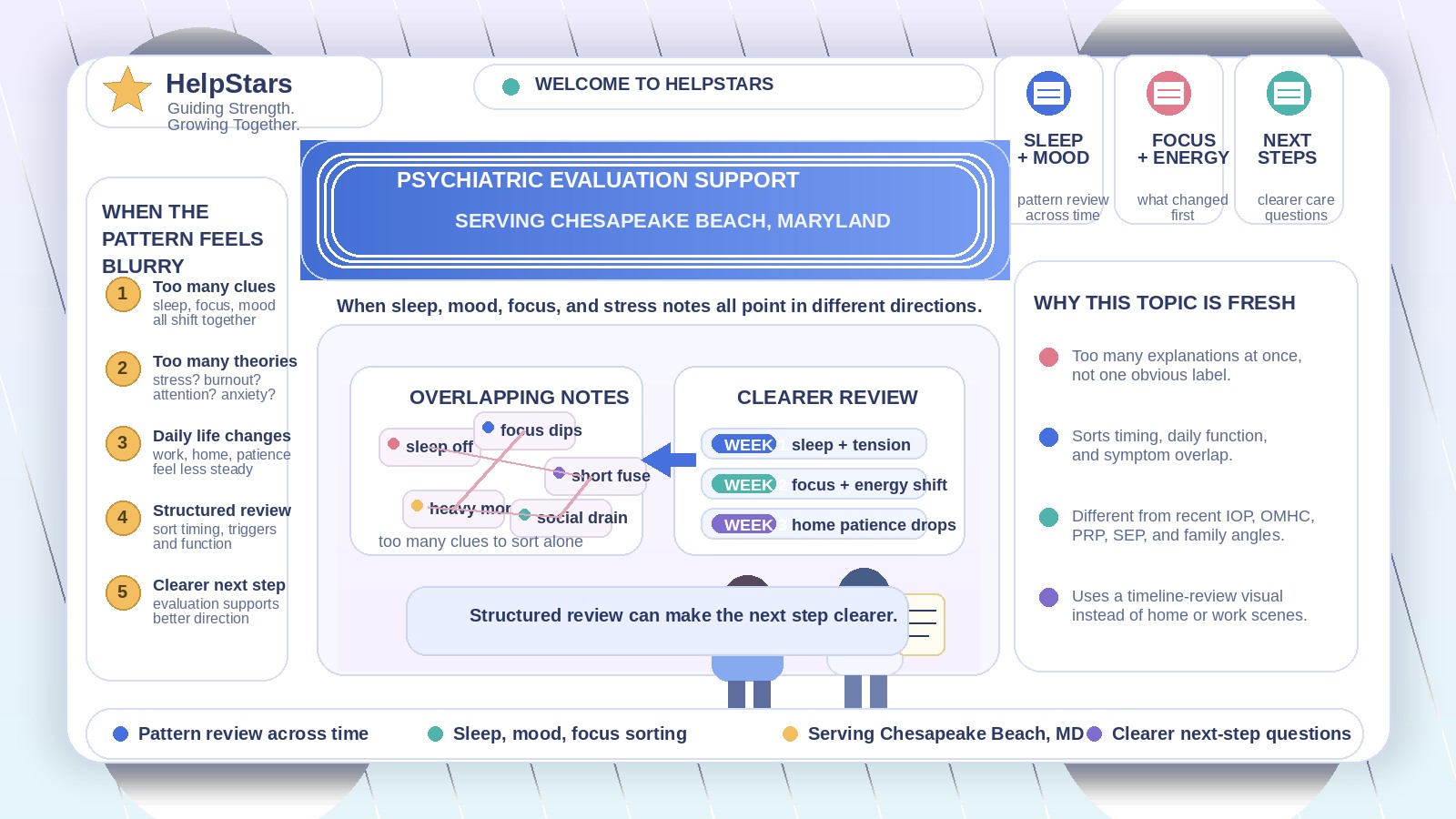
Imagine an adult serving Chesapeake Beach, Maryland and nearby Calvert County communities who has started keeping notes because the week feels harder to explain than it used to. One entry says sleep has been lighter for ten days. Another says motivation falls apart after lunch. A note from the weekend says small noises and routine disruptions felt unusually overwhelming. A Monday entry says work went mostly fine, but patience at home was much shorter than usual. Nothing in the notes is fake or exaggerated. The problem is that the notes do not line up into one simple story.
So the person keeps postponing the next step. They tell themselves they should wait until the picture is clearer. But waiting does not actually make the pattern easier to read. It just creates more notes, more second-guessing, and more pressure to explain the whole thing perfectly before asking for help.
In an outpatient psychiatric evaluation serving Calvert County, the more useful question may not be “What diagnosis do I think this is?” It may be “What changed first, what keeps repeating, what is affecting daily functioning now, and what support question should come next?” That shift matters because it replaces self-guessing with a more structured review.
What To Bring When the Pattern Feels Blurry
Adults do not need a polished summary before seeking help. In fact, practical observations are often more useful than a perfect explanation. If the week has started feeling harder to read, it may help to notice:
- when the changes first became hard to ignore, even if the timeline is approximate,
- whether the harder moments cluster around mornings, evenings, work demands, social contact, or quiet downtime,
- what has changed in sleep, focus, appetite, energy, patience, motivation, or follow-through,
- what parts of home life, work life, relationships, or routine now take more effort than they used to,
- whether there have been recent stressors, losses, health changes, or medication changes, and
- what outcome would make the next few weeks feel more manageable.
These details can help the conversation become more specific without requiring the person to arrive with a complete theory about themselves.
Four Questions That Often Make the Evaluation More Useful
- What changed before the rest of the pattern spread? The first shift is not always the biggest one, but it can still offer an important clue.
- What is getting harder in daily life, not just emotionally? Work tasks, morning routines, errands, parenting, conversations, and recovery time all matter.
- What explanation have I been repeating to myself, and where does it stop fitting? Many adults have a default story that once made sense but no longer explains the full pattern.
- What kind of support question am I actually trying to answer? Some people need help clarifying whether counseling, medication support, a fuller assessment, or another level of structure may be worth exploring.
These questions can change the tone of the visit. Instead of trying to prove how bad things are, the person can focus on what has become confusing, disruptive, or harder to carry alone.
Uncertainty Itself Can Become Part of the Burden
When symptoms stay blurry, adults often spend a surprising amount of time managing uncertainty itself. They replay recent weeks. They compare today to yesterday. They ask whether they are overreacting. They promise themselves they will seek help if one more thing changes. That mental effort can become exhausting, especially when it happens alongside real work, family, and household responsibilities.
For adults serving Chesapeake Beach and surrounding Calvert County communities, this uncertainty often has to coexist with commuting, scheduling, childcare, errands, financial strain, and the ordinary pressure of daily life. A pattern does not need to be extreme to begin disrupting that routine. It only has to become hard enough to keep making the week less steady than it used to be.
A psychiatric evaluation serving Chesapeake Beach, Maryland can be helpful precisely because it creates a place to stop carrying the whole interpretation process alone. The visit can organize the facts of the pattern, not just the fear around the pattern.
Questions Adults Often Ask About Getting Evaluated
Do I need to know exactly what is wrong before asking for an evaluation?
No. Many adults seek an evaluation because they do not know exactly what is wrong and want help sorting out a mixed picture.
What if I am still functioning in some parts of life?
That still matters. A person can keep meeting responsibilities while also noticing that the effort, inconsistency, or emotional cost has changed in a significant way.
Does an evaluation automatically mean medication will be recommended?
No. An evaluation is meant to clarify symptoms and next-step options. Medication may or may not be part of that discussion depending on the person’s situation.
What if my symptoms seem different from one day to the next?
That kind of variability is often part of why an evaluation is helpful. The goal is not to force one neat story. It is to understand the broader pattern across time.
Clearer Direction Can Start Before the Pattern Becomes More Severe
Adults do not have to wait until the situation is unmistakably dramatic before asking for a closer look. Sometimes the most useful time to seek more clarity is earlier, when the pattern is still forming but already changing how the week feels to live in. Earlier support can help people move from constant self-guessing toward a better-informed next step.
HelpStars LLC serves adults and families across Southern Maryland with compassionate behavioral health services. For adults seeking a psychiatric evaluation serving Chesapeake Beach, Maryland, a thoughtful outpatient assessment may help turn a crowded, confusing symptom picture into something clearer, steadier, and easier to respond to.