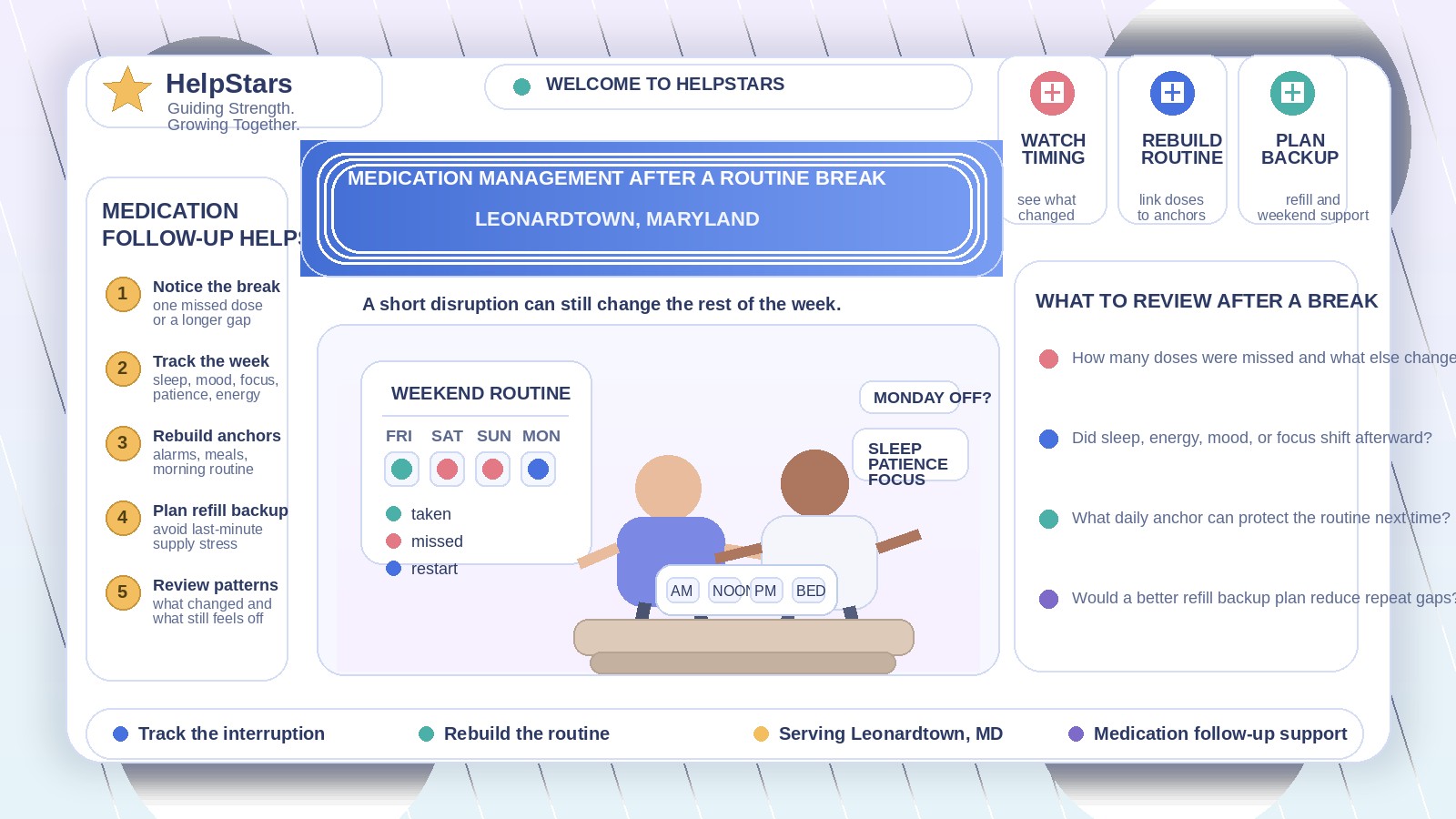
Missing Medication for a Couple of Days Can Change More Than You Expect: Medication Management for Adults in Leonardtown, Maryland
Sometimes the problem is not a brand-new prescription or a major change in symptoms. Sometimes the week simply gets off schedule. A refill runs later than expected. A person sleeps somewhere else for a night or two and forgets part of the routine. A stressful weekend throws off meals, alarms, or bedtime. By Monday or Tuesday, something feels different, but it is hard to tell whether the shift is about stress, sleep, the interrupted medication routine, or all three at once.
For adults in Leonardtown, Maryland, medication management can help when a couple of missed doses or an uneven medication routine leaves the week feeling harder to read. The goal is not to shame anyone for being inconsistent. The goal is to look at what changed, how the interruption happened, what symptoms or side effects showed up afterward, and what kind of follow-up may help restore a steadier routine.
HelpStars LLC supports adults and families across Southern Maryland with compassionate behavioral health services. When a short break in a medication routine starts affecting mood, sleep, patience, focus, or daily functioning, medication management may offer a practical next step for sorting out what happened and what needs attention now.
A Small Break in Routine Can Create a Bigger Feeling Shift
Many adults expect medication problems to be obvious. They imagine a dramatic reaction, a clear side effect, or one simple explanation. Real life is often less neat than that. A person may miss one or two doses, then spend the next few days feeling slightly more irritable, more tired, less focused, more emotionally sensitive, or less settled in their normal routine. Nothing may feel dramatic enough to describe clearly, but the week no longer feels like it was holding together the same way.
That may sound like:
- “I do not know if missing it mattered, but I have felt off since then,”
- “My whole schedule slipped for two days and now I am trying to catch back up,”
- “I thought I would restart and be fine right away, but the week still feels uneven,”
- “I cannot tell what is stress and what is the medication routine being disrupted,”
- “Nothing is completely falling apart, but I definitely do not feel steady.”
That in-between space is exactly where medication follow-up can be useful. People do not need a dramatic crisis before it becomes worth discussing what changed.
Why Missed Doses or Timing Disruptions Can Be Hard To Judge Alone
One reason adults second-guess themselves after a medication interruption is that everyday life keeps moving at the same time. A rough commute, poor sleep, family stress, illness, appetite changes, or a hard conversation at work may all be happening in the same stretch. By the time a person notices the week feels different, several possible explanations are competing for attention.
Another problem is that people often restart their normal routine and expect the unsettled feeling to disappear immediately. When it does not, they may become more anxious about whether something is wrong, or they may minimize the change and try to power through it without talking to anyone.
Medication management in Leonardtown, Maryland can help organize that uncertainty. Instead of treating the situation like a personal failure, the conversation can focus on more practical questions: how many doses were missed, what else changed in the same window, what symptoms became more noticeable, and whether the person now needs closer monitoring, routine support, or a treatment follow-up conversation.
What To Notice After a Medication Routine Gets Interrupted
Adults do not need a perfect symptom diary to make a follow-up visit useful. It often helps to bring concrete observations from the few days before, during, and after the disruption.
Useful details may include:
- when the medication routine first got off track,
- whether one dose was missed or the disruption lasted longer,
- what else was happening around sleep, meals, travel, stress, or schedule changes,
- whether mood, anxiety, irritability, concentration, or energy shifted afterward,
- whether any physical effects such as nausea, headaches, grogginess, or appetite changes showed up, and
- how long it took before the person started feeling more like themselves again, if that has happened yet.
These kinds of observations can make a follow-up discussion much more useful than simply saying, “I missed a couple of days and now I feel weird.”
A Leonardtown Example: The Weekend Slipped and Monday Felt Different
Imagine an adult in Leonardtown, Maryland who usually keeps a fairly reliable medication routine tied to weekday alarms and morning preparation. Then the weekend becomes more chaotic than expected. One night runs late, another morning starts in a rush, and the medication container is not where it normally is. By Sunday evening, the person realizes the routine has gotten patchy.
They restart on Monday and try to move on. But Tuesday feels heavier. Patience is shorter. Focus is not as steady at work. Sleep that night feels less settled. The person is not sure whether the issue is the interrupted medication routine, weekend stress, embarrassment about getting off track, or all of it layered together. Because they did resume the medication, they tell themselves it should already be fine.
That assumption can make the whole experience harder to read. Instead of paying attention to the pattern, the person may start criticizing themselves or dismissing their own symptoms. Medication management can help shift the conversation away from blame and toward clearer review: what was interrupted, how the body and mood responded, what part of the week still feels unstable, and what would help prevent the same problem from repeating.
Four Reasons Adults Commonly Miss Doses Even When They Care About Treatment
- The routine was built around one specific part of the day. When sleep, work, travel, or household timing changes, the medication cue disappears with it.
- The refill or supply plan became tight. A person may wait longer than intended, miscount what is left, or lose track during a busy week.
- The person felt better and became less rigid about the structure. Improvement can make the routine feel less urgent right up until the interruption starts affecting things again.
- Stress disrupted too many daily anchors at once. When meals, alarms, appointments, and attention are all off, medication routines can slip with them.
These patterns do not mean someone is careless. They often mean the treatment plan needs more support around consistency.
How Medication Management Can Help Beyond “Just Remember Better”
Adults are often already criticizing themselves before they bring up missed doses. A helpful medication management conversation does more than tell someone to be more consistent. It can help identify why the routine is vulnerable in the first place.
Depending on the person’s needs, follow-up may help with:
- spotting which part of the medication routine is easiest to break,
- connecting the medication schedule more effectively to real daily anchors,
- reviewing what symptoms or side effects appeared after the interruption,
- clarifying what details should be watched over the next several days,
- building a better refill and backup plan, and
- making the routine more realistic for weekends, travel, or stress-heavy periods.
The goal is not perfection. The goal is a routine that is easier to recover and easier to maintain.
Signs the Interruption May Be Worth Bringing Up Sooner
Adults may want to discuss the disruption more promptly when they notice:
- mood or anxiety changes that feel noticeably different from the prior week,
- sleep that became more unsettled after the medication routine changed,
- more difficulty with patience, concentration, or follow-through,
- side effects or body changes that appeared after restarting,
- repeated trouble getting back on a stable routine, or
- embarrassment causing them to hide the interruption instead of getting support.
These signs do not automatically mean something severe is wrong. They do suggest that guessing alone may be less useful than a clearer review.
Questions Adults Often Ask
Is it worth mentioning if I only missed a short stretch?
It can be. A short interruption may still matter, especially if the week felt noticeably different afterward or if missed doses have happened more than once.
What if I am not sure whether the change came from stress or the medication routine?
That uncertainty is often part of the reason medication management helps. The conversation can look at timing, symptoms, daily functioning, and surrounding stressors together instead of forcing one quick explanation.
Do I need a perfect log before asking for follow-up?
No. Practical observations about when the routine changed and what felt different afterward are often enough to make the discussion useful.
Can medication management fit alongside counseling or other outpatient services?
Yes. Depending on the person’s needs, medication management may be one part of a broader outpatient behavioral health plan that also includes counseling, psychiatric evaluation, PRP, IOP, or family support.
A Steadier Routine Can Be Rebuilt
Missing medication for a couple of days does not mean someone has failed treatment. It may simply mean the routine was more fragile than it looked, and the week is now giving useful information about what needs better support. A thoughtful follow-up can help people understand the interruption, regain steadier footing, and build a plan that holds up better the next time life gets messy.
HelpStars LLC serves adults and families across Southern Maryland with compassionate behavioral health services. For adults in Leonardtown, Maryland whose week started feeling different after a short medication disruption, medication management may help create clearer follow-through and a more workable next step.