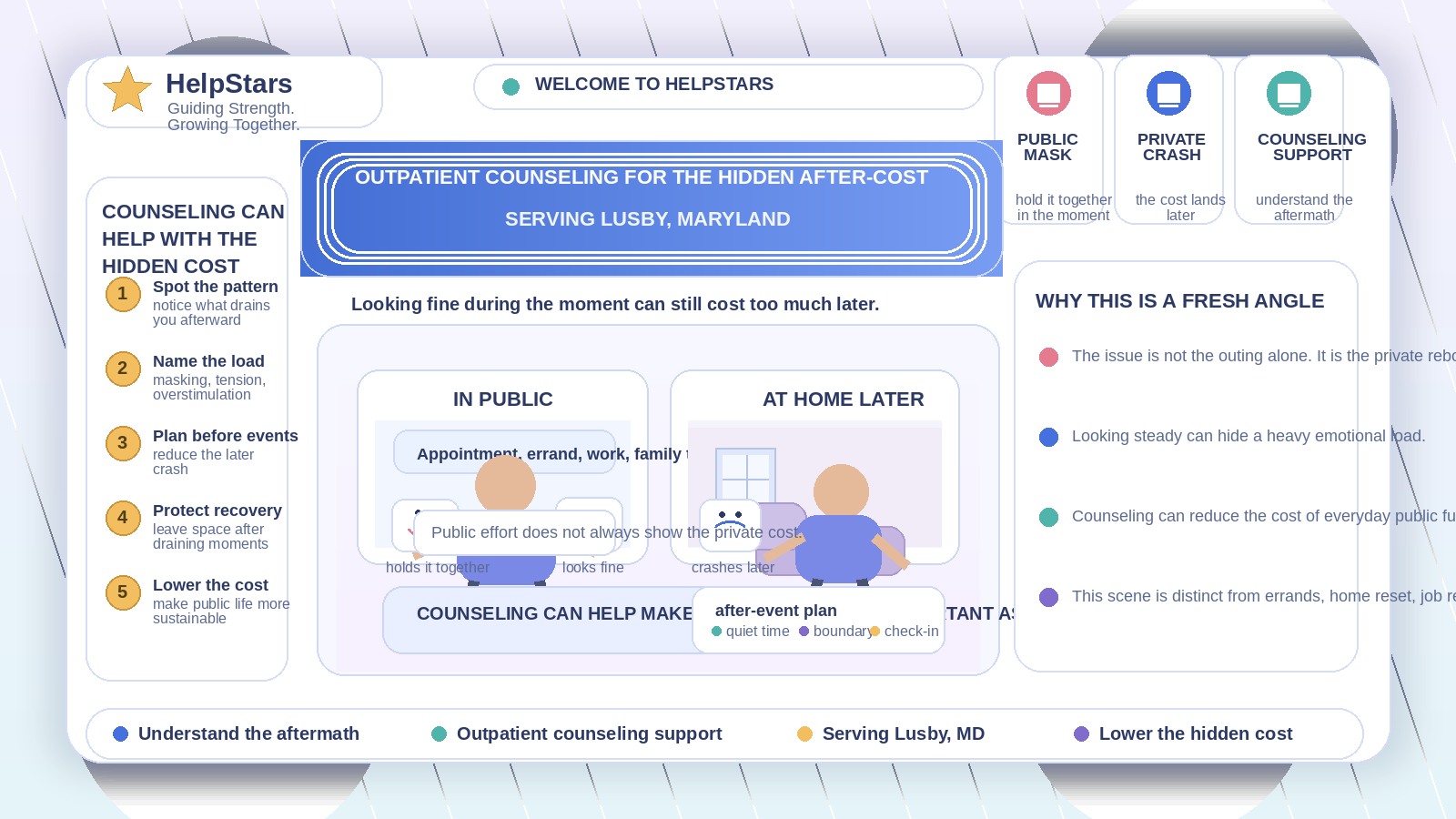
Looking Fine in Public Does Not Mean It Feels Fine Later: Outpatient Mental Health Counseling for Adults in Lusby, Maryland
From the outside, the day may have looked ordinary. The person answered questions, made it through the appointment, smiled when needed, picked up what the house needed, and even sounded steady on the phone. Nothing dramatic happened. Then they got home, closed the door, and felt like all their usable energy had dropped at once.
For adults seeking outpatient mental health counseling in Lusby, Maryland, that pattern can be hard to explain because other people often only see the functional part. They see the errands, the work shift, the family visit, the meeting, or the short conversation that seemed to go fine. They do not always see the crash afterward: the irritability, the shutdown, the tears that make no sense on paper, the need to cancel the rest of the evening, or the feeling that one ordinary interaction used up too much of the day.
HelpStars LLC supports adults and families across Southern Maryland with compassionate behavioral health services. When holding it together in public keeps costing too much in private, outpatient counseling may help adults understand the pattern more clearly and build a steadier way through it.
Functioning in the Moment Can Hide the Cost of the Moment
Many adults look more okay than they feel. They know how to keep moving through a conversation, answer politely, complete the task in front of them, and wait until later to fall apart. Sometimes this becomes such a familiar survival pattern that even the person doing it starts minimizing it.
That may sound like:
- “I got through it, so I keep telling myself it should not count as a problem,”
- “Everyone else saw me doing fine, but they did not see what happened after,”
- “I can show up, but I pay for it later,”
- “The hard part is not always the outing. The hard part is the aftermath,” or
- “I look functional in real time and then feel emotionally wrung out when I get home.”
This does not always mean the person is being fake. Often, it means they are using a lot of effort to stay regulated long enough to get through something that looks small from the outside.
Why the Private Crash Can Be So Confusing
The emotional drop afterward can be difficult to describe because the trigger does not seem dramatic enough. Maybe it was a quick stop at the pharmacy. Maybe it was a regular conversation with a family member. Maybe it was a work meeting, a school-related task, or a routine appointment. The person may ask themselves why such an ordinary moment led to such a strong reaction later.
Part of the confusion is that the cost is delayed. The person manages the interaction first and feels the strain later. By then, other people may assume the day went smoothly, which can leave the adult feeling unseen, ashamed, or unsure whether the pattern is “serious enough” to bring up.
In reality, delayed emotional cost can still be meaningful. Some adults are spending so much energy on appearing steady, safe, agreeable, focused, or calm in public that there is very little regulation left once they are alone again.
What Outpatient Counseling Can Help Untangle
Outpatient mental health counseling can help adults look more closely at what happens before, during, and after these situations. The work is not only about naming stress. It is also about understanding why certain interactions create a rebound effect and what kind of support may reduce the private crash afterward.
Depending on the person’s needs, counseling may help with:
- identifying which public situations create the biggest emotional after-cost,
- noticing whether the main strain comes from anxiety, masking, trauma-related vigilance, depression, people-pleasing, overstimulation, or conflict history,
- building ways to prepare for predictable triggers before the event instead of only recovering afterward,
- reducing shame about needing recovery time after interactions that look manageable from the outside,
- practicing boundaries that lower the amount of emotional performance required, and
- creating more realistic expectations for what the rest of the day can hold after a draining interaction.
The goal is not to make every adult highly social or unbothered by stress. The goal is to reduce the hidden cost of ordinary functioning so daily life stops feeling like an endless cycle of performing and then collapsing.
A Lusby Example: The Conversation Went Fine, but the Evening Was Gone
Imagine an adult in Lusby, Solomons, Prince Frederick, Chesapeake Beach, North Beach, or another Calvert County community who keeps making it through the visible part of the day and then losing the private part. Maybe they attend a school-related conversation, meet with a provider, answer a supervisor’s questions, or handle a family errand that requires more interaction than usual.
Nothing obviously bad happens. They say the right things. They keep their face steady. They do not cry, shut down, or snap while anyone is watching. But when they get back home, the rest of the day becomes unusable. Small questions from loved ones feel too sharp. Dinner feels harder than it should. They stop answering messages. Their body feels tight and over-alert, or suddenly flat and drained.
It is easy for that adult to blame themselves. They may think, “Why did that take so much out of me?” Counseling can help shift the question. Instead of assuming weakness, the person can start examining the actual load they carried during the interaction: self-monitoring, emotional bracing, reading everyone’s tone, suppressing fear, staying polite, anticipating conflict, or pushing through internal overwhelm. Once that load is visible, it becomes easier to work on it directly.
Five Clues That the Real Problem May Be the Aftermath, Not the Event Alone
- You get through things other people think should prove you are okay. The visible functioning makes the private cost easier for others to dismiss and easier for you to minimize.
- Your energy drops sharply only after you get home or get alone. The reaction is delayed, which can make the connection harder to notice at first.
- You start avoiding manageable things because you fear the rebound later. The event itself may not be the whole problem anymore; the aftermath becomes part of the dread.
- You feel guilty for needing recovery time after ordinary interactions. That guilt can keep you from naming a pattern that deserves real attention.
- You spend more effort on looking calm than on actually feeling calm. When appearance takes most of the regulation energy, there is less left once the interaction ends.
These clues do not diagnose the cause by themselves. They do point toward a pattern worth taking seriously rather than brushing off as overreacting.
Why This Pattern Can Quietly Shrink a Person’s World
Adults often start making life smaller to protect themselves from the rebound. They decline plans that seem simple. They delay callbacks. They choose stores at off-hours. They keep visits short. They stop raising concerns because explaining anything feels like more output than they can afford. From the outside, these choices may look like preference, irritability, or poor planning. Underneath, they may be a way of managing the cost of staying composed.
That is one reason behavioral health counseling serving Lusby, Maryland can matter even when someone is still getting some things done. The issue is not only whether the person can function in public at all. The issue is how much it is costing them to do it, and whether that cost is slowly making the rest of life smaller, tenser, or lonelier.
Why Local Routine Still Matters in Calvert County
Adults in Lusby and nearby Calvert County communities are often balancing family responsibilities, commuting, appointments, school demands, errands, and social obligations that do not disappear just because regulation is harder than it looks. When a few ordinary interactions can wipe out the rest of the day, the entire weekly routine becomes more fragile.
That local context matters because support has to fit real life. The point is not only to understand emotions in the abstract. It is to help adults move through the actual conversations, visits, obligations, and community settings that keep creating too much private fallout.
Questions Adults Often Ask About the Private Crash After Public Functioning
If I got through the interaction, does that mean I am doing fine?
Not necessarily. Getting through something and paying heavily for it afterward can still be a meaningful sign that the current pattern is taking too much energy.
What if other people do not believe it is that hard because I look calm?
That is common. Many adults become very skilled at appearing steady during stressful moments. Counseling can help make the hidden cost easier to understand and describe.
Does this only happen with social anxiety?
No. The pattern can show up with anxiety, depression, trauma-related stress, burnout, overstimulation, people-pleasing, and other emotional loads that make public regulation expensive.
Can counseling help if I do not want to stop showing up for life?
Yes. The goal is often not to withdraw more. It is to make ordinary participation cost less and feel more sustainable.
Feeling the Cost Later Still Counts
Some adults keep telling themselves they are fine because they can still make it through the visible part. But if public functioning keeps leading to private collapse, that pattern deserves attention. Relief can begin when the hidden cost finally gets taken seriously.
HelpStars LLC serves adults and families across Southern Maryland with compassionate behavioral health services. For adults looking for outpatient mental health counseling in Lusby, Maryland, support may help make everyday life feel less like something you have to survive twice: once in public, and again after you get home.