It Can Be Easier To Talk in a Room That Does Not Already Know Your Role: Group Therapy for Adults Serving North Beach, Maryland
Some adults do not stay quiet because they have nothing to say. They stay quiet because every room in their life already expects a version of them. At home they may be the steady one. At work they may be the reliable one. In the family they may be the person who keeps the peace, explains things, or takes care of everyone else before speaking about themselves. By the time they consider asking for mental health support, it can feel strangely hard to talk without also protecting the role they are used to carrying.
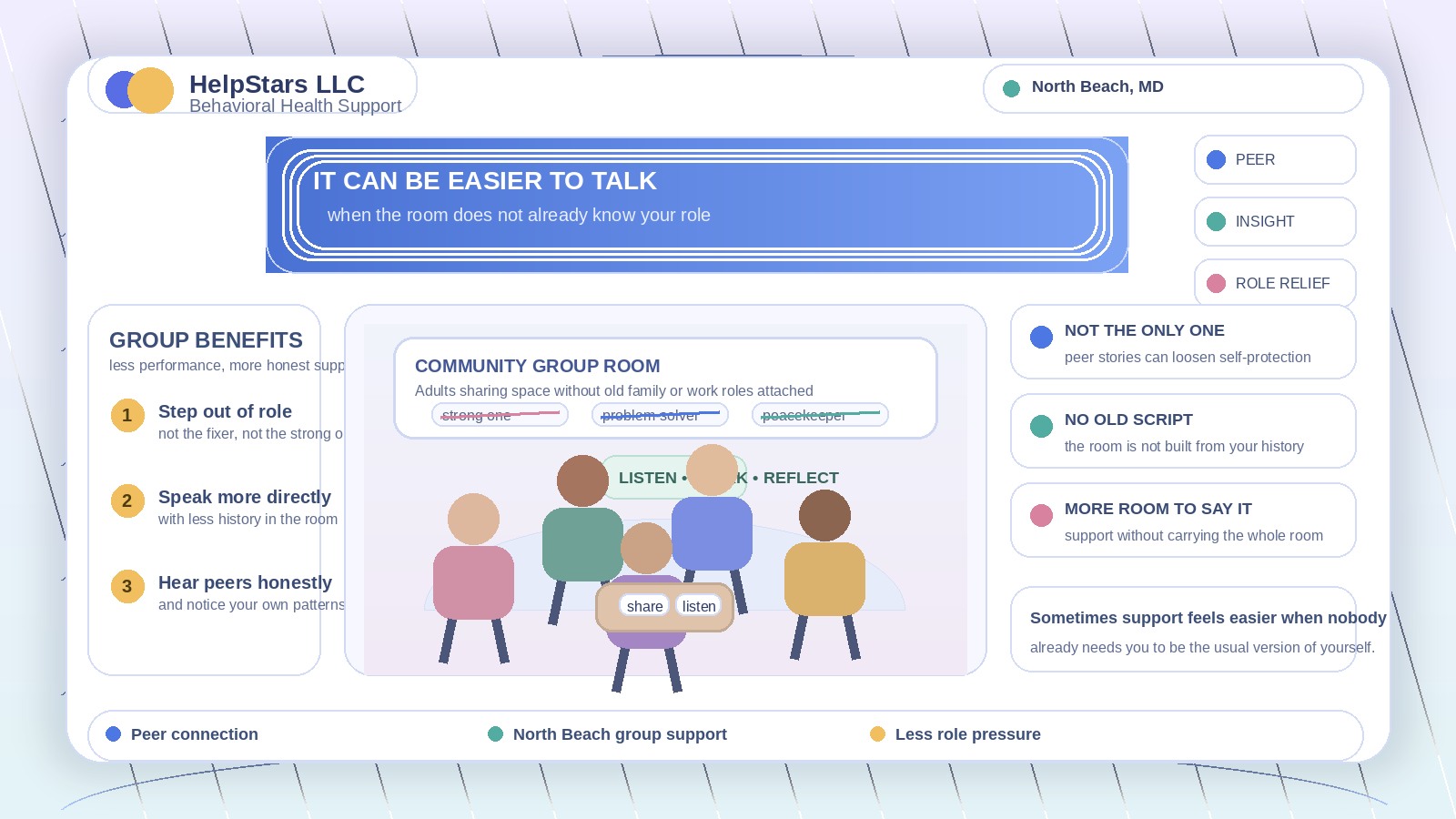
For adults seeking group therapy serving North Beach, Maryland, that can be an important reason the group setting helps. In a well-structured group, the person is not walking into a room full of people who already know the backstory, expect a performance, or need them to stay in character. Group therapy can offer space to talk more honestly, listen differently, and practice being present as a whole person instead of as the role that has slowly taken over everywhere else.
HelpStars LLC supports adults and families across Southern Maryland with compassionate behavioral health care. For some adults, a supportive group setting can create a kind of relief that individual life conversations no longer provide.
Why Familiar Roles Can Make Honest Conversation Harder
Roles are not always bad. They help families function and help workplaces run. But a role can become limiting when a person starts feeling like they can only speak from inside that one version of themselves.
An adult may sound capable all day and still feel emotionally trapped by expectations like these:
- "I am the one who is supposed to stay calm,"
- "If I say how overwhelmed I actually feel, everyone will get worried or disappointed,"
- "I do not want this conversation to turn into advice, fixing, or family drama,"
- "People know me as dependable, so it feels embarrassing to say I am not holding it together," or
- "I am tired of explaining myself to people who already think they know what my problem is."
That pressure can make even caring conversations feel narrow. The person may edit themselves heavily, stay on the surface, or skip the real issue because they do not want the people around them to react from history instead of from the present moment.
What Group Therapy Can Offer That Feels Different
In a thoughtful group setting, adults often discover that it is easier to speak when the room is not organized around their usual identity. They are not someone’s employee, parent, sibling, partner, or household problem-solver first. They are simply another adult trying to understand what is hard and what might help.
That difference can matter in several ways:
- there is less pressure to defend an old version of the story,
- the conversation is not automatically pulled into family roles or workplace expectations,
- people can notice themselves more clearly when they are not busy managing other people’s reactions,
- hearing others speak honestly can make self-protection loosen a little, and
- the group setting can help adults practice showing up more directly and less performatively.
This does not mean group therapy is magically easy. It means the structure can remove one barrier that many adults do not realize they have been carrying for years.
A North Beach Example: The Strong One Is Tired of Only Talking Like the Strong One
Imagine an adult serving North Beach, Maryland who is known for being organized, responsive, and good in a crisis. Friends call them first. Family members assume they can handle pressure. At work, they are the person who smooths out the awkward moment and keeps moving.
But privately, they are worn down. They have been feeling anxious, flat, irritable, or emotionally overextended for longer than they want to admit. When they try to talk with people who know them well, the conversation keeps getting pulled back toward the role they always occupy. Someone reassures them that they are strong. Someone else asks what practical fix they have tried. Another person starts leaning on them for perspective before they have even finished their own thought.
In a group setting, the pattern may change. Nobody needs them to stay composed for the family. Nobody expects them to rescue the conversation. Nobody is invested in preserving their usual image. That can make it easier to say something truer, earlier, and with less self-editing.
Signs a Group Setting May Be Worth Considering
Adult group therapy support in North Beach may feel especially useful when:
- You keep talking around the real issue. The words come out, but the most important part still stays protected.
- People close to you react from history too quickly. They may care deeply, but the old role takes over before the present conversation has room to breathe.
- You are tired of feeling responsible for everyone else’s comfort during your own hard conversation.
- You want support without needing to explain your whole identity first.
- You think hearing from other adults with their own patterns and pressures might help you speak more plainly about yours.
These signs do not prove that group therapy is the only answer. They do suggest that a different conversation format may be more helpful than repeating the same guarded exchanges in the same familiar rooms.
What Adults Often Gain From the Experience
People sometimes assume the main value of group therapy is advice from others. Often the value is broader than that. Adults may gain:
- more comfort naming thoughts and feelings without overexplaining,
- practice staying present even when vulnerability feels unfamiliar,
- a clearer sense of how much of their stress is tied to identity pressure and role fatigue,
- perspective from peers who are working through their own patterns in honest ways, and
- relief from the belief that they always have to be the most composed person in the room.
For some adults, that shift is powerful because it changes more than one conversation. It changes what kind of self becomes available in conversation at all.
What a More Usable Group Space Often Has in Common
Not every room feels safe enough right away. A helpful group space is usually structured, respectful, and clear about how people participate. Adults often benefit when the setting supports:
- shared expectations around listening and confidentiality,
- room for different personalities rather than pressure to perform openness instantly,
- guidance that keeps the conversation supportive instead of chaotic,
- space for both speaking and reflecting, and
- a pace that allows trust to build over time rather than demanding a breakthrough on day one.
That structure matters because many adults are not avoiding support itself. They are avoiding the feeling that they will need to manage one more unpredictable room.
Why Local Support Matters in Calvert County
Adults serving North Beach, Maryland, Chesapeake Beach, Dunkirk, Huntingtown, Prince Frederick, and nearby Calvert County communities often carry work demands, family responsibilities, commuting pressure, and treatment follow-through within the same week. Support works better when it fits real local life well enough to keep showing up for it.
That is part of why group therapy serving North Beach, Maryland can matter. The right setting can give adults a place to step out of their usual role, speak more directly, and build steadier support without needing to carry the whole emotional structure of the room alone.
Questions Adults Often Ask
What if I am usually private around people I do not know?
That is common. A structured group does not require instant openness. Many adults begin by listening, noticing the tone of the room, and speaking more as trust builds.
Does group therapy only help if I am comfortable talking a lot?
No. The value is not only in talking frequently. It can also come from hearing others, noticing your own reactions, and participating at a pace that feels workable.
What if people in my life already know I am struggling?
Even then, group therapy may feel different because the room is not defined by your old family or work role. That can make honesty feel less loaded.
Can group therapy help if I am tired of being the strong one?
For some adults, yes. A group setting can provide practice being present without needing to hold the whole room together.
You May Not Need a Better Performance. You May Need a Different Room.
Some adults do not need more practice sounding okay. They need a setting where sounding more real is actually possible. When familiar roles keep narrowing what can be said, group therapy may offer a more workable kind of support.
HelpStars LLC supports adults and families across Southern Maryland with compassionate behavioral health care. For adults seeking group therapy serving North Beach, Maryland, a structured group space may help make honest conversation feel lighter, clearer, and less tied to the role you have been carrying everywhere else.